Thursday, June 18, 2026

Camp Lejeune Modernizes Tactical Driving With High-Tech Realism

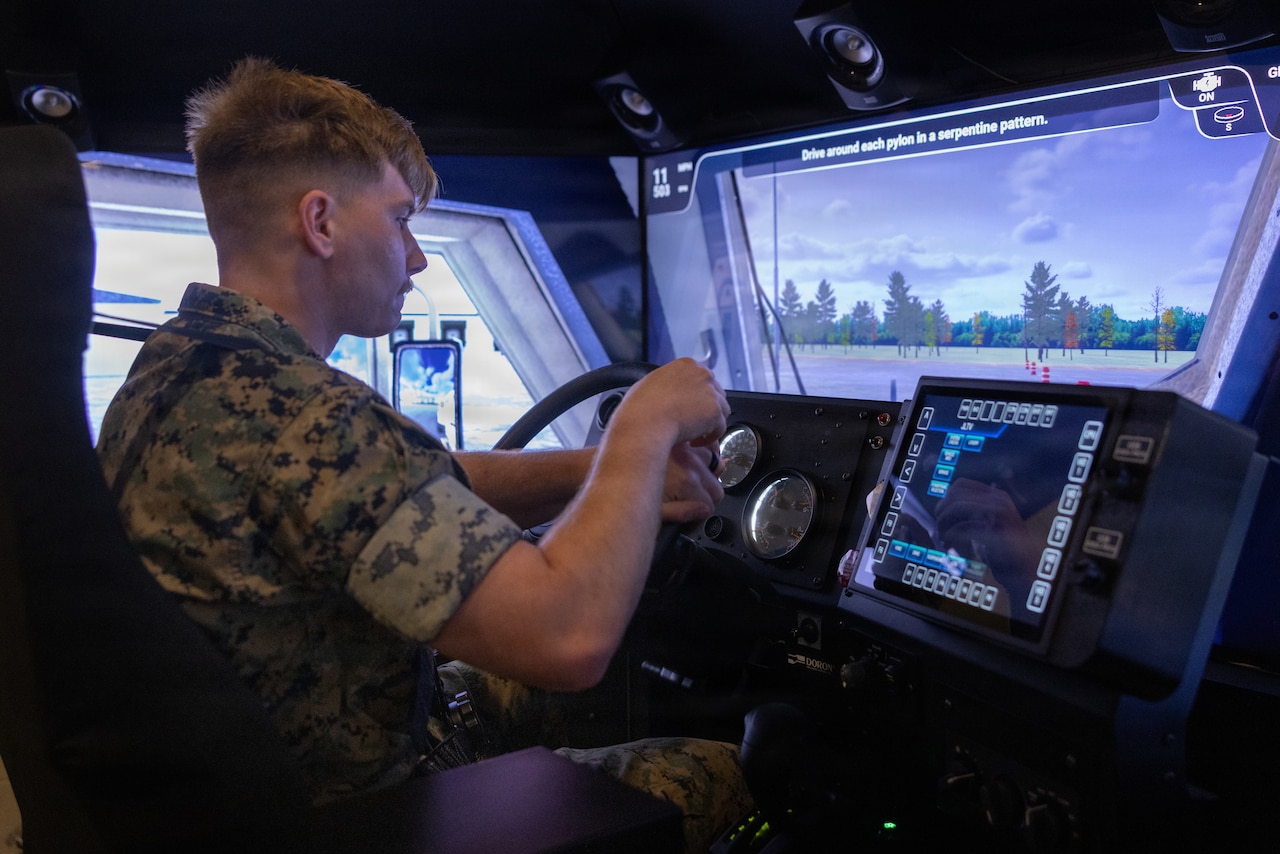
A man wearing a military camouflage uniform operates a driving simulator.

The Marine Corps is taking a leap forward in tactical vehicle training, trading unnecessary wear and tear for high-tech, immersive realism at Marine Corps Base Camp Lejeune, North Carolina. With the introduction of the multiplatform driver simulator, Marines are now able to push the limits of the joint light tactical vehicle without assuming any physical risk.

According to Shannon Ohlinger, the multiplatform driver simulator, or MPDS, training lead and a Marine Corps veteran, the shift in technology is monumental. The new system is designed to build confidence and critical thinking skills more quickly while addressing the challenges of fuel costs and vehicle maintenance.

"The operator driving simulator used prior to the MPDS was all over the place with training," Ohlinger said. "This entire system is much more advanced than the ODS, and it still has the mobility to mimic the movement of the actual vehicle over different types of terrain."

A man wearing casual attire gestures as he speaks to two other men dressed in military camouflage uniforms inside of a driving simulator.

The MPDS is broken into three distinct parts: the cab itself, made with authentic industry parts; the situation screen for viewing analytics and a third-person perspective; and the instructor workstation. While not replacing the actual physical training Marines get in a live joint light tactical vehicle or medium tactical vehicle replacement, it provides a seamless transition from the classroom to the dirt.

"Everything inside the simulator is an exact copy of what you would see in a real live [joint light tactical vehicle]," Ohlinger explained. "From the switches and functionality to the smart user interface, startup procedures and pre-op checks, everything is a one-for-one match."

Where the MPDS truly outperforms previous training methods is at the instructor workstation. From this console, instructors can manipulate the environment in real time, testing a driver's ability to adapt to sudden, catastrophic changes.

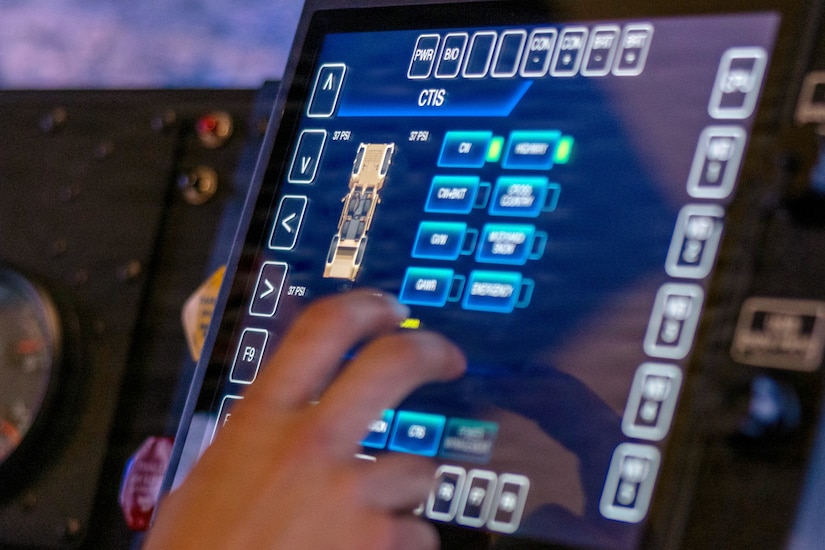
"Through the instructor workstation, I have the ability to throw obstacles at them. I can add rain and thunderstorms, and you will see puddles form and the mud get slick," Ohlinger said. "You're going to start having slippage to where operators need to use their [central tire inflation system] and anything else you would need to incorporate in order to adapt."
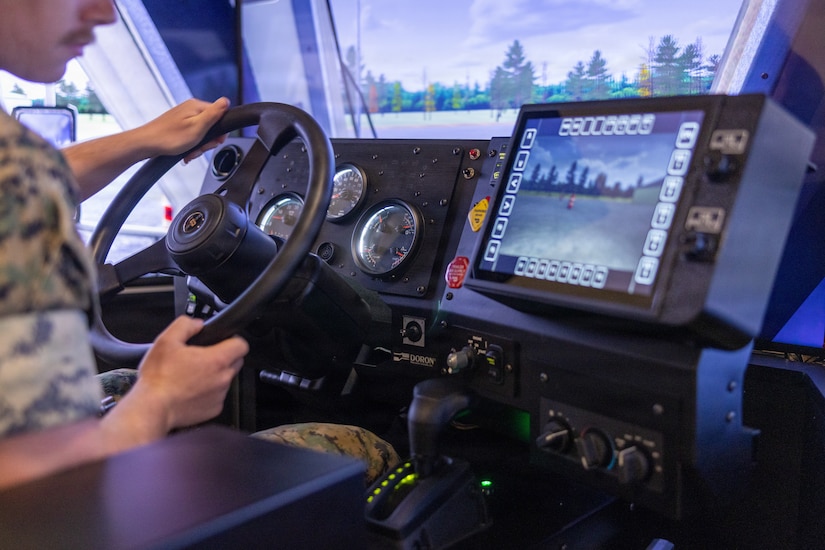
A man wearing a military camouflage uniform looks at a screen while operating a driving simulator.
A close-up of a hand tapping the screen in a driving simulator.
Instructors can tailor scenarios to specific unit needs, whether that means deploying a sudden blizzard, initiating low-visibility night driving or triggering dash warnings like low tire pressure or low battery voltage. The goal is to safely overwhelm the driver in a controlled environment, without risking a vehicle roll or a Marine getting hurt.

For Ohlinger, this capability hits close to home. Having driven more than 3,100 miles in Afghanistan, he understands the stakes of tactical driving.

"As a prior enlisted Marine, I can confidently say that if I had training like this, there are situations I experienced that I wouldn't have ever found myself in," he said. "Marines adapt and overcome when they face the unknown, but the MPDS gives them the critical thinking and experience they need ahead of time."

Ultimately, the Marine Corps modernization efforts are about keeping warfighters lethal and safe. The MPDS ensures that by the time a Marine gets behind the wheel of a real joint light tactical vehicle, they have already survived the worst conditions their instructors could throw at them.

"Being in this position gives me the opportunity to help mitigate the accidents that lead to losing service members," Ohlinger said. "I know if I save one life, I have done my job."

Friday, June 12, 2026

Naval Research Laboratory Receives Space Force Antenna, Expanding Joint Space Capabilities

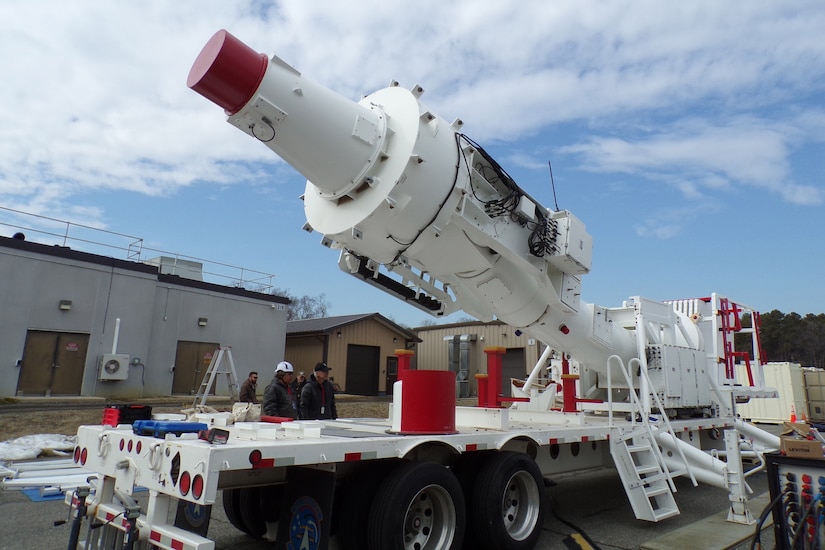
Earlier this year, the U.S. Naval Research Laboratory received a transportable satellite tracking antenna system from Space Systems Command's System Delta 81 to expand joint space testing, training and operational support capabilities at the laboratory's Blossom Point Tracking Facility in Welcome, Maryland. 

A large, white antenna sits on a flatbed truck outside under a blue sky before it is installed.

 
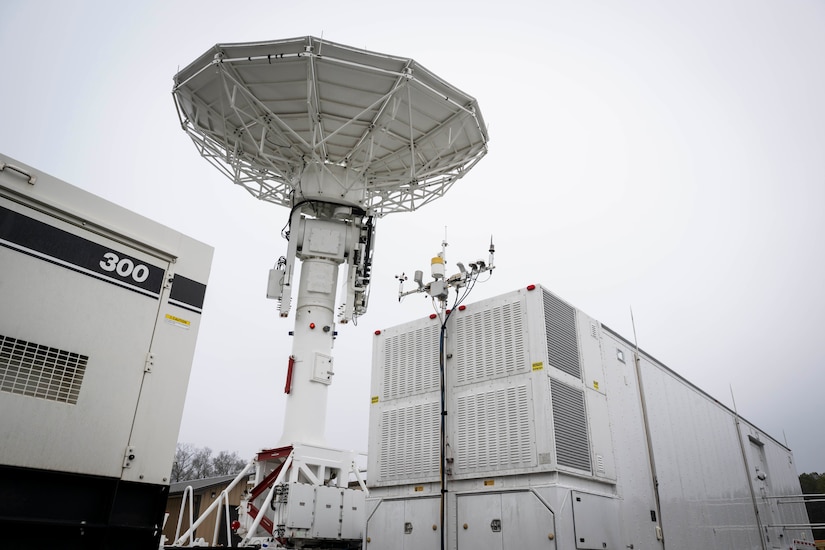
The antenna system enhances the facility's ability to support tracking, telemetry and command operations for emerging space technologies and future operational concepts. The capability will provide additional flexibility for experimentation, system evaluation and long-duration performance monitoring, supporting both naval and joint space missions. 
 
Blossom Point Tracking Facility has long supported satellite command and control, communications experimentation and orbital research. Integrating the transportable system into the site's existing infrastructure increases the facility's capacity to support multiband communications testing, interoperability assessments and advanced space experimentation. Analysis is underway to determine future experiments, exercises and operational events the system may support, as well as potential deployment locations to maximize mission utility. 
 
The transfer supports broader War Department efforts to strengthen joint testing and training infrastructure and improve collaboration across the naval and space communities. The system also supports System Delta 81's mission to develop and field capabilities that enable realistic test and training environments for the Space Force. 

A large, white antenna is pointed upward, next to a large, white trailer.

 
The effort reflects ongoing collaboration between Space Systems Command, System Delta 81 and the Naval Research Laboratory to improve operational readiness, expand flexible testing capability and accelerate the integration of emerging space systems into joint mission environments. The addition of the antenna provides increased access to stable, repeatable testing environments that support the evaluation of critical space-enabled capabilities for future operations. 
 
The laboratory is the Navy and Marine Corps' corporate laboratory, conducting a broad program of scientific research, technology development and advanced experimentation to support operational forces and maintain the nation's technological advantage at sea, on land, in the air and in space. 

Wednesday, June 10, 2026

Army Astronaut Selected for NASA's Historic Artemis III Mission

In a historic announcement that bridges the legacy of military service with the next phase of human space exploration, NASA announced that Army Col. Frank Rubio, assigned to the U.S. Army Space and Missile Defense Command, will serve as a mission specialist on its upcoming Artemis III mission. The announcement, made yesterday at the Johnson Space Center in Houston, places a soldier at the forefront of humanity's return to the lunar surface.

Rubio will join NASA astronauts Randy Bresnik and Andre Douglas, as well as European Space Agency astronaut Luca Parmitano, as they embark on a mission that will serve as a low-Earth orbit demonstration to test systems required for operations in the region between Earth and the moon's orbit. 

Rubio's selection is a testament to his recognized leadership, broad career experience and the technical expertise that soldiers bring to the nation's human spaceflight program.

"I am deeply honored to be selected for Artemis III, a mission that continues to build upon the foundation for the day Americans return to the surface of the moon," Rubio said. "My Army training has been an integral part of the experiences that have enabled me to be ready for this mission. Serving taught me to lead under pressure, how to stay calm when the stakes are highest, and how to put the mission and the people beside you above yourself." 

"To those who have served, and to every soldier and military family serving right now: you are the backbone of everything we do as a nation, including this," he continued. "I am honored to represent the Army on the highest ground."

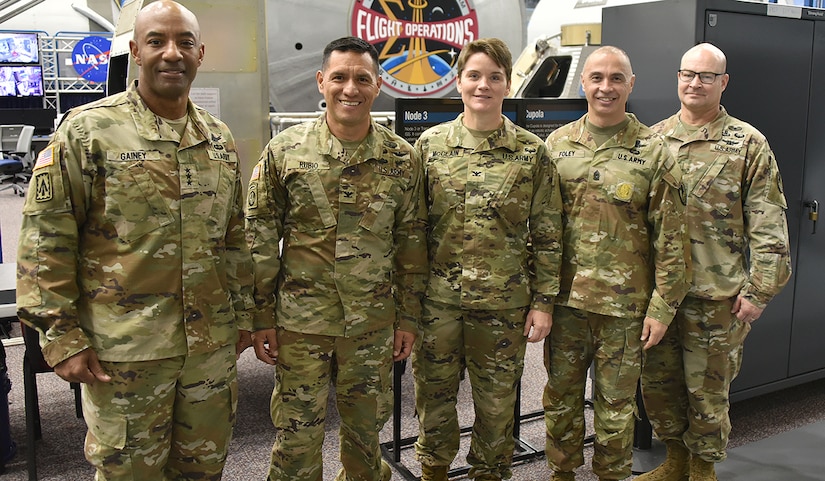
Four men and a woman wearing camouflage military uniforms pose for a photo inside a large room; there is equipment in the background and a command logo that reads, "Flight Operations."

Rubio is no stranger to making history in orbit. He holds the American record for the longest single spaceflight, having spent 371 consecutive days aboard the International Space Station during Expeditions 68 and 69 from September 2022 to September 2023.

During that unexpectedly extended spaceflight, Rubio completed 5,963 orbits of the Earth, traveled more than 157 million miles and conducted three spacewalks totaling 21 hours and 24 minutes. This extensive previous spaceflight experience, marked by deep resilience and adaptability, makes him uniquely qualified to serve under the demanding conditions that will be expected of him and the other Artemis III crewmembers.

Before his selection by NASA in 2017 as a member of Astronaut Class 22, Rubio built a distinguished 19-year military career as both an Army aviator and physician. A 1998 graduate of the U.S. Military Academy at West Point, New York, where he was a member of the Black Knights parachute team, Rubio served as a UH-60 Black Hawk helicopter pilot. He flew more than 1,100 hours, including more than 600 hours of combat and imminent danger time during deployments to Bosnia, Afghanistan and Iraq.

Following his service in the aviation branch, Rubio earned his medical degree from the Uniformed Services University of the Health Sciences in 2010. As a board-certified family physician and flight surgeon, he completed his residency at Fort Benning, Georgia, and subsequently served as a clinic supervisor at Redstone Arsenal, Alabama. Rubio was stationed as a battalion surgeon assigned to the 3rd Battalion, 10th Special Forces Group at Fort Carson, Colorado, at the time of his astronaut selection.

Rubio's selection highlights the critical contributions of the U.S. Army Space and Missile Defense Command NASA Detachment, located at the Johnson Space Center. The detachment bolsters NASA's human spaceflight program by providing active-duty soldiers and space operations officers who deliver leadership, technical expertise and risk management skills. 

Alongside Rubio, the detachment currently includes Army Col. Anne McClain, a veteran astronaut and detachment commander; Army Chief Warrant Officer 3 Joseph Bailey, who in 2025 became the first Army warrant officer selected as an astronaut candidate; and two Army space operations officers and administrative personnel.

Since 1978, a select group of 20 Army astronauts and payload specialists have served at NASA. These Army astronauts and space operations officers not only provide vital human-machine interface and engineering expertise to NASA's operations, but they also bring back invaluable experience and information from NASA and aerospace industry partners to the Army.

"Congratulations to Col. Frank Rubio on his selection for the Artemis III mission," said Army Lt. Gen. John Rafferty, commanding general of U.S. Army Space and Missile Defense Command. "His selection is a testament to his leadership, physical and mental toughness, and technical capability. The U.S. Army celebrates this milestone, and we at U.S. Army Space and Missile Defense Command are incredibly proud of him and the Army astronaut program."

According to NASA, Artemis III's primary objectives for its mid-2027 flight are to test and validate commercial human landing systems. The mission will focus on critical docking operations between the Orion spacecraft and these landing systems. It will also be an opportunity for NASA to conduct the first operational tests of new space suits in orbit.

NASA officials further stated Artemis III's flight will provide the flight experience and standardized vehicle configurations necessary to support subsequent operations. Data gathered from the orbit demonstration will directly clear the path for future crewed landings on the moon and eventual human missions to Mars.

Thursday, May 28, 2026

War Department Signs $9.7B Technology Deal With Dell for Microsoft Services

The War Department announced today a five-year agreement to purchase Microsoft Services — a move expected to save the department $422 million annually. 

"The Department of War is taking a definitive step forward to advance our digital infrastructure to deter near-peer adversaries by awarding a five-year, $9.7 billion Core Enterprise Technology Agreement to Dell Federal Systems," said Kirsten A. Davies, DOW chief information officer. "This second-generation blanket purchase agreement will streamline and consolidate critical Microsoft software and services across the Department of War, the intelligence community and the U.S. Coast Guard." 

The agreement provides the department with access to Microsoft 365, advanced cloud subscriptions and critical on-premises licensing; it's the department's largest to date. 

"This CETA acts as part of the digital connective tissue essential for Combined Joint All-Domain Command and Control ... this ensures our warfighters have the tools for just-in-time data sharing, supports our pivot to [artificial intelligence] and data analytics, and undergirds uninterrupted operational continuity for our most sensitive and disconnected environments," Davies said. 

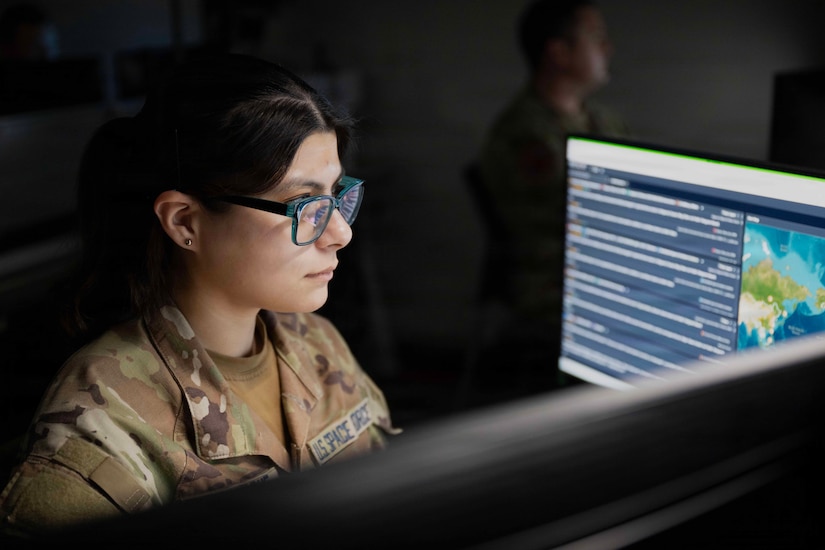
A woman wearing a camouflage military uniform uses a computer in a dark room.

Previously, across the department, dozens of separate contracts provided services to the same groups who will now receive the services under a single enterprisewide contract. The consolidation of contracts ensures service members and department civilians continue to have access to the same services, but now those services will cost less and save taxpayer dollars. 

"This enterprise approach is not just about capability, it's also about delivering on [Secretary of War Pete Hegseth's] promise to be responsible stewards of the American people's resources — taxpayer money," Davies said, noting that the new agreement is not new funding. 

Because the new contract and old contracts are with the same vendor, the funding does not change; the transition will be seamless for those involved. 

"We are achieving unprecedented scale and cost efficiency," Davies said. "This blanket purchase agreement is expected to save the department an initial $422 million annually, a figure we actually expect to rise as we fully consolidate our IT services." 

The new contract also allows warfighters to focus on what matters, she said. 

"This puts the tools in a warfighter's hands, where they need them," Davies said. "They don't need to worry about an enterprise software capability — they can worry about warfighting. They can focus on the mission, and we focus on the tools to support them in the mission." 

The agreement is scheduled to begin June 1 and includes Microsoft products such as Windows Enterprise Operating System and Office Professional Plus, along with cloud and hybrid capabilities. It also provides the digital foundation for Combined Joint All-Domain Combined Command and Control, the overarching concept to link sensors, weapons and decision-makers, as well as seamlessly share data across the armed forces and with coalition partners.

Friday, May 22, 2026

Department of War Publishes Second Release of Unidentified Anomalous Phenomena Files on WAR.GOV/UFO

Statement Attributable to Assistant to the Secretary of War for Public Affairs and Chief Pentagon Spokesman Sean Parnell: 

Today, the Department of War is publishing the second release of declassified and historical Unidentified Anomalous Phenomena (UAP) files as part of the Presidential Unsealing and Reporting System for UAP Encounters (PURSUE). The collection continues to be housed on WAR.GOV/UFO, and additional files will be released on a rolling basis.

Since the site's launch on May 8, 2026, WAR.GOV/UFO has received over 1 billion hits worldwide, highlighting the unprecedented levels of interest in both this topic and the Trump administration's historic transparency effort. The Department of War and our agency partners are actively working on the third release of UAP files, which will be announced in the near future.

Tuesday, May 19, 2026

Defeating the Swarm: Project Flytrap Accelerates NATO's Counter-Drone Lethality

Above the pine forest of the Pabradė Training Area, Lithuania, roughly 30 kilometers from the Belarusian border, a small quadcopter rises into a sky shared with dozens of other drones. Friendly and adversary, sensor and strike, American and British. Below it, soldiers are learning, in real time, what it takes to fight as a squadron in three dimensions.

"Right now, we are implementing these systems at the troop level, company level and squadron level," said Army Staff Sgt. Mateus Nunes, an infantryman assigned to Echo Troop, 2nd Squadron, 2nd Cavalry Regiment. "We are just seeing how they work."

This is Project Flytrap 5.0, a U.S. Army V Corps counter-unmanned aerial systems initiative that, over the past year, has scaled from the individual soldier to the squadron level against the same low-cost drones reshaping the modern battlefield.

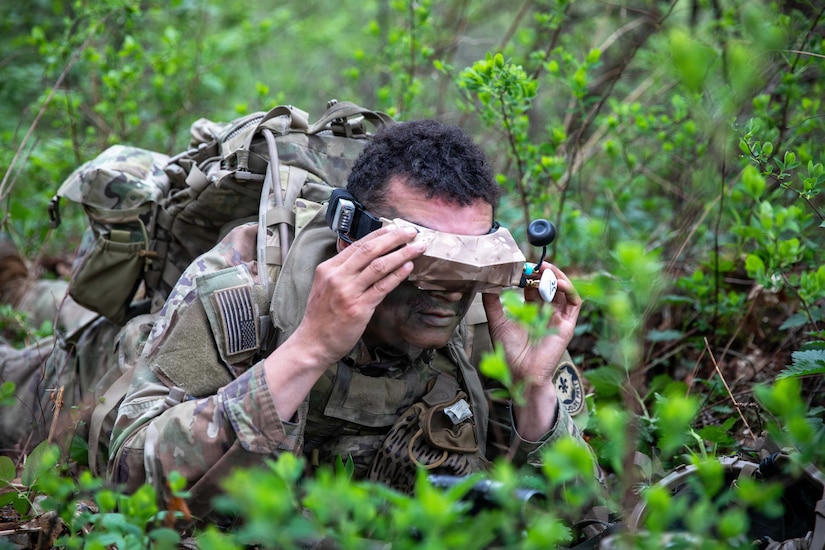
A soldier wearing tech goggles lies in a wooded area surrounded by greenery.
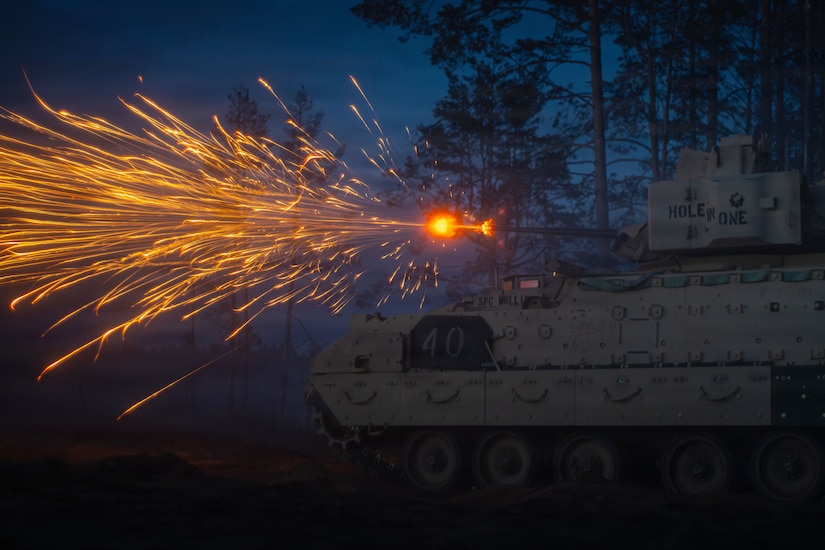
A military fighting vehicle fires into a dark sky, creating dozens of golden streaks.
The exercise, which began April 30 and ended today, is part of Saber Strike 26. The exercise puts the 2nd Squadron, 2nd Cavalry Regiment, in the lead, with the 52nd Air Defense Artillery Brigade and the United Kingdom's 3rd Parachute Regiment integrating and testing more than 50 industry-provided technologies, including radars, radio frequency defeat systems, kinetic interceptors, launched effects and unmanned ground vehicles. The systems were networked across a combined U.S.-U.K. tactical data architecture and tested against a live opposing force.

The program's arc has been deliberate. Iterations 2.0 through 4.0, carried out in Germany and Poland between May and August 2025, tested which counter-UAS equipment belonged at which echelons and developed and standardized initial small-unit level tactics for fighting drones. Flytrap 4.5 at Putlos, Germany, last November, tested the next generation of industry technology and sharpened individual operator proficiency. Now, Flytrap 5.0 is the first to integrate these systems at a squadron scale.

"We are transforming to enable offensive maneuver in a drone and electronic-warfare saturated environment, and Flytrap is essential to making that happen," said Army Gen. Christopher Donahue, commander of U.S. Army Europe and Africa. "This effort is about getting technology into the hands of soldiers, in the field, to figure out what works and what doesn't. Then we share those lessons across the Army, the joint force and with our allies."

Flytrap 5.0 is formally nested inside the Eastern Flank Deterrence Initiative, NATO's warfighting concept in the land domain. EFDI links digital architecture and operating systems across nations to detect and decide faster, leveraging artificial intelligence to process data faster, to connect units and effects to strike faster and at scale. It also means reducing the cost curve in defeating drones and incorporating cheaper attritable systems. 

"Success in Flytrap 5.0 is a little different than other exercises — in some ways failure is still success," said Army Maj. Jared Whitaker, the V Corps technical integration and assessment lead for Project Flytrap. "The industry [that] creates these systems can get immediate feedback, make hardware and technical changes rapidly — so that when those systems are fielded to soldiers, they've already got a look by soldiers and will perform significantly better than in the past." 

Flytrap 6.0 will take the program to the brigade level. That is an order of magnitude for more platforms, soldiers and decisions, and at the level at which V Corps intends to fully validate the capability. Until then, the pine forest at Pabradė is the proving ground.

Friday, May 15, 2026

Department of War Invests $191M to Expand and Enhance the Solid Rocket Motor Industrial Base

The DoW announced today the latest in a series of investments in the solid rocket motor industrial base: an April 20, 2026, investment of $27.3 million in DPA Title III funds to Pacific Scientific Energetic Materials Company (PacSci EMC), in Chandler, Arizona. It supports DoW's objectives to expand the munitions industrial base, bolster supply chain resiliency, and increase domestic production in strategic priority areas.  

"The DoW is focused on rapidly expanding and accelerating munitions production, driving a surge in demand for SRMs," said Michael Duffey, the Under Secretary of War for Acquisition and Sustainment. "Strengthening supply chains through smart investments will help alleviate SRM shortfalls by increasing capacity and reducing manufacturing lead times for key components."

Since December 2024, the Office of the Assistant Secretary of War for Industrial Base Policy (OASW(IBP)) has made nine investments in the solid rocket motor (SRM) industrial base under a recent Defense Industrial Base Consortium Other Transaction Agreement (DIBC OTA) solicitation totaling $191 million in Defense Production Act (DPA) Title III funds. 

PacSci EMC will use their investment funds to expand the production of the universal Arm Fire Device (AFD), a critical safety component in SRM applications, by scaling up proven production capabilities to serve high-volume manufacturing needs for SRM programs. The company will create a fully integrated manufacturing facility that houses all necessary production and support processes, thereby enhancing operational efficiency, reducing potential errors, and streamlining delivery systems.

The prior SRM investments made under the same DIBC OTA solicitation include: 

  • A $5 million investment in Systima Technologies Inc., part of Karman Space & Defense, to increase SRM nozzle production capacity.
  • A $27.7 million investment in R.E. Darling Co., Inc. to establish expanded capacity and a modernized manufacturing capability for SRM case insulation materials.
  • A $12.6 million investment in Americarb Inc. to develop a solution for converting woven rayon fabric into carbonized rayon phenolic, a crucial polymeric ablative material utilized for insulating rocket nozzles in SRMs.
  • A $20.9 million investment in General Dynamics Ordnance and Tactical Systems to increase SRM nozzle production capacity and capability, becoming a new supplier for composite rocket nozzles and insulators. 
  • A $5.1 million investment in SPARC Research LLC to establish a dedicated and affordable supply of rocket motor components for the SRM industrial base, supporting improvements to high-performance propulsion systems.  
  • A $9.3 million investment in ICF Mercantile LLC to establish the first domestic production source of rayon filament cellulose precursor rayon, which will in turn support the production of Carbon Phenolic Ablatives used in SRM and Re-Entry Body heatshields.
  • A $25.2 million investment in Materials Resources LLC to demonstrate SRM prototype production capability that will provide the Department with agile production of SRM metallic cases via additive manufacturing using MRL's scalable manufacturing cells.
  • A $58 million investment in Anduril Industries, Inc. to modernize and expand its SRM production by modifying existing production facilities and improving the manufacturing processes by which it produces SRMs.

The new investment in PacSci EMC is one of five investments made by the DPA Purchases Office totaling $482.6 million since the beginning of fiscal year 2026. The Warfighting Investment, Resourcing, and Execution (WIRE) Directorate oversees DPA Purchases. For more information on the WIRE Directorate, please visit: https://www.businessdefense.gov/ibr/wire.html.

About the Office of the Assistant Secretary of War for Industrial Base Policy (OASW(IBP))

The OASW(IBP) works with domestic and international partners to forge and sustain a robust, secure, and resilient industrial base enabling the Warfighter, now and in the future. OASW(IBP) also uses a Defense Industrial Base Consortium Other Transaction Agreement (DIBC OTA) to solicit new ideas for research or prototype project solutions for critical supply chain resiliency focus areas.  This OTA underscores the Department's ongoing dedication to safeguarding the integrity of our crucial supply chain and promptly giving our Warfighters the materials and technologies they need to accomplish their missions. To learn more about the DIBC OTA, please visit: https://www.dibconsortium.org.