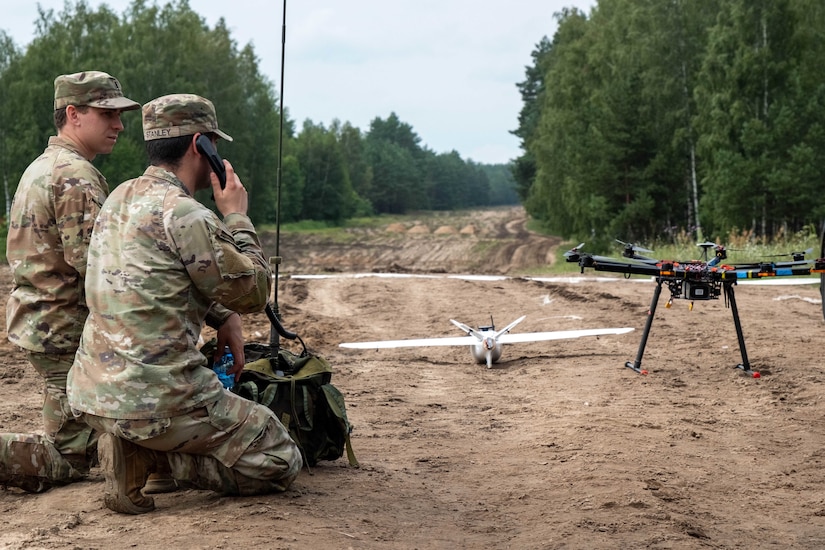
Soldiers assigned to the Army's 2nd Cavalry Regiment
detected, tracked, engaged and defeated multiple drones at ranges
between 500 and 800 meters using the Ballistic Low Altitude Drone
Engagement system from a Stryker vehicle at the Bemowo Piskie Training
Area in northeast Poland during a live-fire event for Project Flytrap
4.0 on Aug. 1.
"Some of those [drone] threats were being flown simultaneously, so
the system defeated one target then quickly targeted and defeated a
second target in a matter of seconds," said David Goldstein,
counter-unmanned aerial systems lead for the Army Combat Capabilities
Development Command Armaments Center at Picatinny Arsenal, New Jersey.
The Armaments Center ran the BLADE science and technology project
from 2016 to 2019 to develop a capability to counter drone threats.
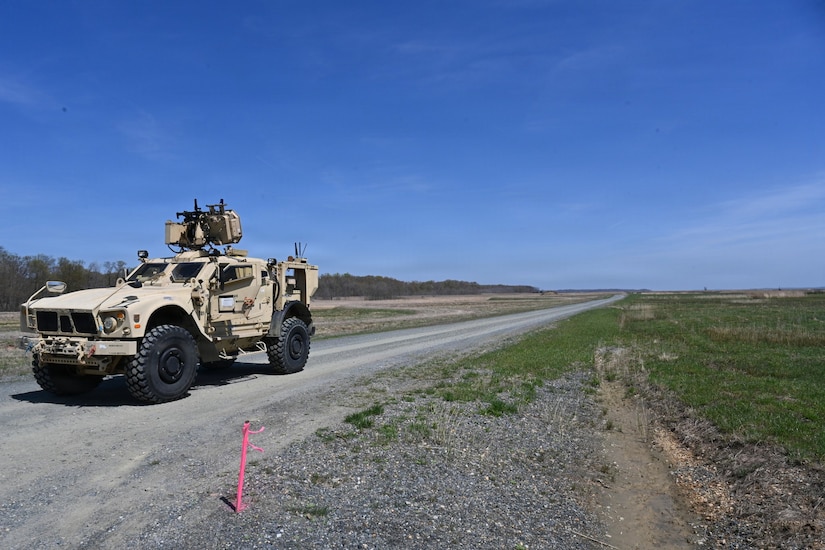
BLADE leverages — and enhances — a system operated throughout existing
Army formations, the Common Remotely Operated Weapons Station.
As a remote system mounted on different types of Army vehicles, CROWS
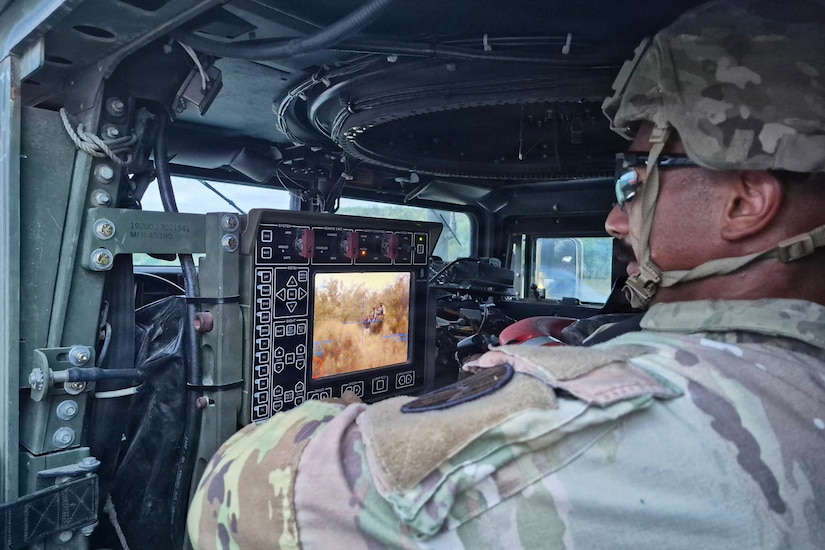
allows an operator to fire a weapon while remaining protected inside.
Using an array of optics, a viewing screen and motorized gimbals and
controls, the operator can effectively select and engage targets.
With BLADE, a precision radar and C-UAS fire control software are
integrated with CROWS hardware and software to assist operators in
identifying, tracking and pointing the weapon to a continually
calculated intercept point, enabling the difficult challenge of
destroying enemy drones.
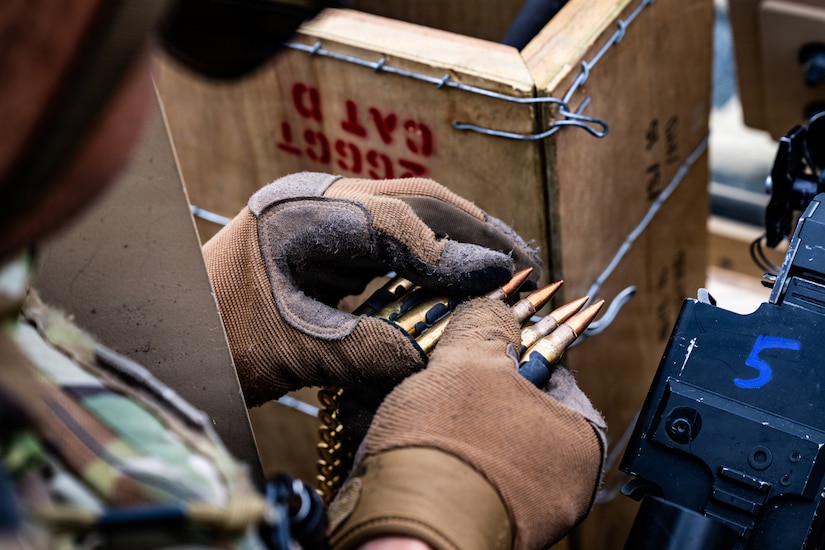
Capable of functioning with numerous weapons, the BLADE/CROWS
combination at Project Flytrap included an M2 .50-caliber machine gun
firing multiround bursts.
BLADE also participated in several project non-firing training
scenarios using the radar for detection, tracking and other simulated
defensive actions, according to Goldstein.
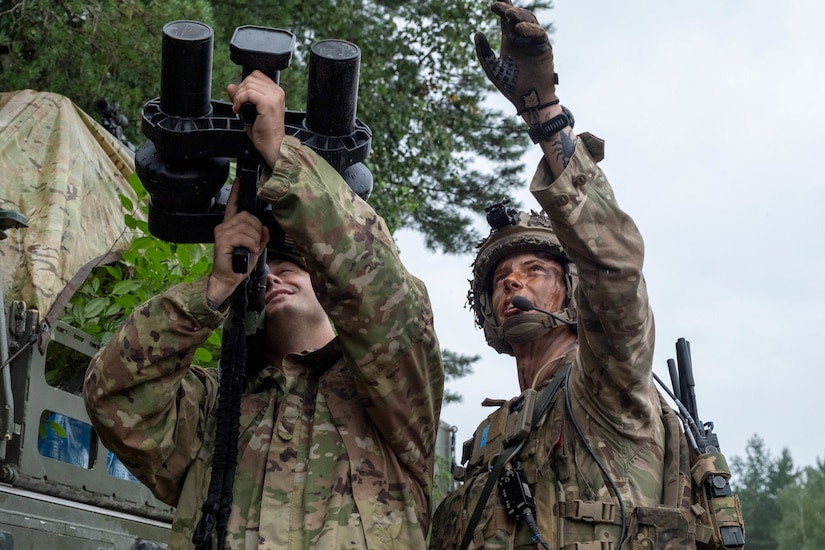
Starting in late July, Project Flytrap 4.0 was the final iteration of
the C-UAS training events, where soldiers from the 2nd Cavalry Regiment
and the 1st Royal Yorkshire Regiment, United Kingdom, tested new C-UAS
capabilities in combined exercises meant to develop and inform the
future of anti-drone tactics and technologies.
"Project Flytrap is part of a series of training events designed to
test and refine new counter-unmanned aerial systems technologies and
tactics to respond to the evolving threat of drone warfare," said Army
Col. Matt Davis, transformation chief and exercise director of V Corps,
Project Flytrap, during a press engagement.
Previous Flytrap events were focused on command-and-control systems
and countering small UAS sensors, Goldstein said. "We were invited to
come out to the latest Flytrap with our BLADE and CNALT systems because
they wanted to see more kinetic capabilities," he added.
The CNALT software plug-in, also being developed by the Armaments
Center, is an application that provides tactical fire control and
visualization tools to reduce time in the kill chain — the cycle of
finding and identifying targets, prioritizing and coordinating attacks.
Time is critical in military operations with targets in constant motion,
considering that potential targets threaten harm to friendly forces.
Soldiers took 15 minutes on new equipment training for CNALT
operations, said Marc Sanzari, chief of the Armaments Center Networked
Lethality and Collaborative Autonomy Branch. During various training
scenarios, CNALT successfully ingested real-time sensor data from the
BLADE precision fires radar, classified unmanned aerial vehicle tracks
and generated actionable engagement recommendations for BLADE and the
Stryker commander.
For BLADE, getting the components to Project Flytrap 4.0 and
operational tested the abilities of engineers and technicians to meet
the Army and Defense Department challenge to get new drone capabilities
into the hands of soldiers quickly and with the fewest constraints.
"Within two weeks of request, the system was installed and
operational and ready for soldier touchpoint training," said Jonathan
Gann, Armaments Center mechanical engineering technician specializing in
autonomous weapons.
Gann was part of an Armaments Center team that shipped the BLADE
components from Picatinny Arsenal to Poland and conducted a field
expedient installation of an existing CROWS on a Stryker vehicle to make
it operational as a BLADE system.
After the installation, Gann met with soldiers to discuss the
tactics, techniques and procedures for BLADE operations within unit
formation while stationary and on the move. He noted that soldier
feedback from the live-fire event provided insights on future
improvements for BLADE, but also, "it highlighted the possibilities of
UAS engagement in a dynamic environment," Gann said.
"I was able to understand the fundamental workflow for the system and
gunner actions within one hour of seeing the BLADE for the first time,"
said Army Maj. Jared Whitaker, deputy chief G31 from V Corps, who, as a
leader, observed the entirety of the drone engagements in a seat
between the gunner and radar operator.
Whitaker, who is proficient in operating CROWS, said that compared to
ground engagements, there were added steps in counter-drone operations.
Schooling on the radar was necessary, as was additional training to
become fluid during rapid reactions while performing counter-drone
scenarios.
"I found that the ability to engage UAS using a CROWS has gone from
impossible to possible with the addition of BLADE," Whitaker said.
After achieving technology readiness level six in 2019, BLADE has
participated in various C-UAS exercises and engagements, such as Project
Convergence, the Maneuver Fires Integrated Exercise and Red Sands –
Operation Hard Kill.
Project Flytrap has become the latest BLADE knowledge builder.
"The Armaments Center continues gathering insights from participating
in C-UAS events and is transitioning the technology to current programs
of record for near-term fielding opportunities," Goldstein said.



 Posts
Posts

