Showing posts with label drone warfare. Show all posts

Thursday, June 25, 2026

Army Armaments Center Develops New Counter-UAS Capability

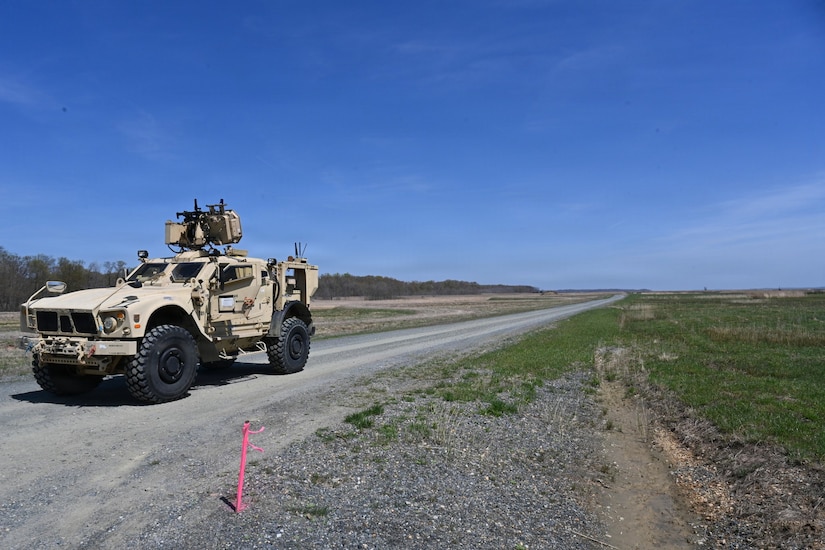
A new effort led by the U.S. Army Combat Capabilities Development Command Armaments Center demonstrated advancements developed for fire control, enabling the ability to engage and defeat drones with a common remotely operated weapon station while shooting on the move.

A military vehicle is parked on a gravel road in a grassy field.

The fire control project is a Science and Technology Integration Office software effort that is designing, developing and demonstrating advanced counter-drone fire control capabilities. The project underwent testing in April at the Aberdeen Proving Ground in Aberdeen, Maryland. 
 
According to Nick Cascia, project officer, the initiative began as a mission-driven response to the emerging small unmanned aerial system threat after leadership directed the team to pursue an advanced fire control capability to defeat small drones.

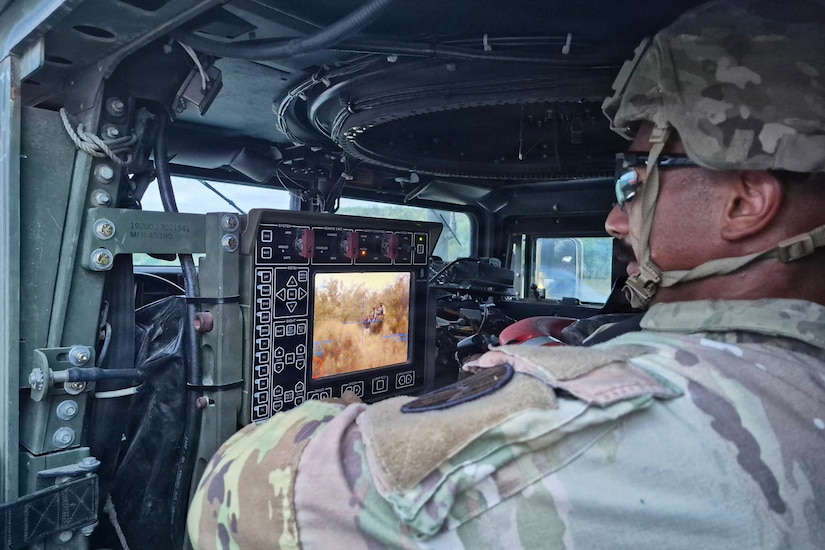
A man in a camouflage military uniform looks at a screen inside a military vehicle.

The effort integrated the Armaments Center's Gunslinger fire control, originally developed under the Future Attack Reconnaissance Aircraft program, and adapted it for ground-to-air targeting. The remote weapon station is able to defeat small moving targets while the vehicle is in motion by using the Gunslinger's fire control, as well as various vehicle sensor feeds, to provide real-time data, ensuring the weapon is accurately aimed at the target drone. 
 
This fire control solution uses a modular open system approach, so the developed software as well as any future enhancements can be shared across the Army. Once matured, the software will improve system accuracy against drones, reducing the number of rounds needed to defeat the threat.

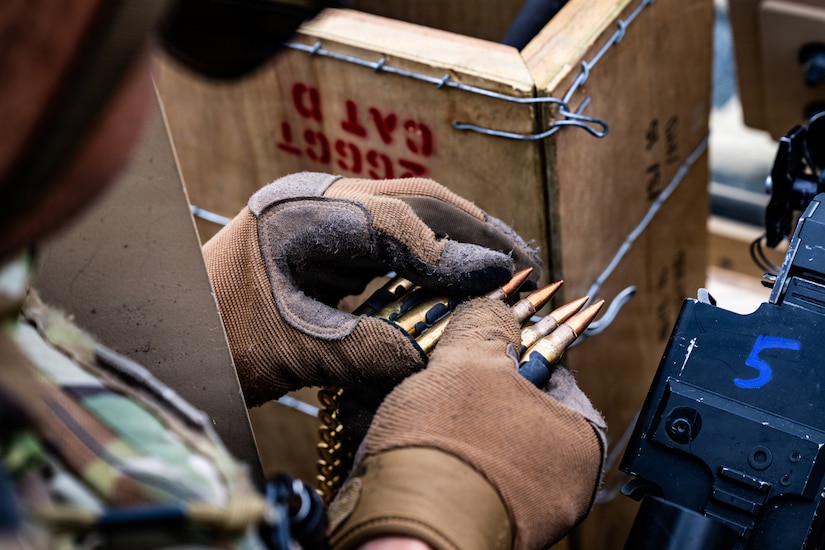
A person in a camouflage military uniform and brown gloves holds a string of large bullets.

 
According to James Little, deputy project lead, the development team received promising results from their April tests and will iterate and build upon these results in subsequent tests to improve system performance. With these tests, developers will continue to increase the speed of both the vehicle and drone. 
 
"It's a great start to the effort," Cascia explained. "The [project] team has put considerable time and effort into developing our advanced fire control algorithms and preparing for this test. Once we started destroying drones, it showed the hard work was paying off."

Wednesday, December 31, 2025

Marine Corps Launches New Drone Training Program

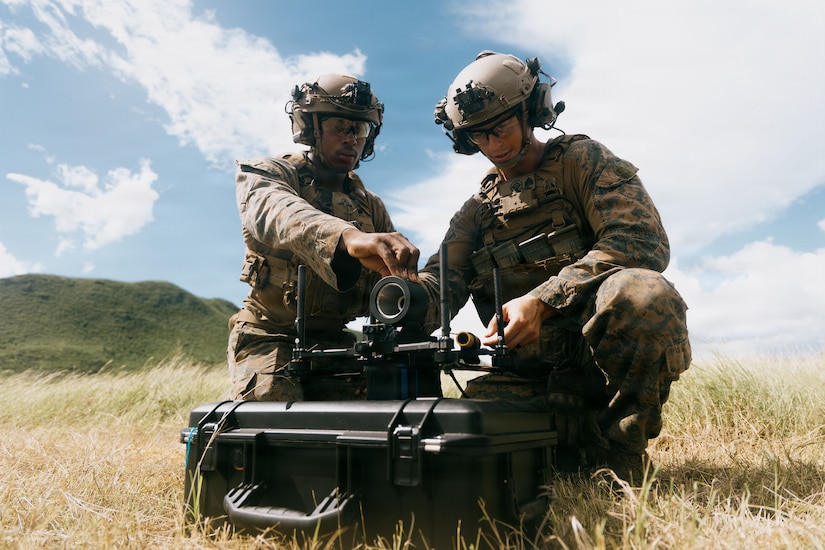
The Marine Corps has launched a training program to rapidly increase the number of small unmanned aircraft system operators for commercial off-the-shelf attack drones. 

Two Marines in an open field kneel by a military drone.

The program, announced in Marine Corps administrative message 624/25, addresses a critical need for standardized training as the service integrates new systems, including the Neros Archer first-person-view attack drone and prepares for this significant investment in various drone technologies.  

This initiative builds on the service's success over the past few months scaling FPV attack drones across the Fleet Marine Force. It also aligns directly with War Department plans to field tens of thousands, and then hundreds of thousands, of attack drones across service components starting in March 2026 and continuing over the next several years. 

The new framework, created by Training and Education Command, establishes six pilot courses and eight certifications to create a standard for drone operators across the force. These initiatives are designed to provide foundational skills for a variety of small unmanned aircraft systems. 

"We are fielding these courses as pilot programs to move quickly while maintaining our commitment to quality training and safety," said Marine Corps Lt. Gen. Benjamin T. Watson, commanding general, Training and Education Command. "This allows us to validate all aspects of the training, from prerequisites and instructional methods to resourcing needs and certification standards, ensuring that we refine and perfect the curriculum before it becomes part of our long-term training framework." 

Six approved pilot courses will certify Marines while testing instructional methods and curriculum. These courses include training for drone operators, payload specialists and instructors, with specific prerequisites such as simulator experience on Training and Education Command-approved systems. The courses aim to ensure proper integration and supervision of new drone capabilities. The Training and Education Command has also established a process to grant certifications to Marines who have existing qualifications and experience through an exception to policy. 

Seven organizations are designated as regional training hubs with the authority to immediately begin conducting the pilot courses, including schools within Training and Education Command, 1st Marine Division, 2nd Marine Division, III Marine Expeditionary Force, and Marine Forces Special Operations Command. 

Weapons Training Battalion at Marine Corps Base Quantico, Virginia, will serve as the interim central hub, responsible for standardizing training, certification and safety across the force. It will consolidate lessons learned and function as the Marine Corps' focal point for adapting training to emerging platforms, payloads and evolving operational requirements. 

This effort to scale standardized FPV attack drone training was shaped by lessons from recent certifications, including two Marine Corps attack drone competitions, one in the National Capitol Region and the other in Okinawa, Japan. These efforts certified 19 attack drone operators, five attack drone instructors, seven payload specialists, and two payload specialist instructors. 

In mid-November, the Marine Corps Attack Drone Team also supported the certification of 22nd Marine Expeditionary Unit Marines, resulting in 14 attack drone operators and 11 payload specialists fully trained, equipped and ready for contingency operations. 

Over the next few months, the Marine Corps Attack Drone Team, alongside Weapons Training Battalion and regional hubs, will certify hundreds more Marines. By May 2026, all infantry, reconnaissance battalions and littoral combat teams across the Corps will be equipped to employ FPV attack drone capabilities. 

Wednesday, September 3, 2025

BLADE Cuts Down Drones During Project Flytrap 4.0

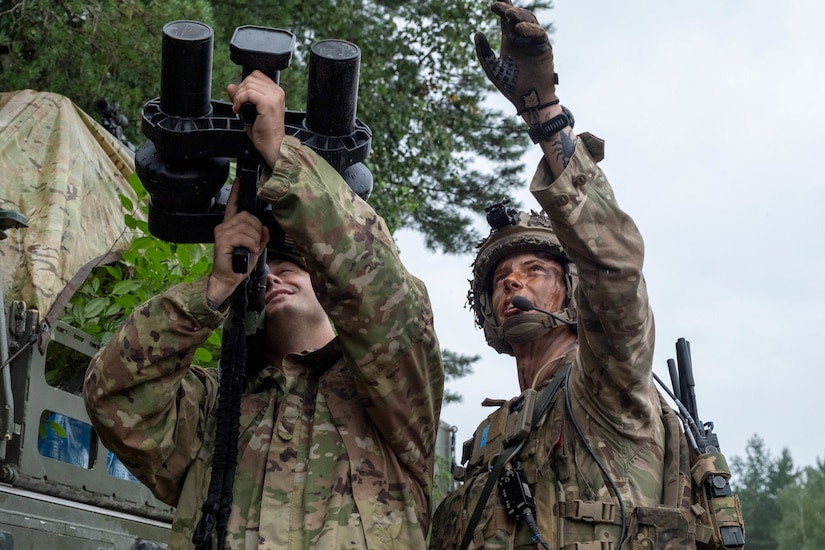
Soldiers assigned to the Army's 2nd Cavalry Regiment detected, tracked, engaged and defeated multiple drones at ranges between 500 and 800 meters using the Ballistic Low Altitude Drone Engagement system from a Stryker vehicle at the Bemowo Piskie Training Area in northeast Poland during a live-fire event for Project Flytrap 4.0 on Aug. 1. 

A soldier in a camouflage military uniform points an electronic jamming device toward the sky. Another soldier, standing in similar attire, points at the sky.

"Some of those [drone] threats were being flown simultaneously, so the system defeated one target then quickly targeted and defeated a second target in a matter of seconds," said David Goldstein, counter-unmanned aerial systems lead for the Army Combat Capabilities Development Command Armaments Center at Picatinny Arsenal, New Jersey. 

The Armaments Center ran the BLADE science and technology project from 2016 to 2019 to develop a capability to counter drone threats. BLADE leverages — and enhances — a system operated throughout existing Army formations, the Common Remotely Operated Weapons Station. 

As a remote system mounted on different types of Army vehicles, CROWS allows an operator to fire a weapon while remaining protected inside. Using an array of optics, a viewing screen and motorized gimbals and controls, the operator can effectively select and engage targets. 

With BLADE, a precision radar and C-UAS fire control software are integrated with CROWS hardware and software to assist operators in identifying, tracking and pointing the weapon to a continually calculated intercept point, enabling the difficult challenge of destroying enemy drones. 

Capable of functioning with numerous weapons, the BLADE/CROWS combination at Project Flytrap included an M2 .50-caliber machine gun firing multiround bursts. 

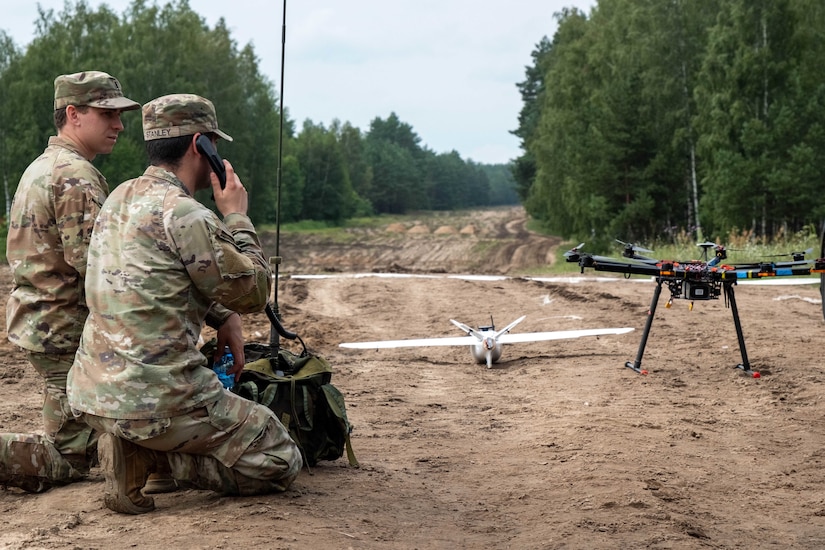
Two soldiers in military camouflage uniforms kneel on a dirt path in a wooded area, with two drones on the ground nearby. The soldier on the right has a backpack in front of him and a phone receiver in his hand.

BLADE also participated in several project non-firing training scenarios using the radar for detection, tracking and other simulated defensive actions, according to Goldstein. 

Starting in late July, Project Flytrap 4.0 was the final iteration of the C-UAS training events, where soldiers from the 2nd Cavalry Regiment and the 1st Royal Yorkshire Regiment, United Kingdom, tested new C-UAS capabilities in combined exercises meant to develop and inform the future of anti-drone tactics and technologies. 

"Project Flytrap is part of a series of training events designed to test and refine new counter-unmanned aerial systems technologies and tactics to respond to the evolving threat of drone warfare," said Army Col. Matt Davis, transformation chief and exercise director of V Corps, Project Flytrap, during a press engagement. 

Previous Flytrap events were focused on command-and-control systems and countering small UAS sensors, Goldstein said. "We were invited to come out to the latest Flytrap with our BLADE and CNALT systems because they wanted to see more kinetic capabilities," he added. 

The CNALT software plug-in, also being developed by the Armaments Center, is an application that provides tactical fire control and visualization tools to reduce time in the kill chain — the cycle of finding and identifying targets, prioritizing and coordinating attacks. Time is critical in military operations with targets in constant motion, considering that potential targets threaten harm to friendly forces. 

Soldiers took 15 minutes on new equipment training for CNALT operations, said Marc Sanzari, chief of the Armaments Center Networked Lethality and Collaborative Autonomy Branch. During various training scenarios, CNALT successfully ingested real-time sensor data from the BLADE precision fires radar, classified unmanned aerial vehicle tracks and generated actionable engagement recommendations for BLADE and the Stryker commander. 

For BLADE, getting the components to Project Flytrap 4.0 and operational tested the abilities of engineers and technicians to meet the Army and Defense Department challenge to get new drone capabilities into the hands of soldiers quickly and with the fewest constraints. 

"Within two weeks of request, the system was installed and operational and ready for soldier touchpoint training," said Jonathan Gann, Armaments Center mechanical engineering technician specializing in autonomous weapons. 

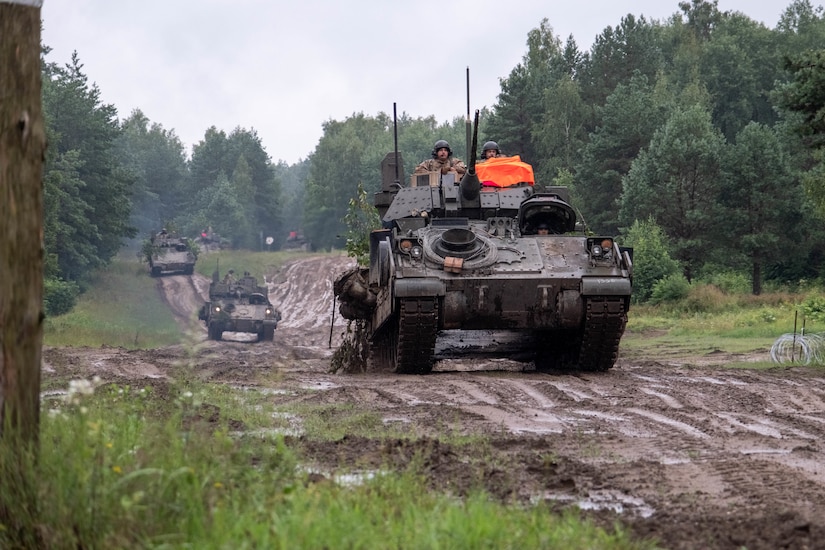
Military tanks roll down a dirt road in a wooded area with soldiers in camouflage military uniforms perched atop of the tanks.

Gann was part of an Armaments Center team that shipped the BLADE components from Picatinny Arsenal to Poland and conducted a field expedient installation of an existing CROWS on a Stryker vehicle to make it operational as a BLADE system. 

After the installation, Gann met with soldiers to discuss the tactics, techniques and procedures for BLADE operations within unit formation while stationary and on the move. He noted that soldier feedback from the live-fire event provided insights on future improvements for BLADE, but also, "it highlighted the possibilities of UAS engagement in a dynamic environment," Gann said. 

"I was able to understand the fundamental workflow for the system and gunner actions within one hour of seeing the BLADE for the first time," said Army Maj. Jared Whitaker, deputy chief G31 from V Corps, who, as a leader, observed the entirety of the drone engagements in a seat between the gunner and radar operator. 

Whitaker, who is proficient in operating CROWS, said that compared to ground engagements, there were added steps in counter-drone operations. Schooling on the radar was necessary, as was additional training to become fluid during rapid reactions while performing counter-drone scenarios. 

"I found that the ability to engage UAS using a CROWS has gone from impossible to possible with the addition of BLADE," Whitaker said. 

After achieving technology readiness level six in 2019, BLADE has participated in various C-UAS exercises and engagements, such as Project Convergence, the Maneuver Fires Integrated Exercise and Red Sands – Operation Hard Kill. 

Project Flytrap has become the latest BLADE knowledge builder. 

"The Armaments Center continues gathering insights from participating in C-UAS events and is transitioning the technology to current programs of record for near-term fielding opportunities," Goldstein said.