Showing posts with label arizona state university. Show all posts

Thursday, August 23, 2012

Native Plants in Urban Yards Offer Birds "Mini-Refuges"


Landscaping with native vegetation helps local bird species

Yards with plants that mimic native vegetation offer birds "mini-refuges" and help to offset losses of biodiversity in cities, according to results of a study published today in the journal PLOS ONE.

"Native" yards support birds better than those with traditional grass lawns and non-native plantings.

Researchers conducted the study through the National Science Foundation's (NSF) Central Arizona-Phoenix Long-Term Ecological Research (LTER) site, one of 26 such sites around the globe in ecosystems from coral reefs to deserts, from forests to grasslands.

"To a desert bird, what's green is not necessarily good," says Doug Levey, program director in NSF's Division of Environmental Biology. "Arizona birds don't view lush urban landscapes as desert oases. The foraging behavior of birds in greener yards suggests that there's less food for them there than in yards with more natural vegetation."

The research, led by scientists Susannah Lerman and Paige Warren of the University of Massachusetts-Amherst, and Hilary Gan and Eyal Shochat of Arizona State University, looked at residential landscape types and native bird communities in Phoenix, Ariz.

It's among the first to use quantitative measures and a systematic approach--including 24-hour video monitoring--in yards to assess and compare foraging behavior of common backyard birds.

The scientists found that desert-like, or xeric, yards had a more even bird community and superior habitat compared with moist, or mesic, grass lawns.

"We already know that bird communities differ, and that there are more desert birds found in a desert-type yard," says Lerman.

"With this study, we're starting to look at how different yards function--whether birds behave differently by yard type. We're doing that using behavioral indicators, especially foraging, as a way of assessing birds' perceptions of habitat quality between differing yard designs."

Lerman and colleagues conducted the experiment in 20 residential yards at least 1.8 miles apart, making it unlikely that the same birds would visit more than one study yard.

Half the yards were desert-like, while the others had green lawns.

From February through April 2010, homeowners removed bird feeders before and during a 24-hour experimental data collection period.

The researchers set up feeding stations--seed trays--in each yard to simulate resource patches similar to ones where birds feed in the wild. Plastic trays contained 0.70 ounces of millet seed mixed into six pounds of sand. The trays were placed on low stools and left out for 24 hours.

Later, Lerman removed the trays, sifted out and weighed uneaten seed to the nearest 0.01 gram. The amount of seed remaining quantified the giving-up densities (GUD), or the foraging decision and quitting point for the last bird visiting a seed tray.

Trays were videotaped for the entire 24-hour experiment.

The experiment assumed that an animal behaving optimally would stop foraging from a seed tray when its energy gains equal the "costs" of foraging, Lerman says.

Costs include predation risk, digestion and missed opportunities to find food elsewhere.

As time spent foraging at a seed tray increases, so do the costs associated with foraging. When a bird first arrives at the tray, seeds are easy to find, but that gets harder as the tray becomes depleted.

Each bird makes a decision about whether to spend time searching in the tray or to move on to a new patch in the yard.

The "giving up" point will be different for different species and in different environmental conditions. Birds visiting seed trays in yards with more natural food available will quit a tray sooner than birds in resource-poor yards.

Since the method only measures the foraging decisions for the last species visiting the seed tray, the researchers devised a mathematical model for estimating the foraging decisions for all visiting species.

Using the videotapes, they counted every peck by every bird for each tray to calculate the relationship between the number of pecks and grams of seed consumed for each seed tray. This was the GUD-peck ratio for the last species visiting the seed tray.

They then estimated the seed consumption--GUD ratio for all other species visiting the seed tray based on the number of pecks per tray when each species quit.

"We know how many pecks each species had and can put that number into the model and calculate the number of grams at that point," Lerman says. This greatly enhances the GUD method by expanding the ability to assess foraging decisions for all species visiting trays.

In all, 14 species visited the trays, 11 of which visited both yard types. Abert's towhee, curve-billed thrasher (a species unique to the Sonoran desert), house finch and house sparrow were the most widespread tray visitors.

Species that visited trays in both yard designs consumed more seed from trays placed in mesic yards, indicating lower habitat quality compared with xeric yards.

Similarly, foragers in the desert-like yards quit the seed trays earlier due to greater abundance of alternative food resources in those yards, spending more time foraging in the natural yards and less at the seed trays.

Lerman says that by videotaping the trays, counting pecks and measuring giving-up points by species, the research also advanced the GUD method, allowing researchers to disentangle some of the effects of bird community composition and density of competitors, and how these factors affect foraging decisions between two different landscape designs.

The results build upon evidence that native landscaping can help mitigate the effects of urbanization on common songbirds, she says.

 -NSF-

Wednesday, June 13, 2012

Uncovering the Veil (Nebula)


The Veil Nebula, left behind by the explosion of a massive star thousands of years ago, is one of the largest and most spectacular supernova remnants in the sky.

The image was taken with Hubble's Wide Field Planetary Camera 2 in November 1994 and August 1997.

Image Credit: NASA, ESA, and the Hubble Heritage (STScI/AURA)-ESA/Hubble Collaboration; Acknowledgment: J. Hester (Arizona State University)

Friday, April 20, 2012

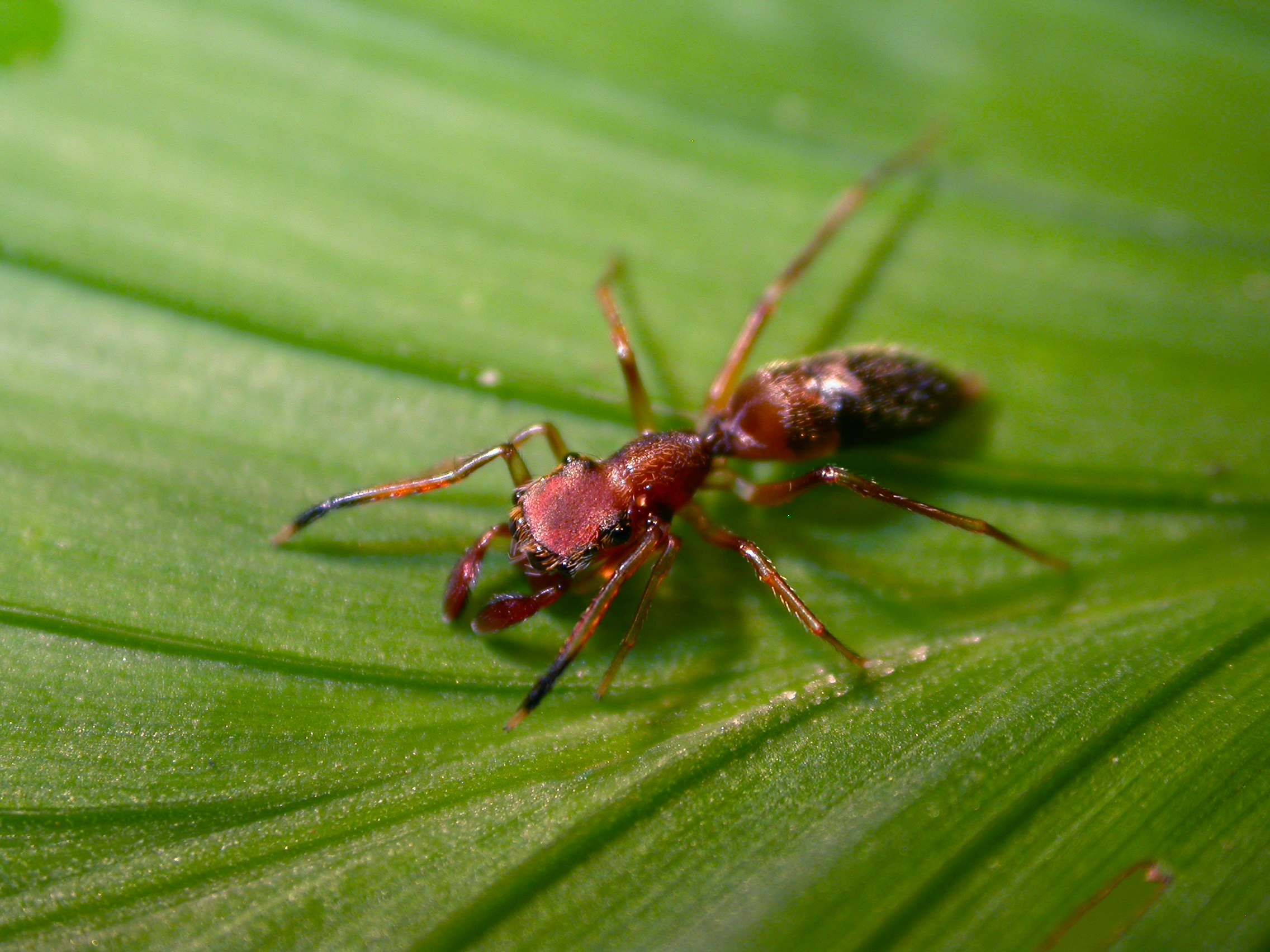
Jumping Spider Mimics


A jumping spider (Hypaeus benignus) from the La Selva Biological Station in Costa Rica. H. benignus is about 7 millimeters long.

More about these Images
As part of her dissertation research, supported by a National Science Foundation graduate research fellowship, Lisa Taylor of Arizona State University's (ASU) School of Life Sciences studied mimicry in the jumping spider family Salticidae. Salticidae are the largest family of jumping spiders in the world.

In biology, mimicry is the similarity of one species to another. The mimicry may offer protection from predators for one or both of the species involved, and may help the mimic acquire food more easily. The mimicking species may be similar to the mimicked in appearance, behavior, sound, scent and location.

There are four types of mimicry used by spiders:

• Batesian--When the mimic takes on characteristics of an organism that is harmful (may sting or bite) and bad tasting, like an ant or wasp, thus helping the spider avoid becoming a meal (Taylor believes that most of the jumping spiders she studied were Batesian mimics).

•Wasmannian mimicry--When the mimic resembles an organism in order to come and go in the organism's territory undisturbed, and may or may not be harmful to the organism. For example, the ability to mimic ants (the technical term for this is myrmecomorphy), particularly those with nasty stings and bites, gives jumping spiders protection from the predators that feed on them such as birds, wasps and lizards. Mimicking ants also gives spiders access to areas where they can hunt and hide that typically would be off limits. Some spiders have the ability to smell like ants--ants use chemical signals to communicate. By mimicking the scent of ants, the spiders can roam freely in and out of ant nests, where they may live or feed on ant larva.

•Peckhamian (or aggressive) mimicry--When an aggressive mimic imitates its prey so it may feed on it more easily. For example, the bolas spider hangs a glob of sticky glue in the air that contains a chemical that mimics the pheromone of a female moth. When male moths fly near to check out the potential "mate," they get stuck to the blob and become a meal for the spider.

•Mullerian mimicry--When the mimic has distinctive, brightly striped patterns that resemble those of a toxic bee or wasp (although no toxic jumping spiders have been identified so far). For example, spiders that mimic the large, fuzzy and brightly colored velvet ant (which is actually a wingless wasp) are protected from potential predators because they associate bright-colored creatures with a painful sting and stay away.

Currently, Taylor is studying the courtship rituals of jumping spiders. In particular, she is interested in how animals use color to communicate. In her dissertation work at ASU, she is working with a group of colorfully ornamented jumping spiders (like the ones pictured here) in the genus Habronattus. She's trying to understand how they use color to advertise themselves to potential mates and competitors, as well as to deceive and avoid potential predators. (Date of Image: 2005-2010)

Credit: Lisa Taylor, Arizona State University

Wednesday, March 28, 2012

CISE CAREER Proposal Writing Workshop


Arizona State University - Tempe AZ

May 18, 2012 8:30 AM  to
May 18, 2012 5:00 PM
Tempe

The goal of the workshop is to enable future CISE proposal submitters to prepare competitive CAREER proposals. The workshop intends to provide young faculty members skills in CAREER proposal writing, panel review experience, and opportunities to interact with NSF program directors and recent NSF awardees.

Organizer:  Dr. Sule Ozev, Arizona State University, Tempe, AZ

Date:  May 18, 2012

Place:  Tempe, AZ

More information:  http://www.connectionone.org/cise2012/

Meeting Type
Workshop

Contacts
 Mohamed Gouda, (703) 292-8458 mgouda@nsf.gov

NSF Related Organizations
 Directorate for Computer & Information Science & Engineering

The National Science Board Announces Recipient of the 2012 Public Service Award


The National Science Board (NSB) announced today that renowned cosmologist and author, Lawrence Krauss, is the recipient of its 2012 Public Service Award for an individual.

Krauss is the Foundation Professor in the School of Earth and Space Exploration and physics director of the Origins Project at Arizona State University. He has been hailed by Scientific American as a rare "public intellectual."

Krauss has authored more than 300 scientific publications and nine books, including the international bestseller The Physics of Star Trek, an entertaining and eye-opening tour of the Star Trek universe and Beyond Star Trek, which responds to recent exciting discoveries in physics and astronomy and takes a look how the laws of physics relate to notions from popular culture.

His most recent bestseller, A Universe from Nothing, offers provocative, revelatory answers to the most basic philosophical questions.

As one of the few scientists to have crossed the chasm between science and popular culture, Krauss has been a frequent commentator and columnist for newspapers such as the New York Times and the Wall Street Journal. He has written regular columns for New Scientist and Scientific American, and appears routinely on radio and television.

Additionally, he performed solo with the Cleveland Orchestra, narrating Gustav Holst's The Planets at the Blossom Music Center for the most highly attended concert at that venue, and received a Grammy nomination for his liner notes for a Telarc CD of music from Star Trek. He also served as a judge at the Sundance Film Festival.

He continues to be a leader in his field as he serves as a co-chair of the board of sponsors of the Bulletin of the Atomic Scientists, on the board of directors of the Federation of American Scientists, and is one of the founders of ScienceDebate2012.

Krauss is internationally known for his work in theoretical physics--he is the only physicist to receive major awards from all three U.S. physics societies: the American Physical Society, the American Institute of Physics and the American Association of Physics Teachers.

Krauss received his Ph.D. from the Massachusetts Institute of Technology in 1982 and joined the Society of Fellows at Harvard University. He was a professor at Yale and the Ambrose Swasey Professor and chair of the physics department at Case Western University prior to taking his current position in 2008.

"Lawrence Krauss' broad public outreach bridges science and popular culture through various media and intellectual pursuits, and we are proud to name him as the recipient of the 2012 NSB Public Service Award presented to an individual," said NSB Chairman Ray Bowen.

The NSB Public Service Award honors individuals and groups that have made substantial contributions to increasing public understanding of science and engineering in the United States. These contributions may be in a wide variety of areas that have the potential of contributing to public understanding of and appreciation for science and engineering--including mass media, education, training programs and/or entertainment.

Krauss will receive the NSB Public Service Award for an individual medal and certificate at an awards ceremony and dinner on May 3 at the U.S. Department of State in Washington, D.C., along with recipients of the Vannevar Bush Award, the NSB Public Service Award for a group and National Science Foundation's Alan T. Waterman Award.

About the National Science Board
The National Science Board is the 25-member policymaking body for the National Science Foundation and advisory body to the president and Congress on science and engineering issues. Drawn primarily from universities and industry, and representing a variety of science and engineering disciplines and geographic areas, NSB members are selected for their eminence in research, education or public service and records of distinguished service. The NSB has 24 members that serve six-year terms. The 25th member is the NSF director, an ex officio member of the NSB. Visit the National Science Board's Web site for more information.

 -NSF-