Showing posts with label bombs. Show all posts

Tuesday, June 26, 2012

Bomb Threat? An App for that, too


Homeland Security’s new smartphone application for bomb threats
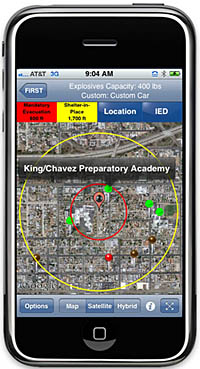
At approximately 6:30 pm on Saturday, May 1, 2010, a smoking SUV in Times Square was reported by alert street vendors. Acting quickly, NYPD evacuated vast stretches on 7th and 8th Avenues, including Broadway theatres and several other buildings and hotels in the area. The entire area was barricaded. Times Square on a Saturday evening before the shows is teaming with people, and the terrorist knew that. The bomb failed, but had it detonated, it would have killed and wounded many, according to NYPD.

In the first chaotic moments after suspicion of a bomb threat, first responders have a myriad of questions, assessments, and decisions to make, all at once, and all the while the scene could be changing rapidly. Is the bomb real? How large is the potential blast radius? Where will we evacuate people? Are there any critical infrastructure or special-needs population centers in the vicinity? Any schools, hospitals nearby? What roads should be closed? Which roads should stay open for evacuees? And on and on....

What if they could get all this information in one place?

Now they can: The U.S. Department of Homeland Security's (DHS) Science and Technology Directorate (S&T) and its public and private sector partners have developed a must-have "app": the First Responder Support Tools (FiRST) for computers and smartphones.

The FiRST application was developed in partnership with the DHS National Protection and Programs Directorate's (NPPD) Office of Infrastructure Protection (IP) along with its Office for Bombing Prevention (OBP), and Applied Research Associates, Inc. (ARA). The FiRST app provides information directly to first responders on their smartphones or laptop computers in order to quickly define safe distances to cordon-off around a potential bomb location, calculate rough damage and injury contours, suggest appropriate roadblocks, determine when mandatory evacuation or shelter-in-place circumstances apply, and to identify nearby areas of particular concern: schools, hospitals, care centers. The application also provides the geospatial information regarding potential injury, glass, or structural damage impact area.

"That's why it works," said Christine Lee, FIRST program manager in S&T's First Responders Group. "Bomb threat scenarios do not reflect a one-size-fits-all approach, and this app allows users to customize information to help them make informed decisions for response."

The FiRST application also includes HAZMAT response information based on the Emergency Response Guidebook (ERG) which includes information on over 3,000 hazardous materials. In addition to providing health precautions and response guidance, FiRST also retrieves current and forecast weather to show downwind protection zones for over 600 materials that are inhalation hazards.

FiRST is available to first responders for a nominal fee (about $12 for mobile devices and $100 for Window PC version).  The app will be of interest and applicable to anyone who might need to address a potential bomb or HAZMAT spill response, such as industry, HAZMAT transport, or security personnel.  HAZMAT information is available to all users.   Specifically defined DHS bomb standoff data is considered sensitive and is automatically made available to those that register the application with a .gov, .mil, or .us email address. Users without a .gov, .mil, or .us email address can be approved for access on a case-by-case basis in coordination with the Office of Bomb Protection.   (However, any user can input into the app and define his own custom bomb and standoff distances, which might be applicable to certain jurisdictions and/or localities.) 
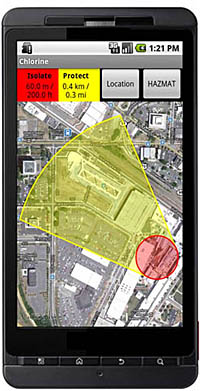
The FiRST app uses services readily available with current smartphones: email, phone, Google Maps, Google Search, and weather and road network data. "We use existing hardware that responders are already familiar with because responders can't waste time navigating a complex interface during the chaos of an incident," said Carl Jerrett, ARA program manager. "No longer will they have to carry additional tools such as hard-copy blast standoff guidance cards, rulers, or maps." Sergeant Thomas Sharkey, the District of Columbia Metro Transit Police Bomb Squad Commander, said "Unlike other confusing software on desktop computers, this application is easy to purchase, easy to install, and even easier to use."

Once a first responder enters a general definition and location of the bomb or HAZMAT incident into the FiRST app, the results are instantaneous. They can run a roadblock analysis to identify which roads are best suited for closure in order to isolate a bomb threat within that specific region. Google Search features are available to identify and display locations where increased numbers of the public may be at potential risk. "FiRST allows responders to label a map with critical information, and this information not only helps first responders better understand an incident, but these maps can then be shared with other responders," said Jerrett. Users can quickly send results to colleagues via email, which includes a text summary, a map image, and GIS file attachments that are viewable in applications like Google Earth or WebEOC¨.

The FiRST app is available for iPhones and iPads, Androids, and Windows personal computers. The application is available for purchase at a nominal fee on iTunes, the Google Play, and ARA's e-commerce website.

FiRST field evaluations were conducted last year by the Washington Metropolitan Area Transit Authority, bomb squad, police, EMT, firefighter, and hazmat units. United States Secret Service personnel observed the evaluations as well. After the application testing and evaluation phases were completed, Sharkey said, "This app is a must-have for bomb technicians and first responders."

FBI Breaks Ground for New TEDAC Laboratory


Today, the FBI, along with its law enforcement and military partners, participated in a groundbreaking for a new Terrorist Explosive Devices Analytical Center (TEDAC) Laboratory at Redstone Arsenal in Huntsville, Alabama. It is a milestone in TEDAC’s development and in the combined efforts to defeat the threat of improvised explosive devices, or IEDs.

The new building will provide dedicated forensic and technical exploitation workspace for TEDAC. Currently, TEDAC shares laboratory facilities with the FBI Laboratory at Quantico. The Huntsville laboratory will provide processing and examination capabilities in various forensic disciplines. The facility also will support technical exploitation of IEDs and related devices and will facilitate the exchange of personnel among TEDAC partner agencies, further strengthening TEDAC’s interagency role and mission.

Beginning in 2003, the FBI Laboratory began receiving recovered and seized IEDs and related materials from the Department of Defense (DOD) for forensic and technical analysis in support of the ongoing war on terrorism and combat operations in Iraq and Afghanistan. Subsequently, in December 2004, TEDAC was formally established and given the mission of forensically and technically exploiting, for evidentiary, investigative, and intelligence purposes, IEDs used by terrorists. Prior to TEDAC, no single entity in the government was responsible for this critical mission.

Over the past nine years, TEDAC has proven to be one of the nation’s most valuable tools in the war on terror. Since its creation, TEDAC has processed more than 80,000 submissions of IEDs and related forensic materials from Iraq, Afghanistan, and other foreign countries. Scientists and engineers have made dozens of forensic matches and connections between seemingly unrelated IEDs.

Interagency partners participating in TEDAC include the FBI; Bureau of Alcohol, Tobacco, Firearms, and Explosives (ATF); the Department of Defense (DOD) Combined Explosives Exploitation Cells (EXCs); Biometrics Task Force; Joint Improvised Explosive Device Defeat Organization; National Ground Intelligence Center; the U.S. Army Intelligence and Information Warfare Directorate; the Defense Intelligence Agency; the U.S. Army Asymmetric Warfare Office; the National Security Agency; the Central Intelligence Agency; and the Counter Terrorism Command, London Metropolitan Police Service.

The FBI and its partners at Restone Arsenal—alongside the FBI’s Hazardous Devices School and the ATF’s National Center for Explosives Training and Research—join to advance TEDAC’s mission by enhancing collaboration and further strengthening a government-wide approach to countering IEDs and other explosives threats.

Saturday, November 19, 2011

Navy Scientists Discover IED Detection Technique

From Naval Surface Warfare Center Dahlgren, Public Affairs

DAHLGREN, Va. (NNS) -- Thanks to a discovery while researching synthetic aperture radar, detecting improvised explosive devices will now be easier, according to a Nov. 16 announcement by Navy scientists at Naval Surface Warfare Center Dahlgren Division (NSWCDD).

Synthetic aperture radar (SAR) provides high-resolution imagery from airborne or space-borne platforms, coupling the long-range propagation characteristics of radar signals and digital electronics. Expected results include improved ability to conduct target detection and discrimination, supporting intelligence analysis.

"New detection techniques will lead to enhanced remote sensing capabilities with immediate application to asymmetric operations and battle space awareness in addition to intelligence, surveillance, reconnaissance and targeting applications," said Houra Rais, an NSWCDD scientist.

Dahlgren scientists George Rogers and Houra Rais made the discovery while conducting research on an Office of Naval Research-sponsored project focusing on polarimetric synthetic aperture radar that uses multiple polarizations to provide detailed information at the pixel level, the smallest addressable screen element in a display device.

Naval Surface Warfare Center Dahlgren Division, Dahlgren is a Naval Sea Systems Command field activity and a research and development center that serves as a specialty site for weapon system integration. The activity rapidly introduces new technology into complex warfighting systems based on its longstanding competencies in science and technology, research and development, and test and evaluation.

Sunday, November 13, 2011

Army, Pentagon Seek Small, ‘Throwable’ Robots

Any fan of military technology will also love police technology!

By Kris Osborn, Assistant Secretary of the Army for Acquisition, Logistics and Technology Public Affairs

WASHINGTON (Army News Service) — The Army, Marine Corps and the Pentagon’s Joint IED Defeat Organization (JIEDDO) are working to procure and deliver thousands of small, easily transportable “throwable” robots equipped with surveillance cameras designed to beam back video from confined spaces, buildings, tunnels and other potentially dangerous locations, service officials said.

“These robots can provide dismounted troops that extra bit of stand-off distance,” said Marine Corps Lt. Col. Dave Thompson, project manager, Robotic Systems Joint Project Office (RS JPO).

The Joint IED Defeat Organization, or JEIDDO, is in the process of responding to a joint urgent operational needs statement for an ultra-light recon robot capability to support dismounted operations in Afghanistan; combatant commanders are looking to receive an initial delivery of about 4,000 of the small robots, some of which are engineered to be thrown through a second-story window to provide “eyes” on a potentially hazardous combat situation, said Mathew Way, program integrator for Mitigate and Neutralize, JIEDDO.

After finishing up a market survey of which commercially-available technologies might be able to meet the needs of the Joint Urgent Operational Needs Statement (JUONS) — and quickly conducting testing on numerous small robots designed to establish quantitative data with the National Institute for Standards and Technology — JIEDDO chose three lightweight, “throwable” robots to run through a series of combat-assessments in Afghanistan.

Included among those systems are iRobot’s 110 First Look robot, MacroUSA’s Armadillo V2 Micro Unmanned Ground Vehicle, and QinetiQ North America’s Dragon Runner.

About 50 of each of these robots will be deployed with forces in different parts of Afghanistan in order to assess the capability of the “throwbots” to perform across different types of combat terrain. The bots will be placed with infantry, engineering and explosive ordnance disposal units, among others, Way said.

“What we are going to try to do is give a sampling of every type of system down range across different regions of Afghanistan. More than likely there will be more than one system needed to answer this JUONS (Joint Urgent Operational Needs Statement),” said Way.

The theater assessment in Afghanistan, called an “OCONUS” trail, or Outside the Continental United States, is aimed at informing development of requirements regarding the tasks the systems will be needed to perform.

“This OCONUS trial will give us the Soldier feedback that we need. This will allow us to go to industry and tell them what we want. JIEDDO can then use those precise requirements to support a rapid, open competition, to then field the final solution or solutions to fulfill the warfighter need,” Way said.

At the same time, the Army-led RS JPO is coordinating efforts across the DOD and also working on developing, purchasing, and deploying several of the small, mobile “throwable” robots such as iRobot’s First Look and the Recon Robotics Recon Scout XT Throwbot.

“This is an area of joint interest. JIEDDO has a large part of this, as does the Army’s Rapid Equipping Force and the Marine Corps. We are all looking at similar systems. RS JPO is trying to do some coordination between all of these organizations and see if we can look at the systems that are out there, look at the requirements, and start to posture ourselves for the sustainment and the maintenance of these systems in the long term,” said Thompson.

The anticipated value of the “throwbots” is in part driven by the frequency of dismounted small unit and squad patrols in Afghanistan, where Soldiers and Marines routinely check areas for IEDs and insurgent activity, Thompson explained.

At the moment, many units use the Small Unmanned Ground Vehicle 320, a small tactical robot equipped with video reconnaissance technology that is 32 pounds. Still, there is a need for something that is lighter, more easily transportable by dismounted units on the move and able to be “thrown” into forward locations such as buildings and caves, Way and Thompson said.

THROWBOTS
The Recon Scout XT Throwbot, for instance, is only 1.2 pounds. The device is designed to withstand a 30-foot vertical drop and provide “eyes” or forward-positioned cameras able to capture images from dangerous locations. It is a small, barbell-shaped robot with wheels at each end of a titanium tube along with a camera, antenna and illuminator. The Recon Scout also includes an operator control unit with a small viewing screen and joystick. The Recon Scout is currently being acquired by the Army’s Rapid Equipping Forces, or REF.

“The Recon Robot XT responds to the Soldiers’ need to see where they’re going before they get there. With this throwbot capability, warfighters gain situational awareness of an area, thus mitigating risks and casualties,” an REF technology spokesperson said.

QinetiQ’s Dragon Runner, originally developed for the Marine Corps, weighs about 14-pounds and includes cameras, motion-detectors and an optional small manipulator arm able lift about 10-pounds.

iRobot’s First Look is about 10-inches long and weighs less than five pounds. The robot has four built-in cameras facing different directions and is engineered to withstand a 15-foot drop. It is waterproof up to three feet and is designed to climb steps as high as eight inches. The robot is configured like a miniature model of the well-known and widely used PackBot robot. The First Look’s sensor payload includes cameras, thermal imagers and chem-bio radiation sensors.

The Armadillo V2 is also about 5-pounds. It has four small wheels, is built to withstand eight-meter “throws” and also includes multiple cameras and thermal imaging.

This article first appeared on Army.mil.