Showing posts with label Homeland Security. Show all posts

Thursday, December 18, 2025

Joint Interagency Task Force Integrates Skills, Creates Layered Counter-Drone Defense

Small unmanned aircraft systems, once largely confined to overseas battlefields, are increasingly being exploited by criminal organizations, cartels and terrorist networks inside the homeland.
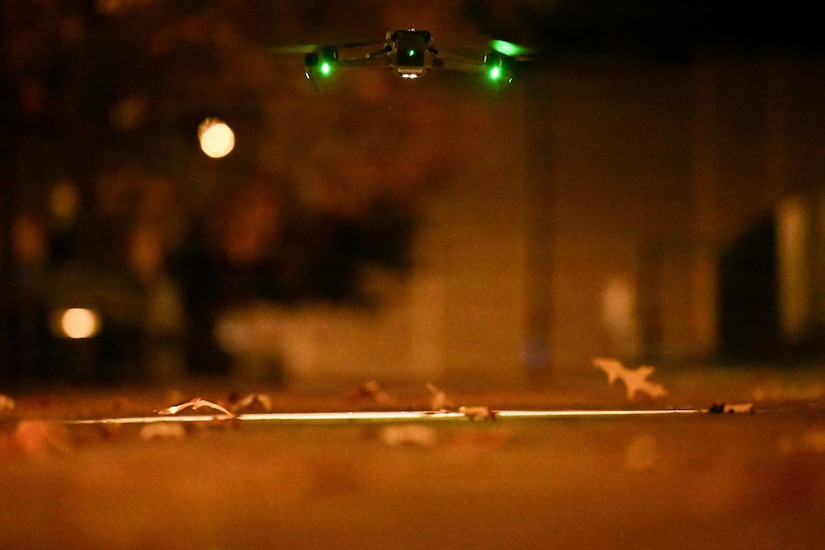
A small drone launches from the ground outside at night.

In response, the War Department is leading a coordinated, whole-of-government effort to strengthen counter-unmanned aircraft systems capabilities in direct support of military forces and state, local, territorial and tribal law enforcement partners.

At the center of this effort is Joint Interagency Task Force 401, a specialized organization established in August to rapidly integrate, test and deliver C-UAS capabilities. The task force's mission and progress in support of local law enforcement were the focus of a law enforcement symposium held at Joint Base Myer–Henderson Hall in Arlington, Virginia, Dec. 11.

The urgency of that partnership is underscored by recent real-world events, during which drones disrupted air travel in Europe.

"Unmanned systems are a defining threat of our time," said Army Brig. Gen. Matt Ross, JIATF-401 director. "They are prolific, they are evolving rapidly, and they are no longer confined to combat zones. Nothing is more important than defending our homeland, our people and the law enforcement professionals who protect them every day." 

The central focus of JIATF 401's mission is supporting state, local, territorial and tribal law enforcement, particularly as the nation prepares to host major international events like the 2026 FIFA World Cup and the 2028 Summer Olympics. This includes enhanced planning, technical integration and assisting with capability delivery to the 11 U.S. cities scheduled to host World Cup matches.
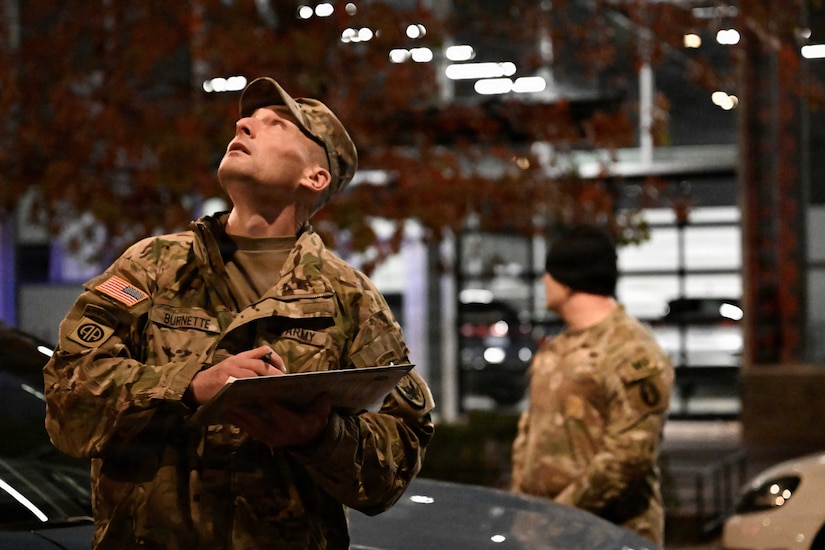
A man in a camouflage military uniform looks up, observing something out of frame while holding a clipboard.

To accelerate this support, the task force is working in close coordination with the Defense Logistics Agency to assist law enforcement agencies and to leverage a Notice of Funding Opportunity from the Federal Emergency Management Agency. The $250 million available is dedicated to counter-UAS and air domain awareness capabilities. Through this partnership, DLA provides contracting expertise, logistics support and scalable procurement pathways to help state, local, territorial and tribal agencies move rapidly to full-fielded capabilities. 

"Our goal is to integrate sensors, effectors and mission command systems into a responsive, interoperable network that protects service members and American citizens alike," Ross said. "By pairing JIATF 401's operational expertise with DLA's logistics and contracting capabilities, we are helping law enforcement turn available grant funding into real, deployable counter-UAS capacity, quickly and responsibly." 

A cornerstone of this effort is the development of a counter-UAS marketplace, a centralized mechanism that allows interagency and law enforcement partners to access DOW test data, operational user feedback and validated procurement options. This approach reduces risk, accelerates fielding timelines and ensures taxpayer resources are applied to proven solutions. 

The symposium also highlighted the need for a shared, integrated air picture across jurisdictions. The Joint Task Force National Capital Region and the Military District of Washington shared their experiences coordinating and executing a counter-drone training exercise, which can serve as a model for municipalities across the country, in Washington, Nov. 17-21.

"We need a common air picture that includes drones," Ross said, citing more than 3,000 drone incursions detected along the southern border in the past year. "That requires integrating data from both classified and unclassified sensors and proliferating active and passive sensing across federal and nonfederal partners. We're not there yet, but we are making measurable progress."

Senior leaders from across the federal and law enforcement enterprises attended the symposium, including Army Secretary Daniel P. Driscoll, and JTF NCR and MDW Commander Army Brig. Gen. Antoinette Gant and Bureau of Alcohol, Tobacco, Firearms and Explosives Deputy Director Robert Cekada.

A man in business attire sits at a long table with people in similar attire.
 

Andrew Giuliani, executive director of the White House FIFA Task Force, also participated to highlight how his team is working with JIATF 401 to assist local law enforcement in cities hosting 2026 World Cup matches — underscoring the depth and breadth of the coalition aligned behind this mission.    

Ross said events like this serve as a clear signal of national resolve. Through sustained partnership with state, local, territorial and tribal law enforcement, deliberate integration with DLA, and disciplined use of FEMA grant funding, DOW is strengthening the nation's ability to secure its airspace and protect the American people today, and in the years ahead.  

"JIATF-401 exists to integrate joint and interagency skills to create the layered counter-drone defense our nation requires," he added. 

Friday, August 21, 2015

Wisconsin addresses response to cyber-attack on power grid


August 21, 2015
Lori Getter
Wisconsin Emergency Management

How would utilities and state agencies respond to a massive blackout or grid failure to hit Wisconsin? That question was discussed at a national energy infrastructure security summit held July 20-22, 2015 in Washington, D.C.

As part of the Electric Infrastructure Security (EIS) Summit VI held at the U.S. Capitol, some of Wisconsin's top utility, emergency management and homeland security officials were invited to discuss Wisconsin's plans to such events. Maj. Gen. Don Dunbar, Wisconsin adjutant general and Wisconsin's Homeland Security Advisor, chaired the panel on opportunities and challenges facing Wisconsin. Joining him were Wisconsin Emergency Management Administrator Brian Satula; Mike Huebsch, commissioner with the Wisconsin Public Service Commission; and David Wojtczak with American Transmission Company (ATC).
               
Dunbar discussed the risks associated with cyber-attacks for the nation and the electrical power grid. In Wisconsin, the state coordinates with the private sector to develop a cyber annex to the Wisconsin Emergency Response Plan.

"State government has a clear responsibility to protect state networks and respond to cyber incidents," Dunbar said. "The Cyber Annex describes essential state requirements and tasks that are a priority in the event of a cyber disruption."

The panel also discussed what would happen during "Black Sky Days," which are defined as extraordinary and hazardous catastrophes in the electric power grid. Those events provide not only incredible challenges for the utility industry, but also for public safety officials.

"In Wisconsin, we have identified in our Threat and Hazard Identification and Risk Assessment (THIRA) two such events that could lead to Black Sky Days," Satula said. "The first would be a cyber-attack on public infrastructure that would result in a downed power grid. The second would be a long-term power outage during the winter. Either would cause incredible challenges such as the need for mass evacuations and sheltering, and loss of other critical infrastructure such as water, fuel, and communications."

Satula said the state has also been working with the private sector on a comprehensive response system that focuses on initial disaster priorities for the first 72 hours of an event. That would include stabilizing and restoring essential infrastructure. He said it is important to have business and private sector integrated in the planning process to ensure they are part of emergency operations centers when a Black Sky or a Gray Sky Day occurs, and that workers have credentials for incident access and involvement in long term recovery operations.

David Wojtczak presented on ATC's work with Wisconsin Emergency Management (WEM) and the Wisconsin National Guard to prepare for Black Sky events.

"The joint cooperation of WEM/Wisconsin National Guard with ATC and other electric utilities sets the stage for better preparedness and synergistic use of emergency resources to assist in restoring the grid,” Wojtczak said. “The meetings we have had to date have been very helpful in identifying ways in which we can work together to protect our citizens and to restore vital services."

As the grid evolves, Huebsch said, it’s crucial for regulators and utility leaders to understand the policy, as well as legal and economic issues associated with protecting and strengthening the grid.

"Wisconsin has taken important steps to protect its resources and facilities in order to ensure reliability," Huebsch said, "and the panel conveyed more about the lessons learned in that process."

The EIS Summit is an international event for senior government and industry officials to review and assess the power grid security around the world. Participants included officials from state and federal agencies, energy and private sector and members of Congress. This year's theme of "whole community collaboration" focused on the ongoing coordination between utilities and government partners for emergency support and response.

Friday, September 14, 2012

Dulles CBP Global Entry Surpasses 250,000 User Sessions


Trusted Travelers Can Apply for Membership at GlobalEntry.gov

Sterling, Va. – Global Entry, a U.S. Customs and Border Protection (CBP) initiative to speed pre-approved trusted travelers through international arrivals processing, surpassed 250,000 user sessions at Washington Dulles International Airport Sunday.

Washington Dulles International Airport, where Global Entry launched on June 6, 2008, ranks seventh nationally in user sessions.

The program, popular with the international travel community, continues to grow in membership. More than 414,000 members have enrolled in Global Entry. Another 750,000 travelers enjoy the expedited processing benefits of Global Entry through other trusted traveler programs such as NEXUS (Northern border) and SENTRI (Southern border). Interested travelers can learn more about Global Entry membership.

“Global Entry works. It has proven to be a winner for frequent, low-risk international travelers, such as business professionals, travel industry representatives, U.S. diplomats and airline employees,” said Christopher Hess, CBP Port Director for the Port of Washington (DC). “Global Entry at Washington Dulles International Airport continues to set significant milestones in user sessions and continues as one of our nation’s pace setters for trusted traveler processing,” said Hess.

Global Entry members also automatically qualify for participation in the TSA Pre™ expedited passenger screening program for domestic travel.

Washington Dulles, with its 250,918 Global Entry user sessions, ranks behind New York’s John F. Kennedy International Airport, Houston’s George Bush Intercontinental Airport, Newark (N.J.) Liberty International Airport, Miami International Airport, Hartsfield-Jackson Atlanta International Airport and Chicago O’Hare International Airport.

Trusted travelers with Global Entry benefits have processed their international arrivals a combined 2,959,578 times at self-help kiosks located in 37 airports in the United States and at pre-clearance stations overseas.

The most significant benefit to Global Entry is time saved waiting in primary inspection lines. Average processing time for Global Entry members is about one minute. Wait times for passengers without trusted traveler memberships can be lengthy during peak arrival times. View your local airport wait times on CBP.gov.

Participation in Global Entry is voluntary. Participants must possess a machine-readable U.S. passport or permanent resident card, pay a non-refundable $100 application fee, submit an online application, pass a law enforcement check, and complete an interview at a CBP enrollment center.

Washington Dulles was one of three original airports to deploy Global Entry in June 2008; JFK and Houston Intercontinental were the others. More than 3.2 million international travelers arrived to Washington Dulles during 2011.

For more information on other CBP Trusted Traveler opportunities, please visit CBP.gov.

U.S. Customs and Border Protection is the unified border agency within the Department of Homeland Security charged with the management, control and protection of our nation's borders at and between the official ports of entry. CBP is charged with keeping terrorists and terrorist weapons out of the country while enforcing hundreds of U.S. laws.

Sunday, August 12, 2012

CBP Detroit Donates Seized Fossils to University of Michigan


Detroit – U.S. Customs and Border Protection in the Port of Detroit announced the donation of hundreds of seized pre-historic fossils to the University of Michigan.

Some of the seized fossils donated by U.S. Customs and Border Protection to the University of Michigan.

A CBP officer working at a primary lane of the Ambassador Bridge on March 28, 2011, encountered two Canadian citizens who claimed they were attending a fossil trade show in Illinois. The two travelers had several boxes containing over 1,100 fossils.

Secondary inspection revealed that the fossils were actually for sale and the individuals did not properly declare their goods. The fossils were seized after a lengthy forfeiture process, which afforded the individuals the opportunity to pay associated penalties, however the violators did not respond to CBP efforts to assist them in reclaiming their property.

“This interception is an excellent example of CBP’s commitment at our ports of entry to the surrounding community,” said Roderick Blanchard, Detroit port director. “CBP not only stopped the illegal entry, but was able to contribute to the University of Michigan. This seizure highlights the diversity of the CBP mission.”

This donated fossils will be used for research and/or teaching by the University of Michigan Paleontology Department, which maintains a repository for fossil specimens.

U.S. Customs and Border Protection (CBP) is the unified border agency within the Department of Homeland Security charged with the management, control, and protection of our Nation's borders at and between the official ports of entry. CBP is charged with keeping terrorists and terrorist weapons out of the country while enforcing hundreds of U.S. laws.

Tuesday, July 17, 2012

CBP Launches Border Radio Pilot


AM Radio System Installed to Inform Land Border Crossers

Washington– U.S. Customs and Border Protection today announced the installation of a pilot AM radio broadcast system, aimed to better inform the border crossing public. CBP has installed AM radio frequency transmitters at two ports of entry on the southwest border, Ysleta in El Paso, Texas and Lincoln-Juarez in Laredo, Texas in order to communicate important border crossing information to travelers.

CBP has transformed the way it does business at land ports of entry over the last few years and one of the key elements is the concept of active lane management. This concept allows infrastructure enhancements such as improved license plate readers and radio frequency identification (RFID) technology coupled with new Ready Lanes, light emitting diode (LED) signage and Trusted Traveler lanes (NEXUS, SENTRI, FAST) to facilitate the entry process for travelers.

Furthering this concept CBP believes an informed and educated traveler is an efficient traveler.

CBP is always looking for new and effective ways to communicate with the traveling public and the model of the AM transmitter, used by many highway and traffic authorities, hopes to prove an effective tool for CBP.

Information broadcast will include reminders of document requirements and how to use high-tech travel cards, information about CBP’s Trusted Traveler Programs, basic border crossing rules and regulations, and will allow the ability for each port of entry to update with emergency travel information or updates.

While in a pilot phase, CBP will monitor the effectiveness of this new tool in a few locations on the northern and southern borders. Analysis of the pilot will inform further system installations and messaging.

U.S. Customs and Border Protection is the unified border agency within the Department of Homeland Security charged with the management, control and protection of our nation's borders at and between the official ports of entry. CBP is charged with keeping terrorists and terrorist weapons out of the country while enforcing hundreds of U.S. laws.

Friday, July 6, 2012

A World Free of one of the Most Virulent Animal Diseases?


The Departments of Homeland Security and Agriculture have developed a novel vaccine for one of the seven strains of the dreaded foot-and-mouth disease, paving the way for the development of the others.

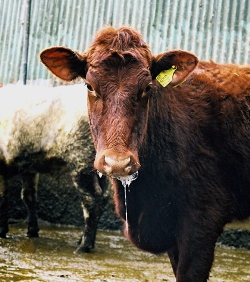
One of the most economically devastating diseases in the world for those who raise cows, sheep, pigs, goats, deer and other cloven-hoofed animals is foot-and-mouth disease (FMD). This incredibly contagious and fast-spreading disease causes fever, blisters on the feet and mouth (hence the name), loss of appetite, drooling, and lameness. Most herds affected are culled, as in the case of the 2001 outbreak in Great Britain when over 10 million animals had to be destroyed.

Traditional vaccines for FMD typically have three problems: first, there are so many different strains of the FMD virus that you must have a very well-matched vaccine to have any effect; second, traditional vaccines contain live FMD virus so they cannot be produced in the United States, and; third, depending on a vaccine's quality, it can be nearly impossible to determine whether an animal is actually infected, or has simply been exposed to the vaccine. Unless one can differentiate between vaccinated and infected animals, those animals vaccinated outside the U.S. with the traditional vaccine would be prohibited from entering any country that is designated FMD free. The United States has been FMD-free since 1929, but that is no guarantee that the disease will not strike again, as the UK learned in 2001after being FMD-free for 34 years.

Now, at the Department of Homeland Security Science and Technology Directorate's high-containment Plum Island Animal Disease Center (PIADC), located off the tip of Long Island, N.Y., scientists have produced a molecular vaccine against one strain of FMD, that 1) does not use a live FMD virus for vaccine manufacture, and, 2) can be used to differentiate an infected from inoculated animal using common diagnostic tests.

"This is the biggest news in FMD research in the last 50 years," says PIADC Director Dr. Larry Barrett. "It's the first licensed FMD vaccine that can be manufactured on the U.S. mainland, and it supports a vaccinate-to-live strategy in FMD outbreak response."

The new FMD vaccine, originally discovered by Dr. Marvin Grubman in the USDA Agricultural Research Service at PIADC, took seven years to develop and license. Dr. Bruce Harper, Director of Science at PIADC and the manager over PIADC's Targeted Advanced Development Branch, led the development team, who worked with industry partners GenVec Inc., a biopharmaceutical company in Gaithersburg, Maryland, and Antelope Valley Biologics, a Benchmark Biolabs affiliate in Lincoln, Nebraska.

The FMD viral structure includes genetic material surrounded by a coat of proteins called a capsid. The new vaccine produces only the virus coat particles, which form empty viral capsids, and not the entire genome of the virus; thus it lacks the infectious viral nucleic acids. When the vaccine is injected into the animal the resulting empty viral capsids trigger a protective immune response.

"The absence of the nucleic acids of the real virus allows us to differentiate between vaccinated and infected animals," said Grubman. "This is critical when determining that an animal is free of infection after an FMD outbreak. Now it will no longer be necessary to destroy all the animals in a herd when just a few become infected."

The development of the vaccine was a team effort that required new scientific discoveries in order to work properly. Dr. John Neilan, the Branch Chief of the DHS Targeted Advanced Development Branch at PIADC, developed a way to address the immune response to the vaccine, which made it possible to achieve the level of effectiveness required for a USDA license. The vaccine has been granted conditional license for use in cattle by the USDA Animal and Plant Health Inspection Service's Center for Veterinary Biologics. Under the conditional license, the product may be distributed should the need for it arise, as authorized by federal emergency management officials within USDA. APHIS issued the conditional license to Antelope Valley Bios, Inc., who manufactured the vaccine under a contract from GenVec.

The FMD virus, noted since at least the 16th century, survives in lymph nodes and bone marrow. Large amounts of the virus are found in all body secretions and excretions and every time an infected animal breathes out it releases large amounts of infectious virus, exposing other animals. FMD virus can survive on the ground for extended periods, and can be carried in contaminated feed, manure, on the tires of vehicles and on the shoes and clothes of people. It has been documented to spread by being carried with the wind over long distances. The most common route of introduction of FMD into a country has been through feeding contaminated meat product scraps to pigs, as was the case in the devastating 2001 outbreak in the United Kingdom.

There are seven known serotypes and more than 60 subtypes of the FMD virus, and there is no universal vaccine against the disease. Potential cost of an FMD outbreak in United States could exceed $50 billion. FMD is present today in Africa, the Middle East, Asia, and parts of South America.

PIADC has entered into a cooperative research and development agreement with an industry partner, Merial, to evaluate the FMD vaccine production process. S&T is also funding efforts to develop vaccines against other foreign animal disease threats such as classical swine fever, African swine fever, and Rift Valley fever.

"Our work isn’t over yet," says S&T's Agricultural Defense Branch Chief Michelle Colby. "This vaccine protects against just one strain of FMD, so this is just the tip of a growing iceberg. DHS has several vaccines for other FMD serotypes ready to enter the licensure process."