Showing posts with label north carolina state university. Show all posts

Tuesday, August 14, 2012

Universities Go to Space: NASA Announces Early Career Faculty Space Tech Research Grants


David E. Steitz
Headquarters, Washington
202-358-1730
david.steitz@nasa.gov

WASHINGTON -- NASA has announced the selection of 10 research efforts from the agency's inaugural Space Technology Research Opportunities for Early Career Faculty solicitation. NASA will provide grants of as much as $200,000 per year for as long as three years in support of these faculty and their research in specific, high-priority technology areas.

The selected faculty will conduct research in areas closely aligned with NASA's Space Technology Roadmaps and priorities identified by the National Research Council. These priorities include extending and sustaining human activities beyond low Earth orbit, exploring the evolution of the solar system and potential for life elsewhere, and expanding our understanding of Earth and the universe.

"It's an honor to announce this outstanding group of early career faculty researchers, representing some of the most talented new faculty from the best institutions of higher learning in America," said Michael Gazarik, director of NASA's Space Technology Program at NASA Headquarters in Washington. "NASA will benefit from the work these faculty researchers conduct in unique, disruptive or transformational space technologies or concepts, while strengthening America's continued global leadership in the new technology economy."

The selected Early Career Faculty researchers are:

--Chih-Hao Chang, North Carolina State University, Raleigh
--Nicolaus Correll, University of Colorado at Boulder
--Julia Greer, California Institute of Technology, Pasadena
--Mary Lind, Arizona State University, Tempe
--Michele Manuel, University of Florida, Gainesville
--Jeremy Munday, University of Maryland, College Park
--Marco Pavone, Stanford University, Stanford, Calif.
--Mina Raies-Zadeh, University of Michigan, Ann Arbor
--Debbie Senesky, Stanford University
--Wei-Chuan Shih, University of Houston

Newly-selected early career efforts will develop technologies to automate the production of food in space and investigate and test advanced wastewater recovery technologies. These efforts also will look to develop robust timekeeping technologies that enable more precise landing and autonomous rendezvous in space, and formulate new ultra-lightweight materials with properties that can be tailored.

NASA's Early Career Faculty efforts are an element of the agency's Space Technology Research Grants Program. It is designed to accelerate the development of technologies originating from academia that support the future science and exploration needs of NASA, other government agencies and the commercial space sector.

For more information about NASA's Space Technology Grants Program, and a listing of the titles of the selected research topics, visit http://go.usa.gov/P31.

The Space Technology Research Grants Program is a part of NASA's Space Technology Program, dedicated to innovating, developing, testing, and flying hardware for use in NASA's future science and exploration missions. NASA's technology investments provide cutting-edge solutions for our nation's future.

For more information about the Space Technology Program and the crosscutting space technology areas of interest to NASA, visit http://www.nasa.gov/oct.

- end -

Thursday, May 24, 2012

Better Drug Delivery With New Smart Inhaler (Images 1 and 2)


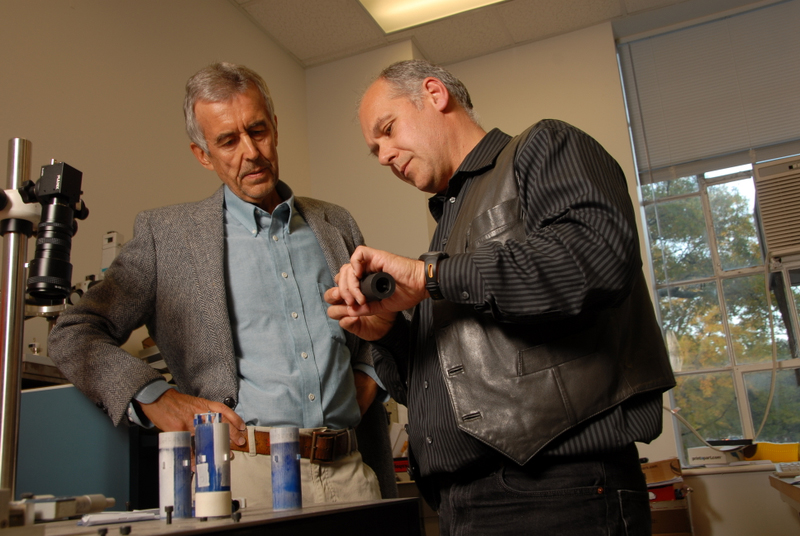
Professors Clement Kleinstreuer (left) and Stefan Seelecke of the College of Engineering at North Carolina State University examine parts of a smart inhaler system they developed that could improve treatment of diseases by targeting drugs onto diseased tissue without affecting healthy areas of the throat and lungs. The system could be a breakthrough for patients suffering from lung cancer, asthma, diabetes and other ailments.

This computer controlled inhaler system implements a technology that for the first time, tightly controls where inhaled drugs end up in the respiratory system. Developed by engineers at North Carolina State University, the system could improve treatment of diseases by targeting drugs onto diseased tissue without affecting healthy areas of the throat and lungs--a breakthrough for patients suffering from lung cancer, asthma, diabetes and other ailments.

To read more about this discovery, see the NC State news story New Inhaler System Could Be Breakthrough for Disease Treatment. (Date of Images: 2008-09)

Credit: Roger Winstead, North Carolina State University

Friday, March 30, 2012

Genetic Patchworks


Each point in these colorful patchworks represents the correlation between two sleep-associated genes in fruit flies (Drosophila). Vibrant reds and oranges represent high and intermediate degrees of association between the genes, respectively. Genes in these areas show similar activity patterns in different fly lines. Cool blues represent gene pairs where one partner's activity is high and the other's is low. The green areas show pairs with activities that are not correlated. These quilt-like depictions help illustrate a recent finding that genes act in teams to influence sleep patterns.

The research was performed by Trudy Mackay, a geneticist at North Carolina State University who is studying the sleep patterns of fruit flies, and Susan Harbison, a postdoc in Mackay's lab. To learn more about this research, see the National Institutes of Health news release, Gene Teams Help Govern Sleep Patterns. (Date of Image: 2009)

Credit: Trudy Mackay, Department of Genetics, North Carolina State University. Harbison, S. T., Carbone, M. A., Ayroles, J. F., Stone, E. A., Lyman, R. F. & Mackay, T. F. C. 2009. Co-regulated transcriptional networks contribute to natural genetic variation in Drosophila sleep. Nat. Genet. 41: 371-375. PMCID: PMC2683981.

Tuesday, December 20, 2011

NSF Day at North Carolina State University

Raleigh, NC
 
February 28, 2012 7:30 AM  to
February 28, 2012 4:30 PM
McKimmon Conference and Training Center
 
The National Science Foundation and North Carolina State University will be holding a one-day workshop on Tuesday, February 28, 2012. This workshop is primarily designed for researchers and educators less experienced in proposing to NSF; however, more experienced proposers and NSF grantees may well find the workshop useful and informative. It is our hope that events such as this will stimulate new interest in NSF programs at institutions that have not been among our traditional customers, as well as at premier research institutions.
 
We want to extend an invitation to you and to anyone else at your institution who would like to attend this workshop and learn more about the NSF and its programs.
 
The workshop will provide an overview of the Foundation, its mission, priorities, and budget. It will cover the NSF proposal and merit review process and NSF programs that cut across disciplines. Additionally, representatives from the seven NSF directorates and the Office of International Science and Engineering and the Office of Integrative Activities will make presentations on their programs and will also be available informally and in breakout sessions for discussions of potential research proposals.
 
The workshop will be held at the NC State University's McKimmon Conference and Training Center, Raleigh, NC. There is a registration fee of $40 for the NSF Day workshop and preregistration is required. You can register on the NC State web site using the link below. Please register by Friday, February 17, 2012. Registration is limited, so please register early.
 
Meeting Type
Outreach
 
Contacts
 George M. Wilson, (703) 292-7733 gwilson@nsf.gov
        Preferred Contact Method: Email
 Barbara E. Smith, (919) 515-3639 besmith@ncsu.edu
        Preferred Contact Method: Email

Monday, October 24, 2011

NASA Telescopes Help Solve Ancient Supernova Mystery

Trent J. Perrotto
Headquarters, Washington

Whitney Clavin
Jet Propulsion Laboratory, Pasadena, Calif.

WASHINGTON -- A mystery that began nearly 2,000 years ago, when Chinese astronomers witnessed what would turn out to be an exploding star in the sky, has been solved. New infrared observations from NASA's Spitzer Space Telescope and Wide-field Infrared Survey Explorer, or WISE, reveal how the first supernova ever recorded occurred and how its shattered remains ultimately spread out to great distances.

The findings show that the stellar explosion took place in a hollowed-out cavity, allowing material expelled by the star to travel much faster and farther than it would have otherwise.

"This supernova remnant got really big, really fast," said Brian J. Williams, an astronomer at North Carolina State University in Raleigh. Williams is lead author of a new study detailing the findings online in the Astrophysical Journal. "It's two to three times bigger than we would expect for a supernova that was witnessed exploding nearly 2,000 years ago. Now, we've been able to finally pinpoint the cause."

A new image of the supernova, known as RCW 86, is online at http://go.nasa.gov/pnv6Oy.

In 185 A.D., Chinese astronomers noted a "guest star" that mysteriously appeared in the sky and stayed for about 8 months. By the 1960s, scientists had determined that the mysterious object was the first documented supernova. Later, they pinpointed RCW 86 as a supernova remnant located about 8,000 light-years away. But a puzzle persisted. The star's spherical remains are larger than expected. If they could be seen in the sky today in infrared light, they'd take up more space than our full moon.

The solution arrived through new infrared observations made with Spitzer and WISE, and previous data from NASA's Chandra X-ray Observatory and the European Space Agency's XMM-Newton Observatory.

The findings reveal that the event is a "Type Ia" supernova, created by the relatively peaceful death of a star like our sun, which then shrank into a dense star called a white dwarf. The white dwarf is thought to have later blown up in a supernova after siphoning matter, or fuel, from a nearby star.

"A white dwarf is like a smoking cinder from a burnt-out fire," Williams said. "If you pour gasoline on it, it will explode."

The observations also show for the first time that a white dwarf can create a cavity around it before blowing up in a Type Ia event. A cavity would explain why the remains of RCW 86 are so big. When the explosion occurred, the ejected material would have traveled unimpeded by gas and dust and spread out quickly.

Spitzer and WISE allowed the team to measure the temperature of the dust making up the RCW 86 remnant at about minus 325 degrees Fahrenheit, or minus 200 degrees Celsius. They then calculated how much gas must be present within the remnant to heat the dust to those temperatures. The results point to a low-density environment for much of the life of the remnant, essentially a cavity.

Scientists initially suspected that RCW 86 was the result of a core-collapse supernova, the most powerful type of stellar blast. They had seen hints of a cavity around the remnant, and, at that time, such cavities were only associated with core-collapse supernovae. In those events, massive stars blow material away from them before they blow up, carving out holes around them.

But other evidence argued against a core-collapse supernova. X-ray data from Chandra and XMM-Newton indicated that the object consisted of high amounts of iron, a telltale sign of a Type Ia blast. Together with the infrared observations, a picture of a Type Ia explosion into a cavity emerged.

"Modern astronomers unveiled one secret of a two-millennia-old cosmic mystery only to reveal another," said Bill Danchi, Spitzer and WISE program scientist at NASA Headquarters in Washington. "Now, with multiple observatories extending our senses in space, we can fully appreciate the remarkable physics behind this star's death throes, yet still be as in awe of the cosmos as the ancient astronomers."

For more information about Spitzer, visit http://www.nasa.gov/spitzer.

For more information about WISE, visit http://www.nasa.gov/wise.

- end -