Showing posts with label university of california irvine. Show all posts

Friday, December 2, 2011

Study of Yellowstone Wolves Improves Ability to Predict Their Responses to Environmental Changes

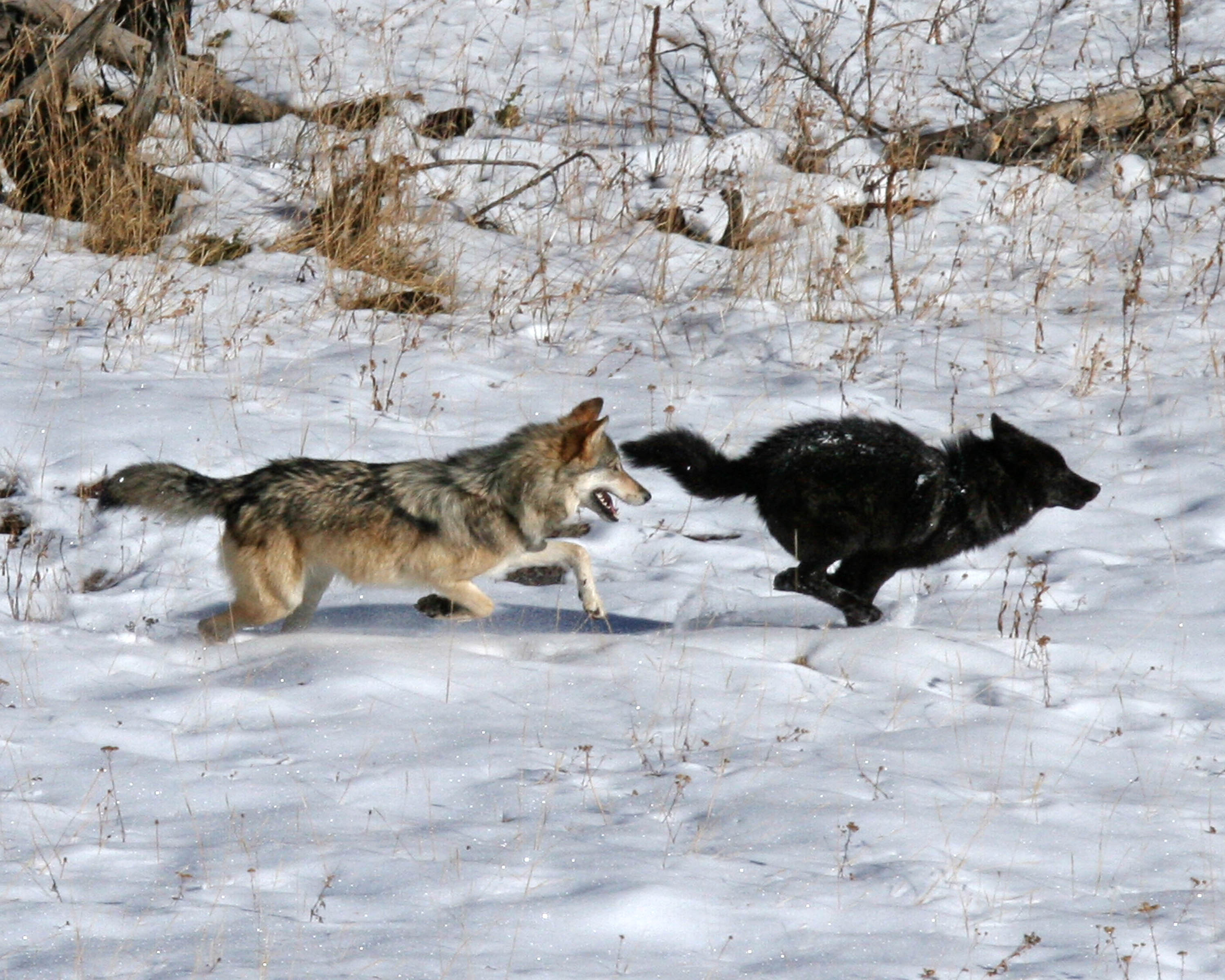
A study of the wolves of Yellowstone National Park recently improved predictions of how these animals will respond to environmental changes.

The study, which was partially funded by the National Science Foundation, appears in the Dec. 2, 2011 issue of Science.

Part of the Yellowstone Wolf Project, researchers tracked changes in various characteristics of wolves living in the  national park between 1998 and 2009. They found some tracked characteristics--such as population size--are related to population ecology, while other tracked characteristics--such as coat color--are genetically determined through evolution.

The project also involved using a new model to compare data collected on Yellowstone wolf characteristics to environmental conditions through the years covered by the study. Researchers defined conditions in the park during each year of the study along a continuum from "good years" to "bad years"--with good years more favorable to wolf survival than bad years.

Tim Coulson of Imperial College London, the study's lead author, explains, "The novelty of the new model is that it looks at how the frequencies of changes in environmental conditions along the 'good to bad' year continuum simultaneously impact many wolf characteristics."

Study results indicate:

•Environmental changes will inevitably generate simultaneous ecological and evolutionary responses in the Yellowstone wolves.
•Changes in mean environment conditions will impact the size of the Yellowstone wolf population more than will changes in the variability of environmental conditions.
•A single environmental change may impact various wolf characteristics differently, depending on which particular aspects of wolf biology it impacts.

Researchers say to understand their conclusions, suppose environmental conditions in a "good year" helped increase the population size of Yellowstone wolves by increasing their survival rates. Also, suppose that a grey coat color would confer a survival advantage to wolves. Then, under those particular "good" conditions, an increase in the size of the wolf population would be expected to produce an increase in the prevalence of grey coats among the wolves.

By contrast, suppose that certain environmental conditions in a "good year" helped increase the population size of Yellowstone wolves by increasing the availability of their prey. Because the availability of prey and coat color are not related to one another, under those particular "good" conditions, an increase in the size of the wolf population would not be expected to produce an increase in the prevalence of grey coats among the wolves.

Coulson says increasing the specificity of the model's predictions requires collecting more data on the ecological and evolutionary responses of Yellowstone's wolves to various environmental conditions and on the relationships of these responses to one another.

As part of this effort, the Yellowstone Wolf Project research team currently is studying the differential impacts of various environmental changes on ecological and evolutionary characteristics of Yellowstone wolves during various stages of their life cycles. The team also  is working to identify the types of environmental conditions--such as the sizes of various populations of prey species and the amount and residence time of snow on the ground--that define good, bad and intermediary years for wolves.

The researchers hope once the methods developed through this study are refined, they may be applicable to other types of species, such as insects or crop pests, that live in other types of ecosystems. What's more, Coulson suggests that these methods may ultimately help answer questions about human populations. As just one example, the methods developed through this study might ultimately be used to help predict the impacts of the ongoing obesity epidemic on survival and fertility rates and the resulting influence of those variables on the growth rate of selected human populations.

The National Science Foundation provided funding to all of this paper's co-authors: Daniel R. MacNulty of the University of Minnesota at St Paul, Daniel Stahler of the National Park Service, Bridgett vonHoldt of the University of California at Irvine, Robert K. Wayne of the University of California at Los Angeles and Douglas Smith of the National Park Service.

-NSF-

Thursday, August 18, 2011

NASA Research Leads To First Complete Map Of Antarctic Ice Flow

Steve Cole
Headquarters, Washington
 
Alan Buis
Jet Propulsion Laboratory, Pasadena, Calif.

WASHINGTON -- NASA-funded researchers have created the first complete map of the speed and direction of ice flow in Antarctica. The map, which shows glaciers flowing thousands of miles from the continent's deep interior to its coast, will be critical for tracking future sea-level increases from climate change. The team created the map using integrated radar observations from a consortium of international satellites.

"This is like seeing a map of all the oceans' currents for the first time. It's a game changer for glaciology," said Eric Rignot of NASA's Jet Propulsion Laboratory in Pasadena, Calif., and the University of California (UC), Irvine. Rignot is lead author of a paper about the ice flow published online Thursday in Science Express. "We are seeing amazing flows from the heart of the continent that had never been described before."

Rignot and UC Irvine scientists Jeremie Mouginot and Bernd Scheuchl used billions of data points captured by European, Japanese and Canadian satellites to weed out cloud cover, solar glare and land features masking the glaciers. With the aid of NASA technology, the team painstakingly pieced together the shape and velocity of glacial formations, including the previously uncharted East Antarctica, which comprises 77 percent of the continent.

Like viewing a completed jigsaw puzzle, the scientists were surprised when they stood back and took in the full picture. They discovered a new ridge splitting the 5.4 million-square-mile landmass from east to west.

The team also found unnamed formations moving up to 800 feet annually across immense plains sloping toward the Antarctic Ocean and in a different manner than past models of ice migration.

"The map points out something fundamentally new: that ice moves by slipping along the ground it rests on," said Thomas Wagner, NASA's cryospheric program scientist in Washington. "That's critical knowledge for predicting future sea level rise. It means that if we lose ice at the coasts from the warming ocean, we open the tap to massive amounts of ice in the interior."

The work was conducted in conjunction with the International Polar Year (IPY) (2007-2008). Collaborators worked under the IPY Space Task Group, which included NASA, the European Space Agency (ESA), Canadian Space Agency (CSA), Japan Aerospace Exploration Agency, the Alaska Satellite Facility in Fairbanks, and MacDonald, Dettwiler and Associates of Richmond, British Columbia, Canada. The map builds on partial charts of Antarctic ice flow created by NASA, CSA and ESA using different techniques.

"To our knowledge, this is the first time that a tightly knit collaboration of civilian space agencies has worked together to create such a huge dataset of this type," said Yves Crevier of CSA. "It is a dataset of lasting scientific value in assessing the extent and rate of change in polar regions."

For a video animation of the new Antarctic map, visit http://1.usa.gov/poJq1P.

For more information about NASA and agency programs, visit http://www.nasa.gov.

- end -

Friday, February 18, 2011

Herschel Measures Dark Matter Required for Star-Forming Galaxies

Trent J. Perrotto
Headquarters, Washington                               
 
Whitney Clavin
Jet Propulsion Laboratory, Pasadena, Calif.

WASHINGTON -- The Herschel Space Observatory has revealed how much dark matter it takes to form a new galaxy bursting with stars. Herschel is a European Space Agency cornerstone mission supported with important NASA contributions.

The findings are a key step in understanding how dark matter, an invisible substance permeating our universe, contributed to the birth of massive galaxies in the early universe.

"If you start with too little dark matter, then a developing galaxy would peter out," said astronomer Asantha Cooray of the University of California, Irvine. He is the principal investigator of new research appearing in the journal Nature, online on Feb. 16 and in the Feb. 24 print edition. "If you have too much, then gas doesn't cool efficiently to form one large galaxy, and you end up with lots of smaller galaxies. But if you have the just the right amount of dark matter, then a galaxy bursting with stars will pop out."

This right of amount of dark matter turns out to be a mass equivalent to 300 billion of our suns.

Herschel launched into space in May 2009. The mission's large, 3.5-meter telescope detects longer-wavelength infrared light from a host of objects, ranging from asteroids and planets in our own solar system to faraway galaxies.

"This remarkable discovery shows that early galaxies go through periods of star formation much more vigorous than in our present-day Milky Way," said William Danchi, Herschel program scientist at NASA Headquarters in Washington. "It showcases the importance of infrared astronomy, enabling us to peer behind veils of interstellar dust to see stars in their infancy."

Cooray and colleagues used the telescope to measure infrared light from massive, star-forming galaxies located 10 to 11 billion light-years away. Astronomers think these and other galaxies formed inside clumps of dark matter, similar to chicks incubating in eggs.

Giant clumps of dark matter act like gravitational wells that collect the gas and dust needed for making galaxies. When a mixture of gas and dust falls into a well, it condenses and cools, allowing new stars to form. Eventually enough stars form, and a galaxy is born.

Herschel was able to uncover more about how this galaxy-making process works by mapping the infrared light from collections of very distant, massive star-forming galaxies. This pattern of light, called the cosmic infrared background, is like a web that spreads across the sky. Because Herschel can survey large areas quickly with high resolution, it was able to create the first detailed maps of the cosmic infrared background.

"It turns out that it's much more effective to look at these patterns rather than the individual galaxies," said Jamie Bock of NASA's Jet Propulsion Laboratory in Pasadena, Calif. Bock is the U.S. principal investigator for Herschel's Spectral and Photometric Imaging Receiver instrument used to make the maps. "This is like looking at a picture in a magazine from a reading distance. You don't notice the individual dots, but you see the big picture. Herschel gives us the big picture of these distant galaxies, showing the influence of dark matter."

The maps showed the galaxies are more clustered into groups than previously believed. The amount of galaxy clustering depends on the amount of dark matter. After a series of complicated numerical simulations, the astronomers were able to determine exactly how much dark matter is needed to form a single star-forming galaxy.

"This measurement is important, because we are homing in on the very basic ingredients in galaxy formation," said Alexandre Amblard, also of UC Irvine, first author of the Nature paper. "In this case, the ingredient, dark matter, happens to be an exotic substance that we still have much to learn about."

NASA's Herschel Project Office is based at JPL, which contributed mission-enabling technology for two of Herschel's three science instruments. The NASA Herschel Science Center, part of the Infrared Processing and Analysis Center at the California Institute of Technology in Pasadena, supports the U.S. astronomical community.

For more information about Herschel, visit http://www.nasa.gov/herschel and http://www.esa.int/herschel.

- end -

Wednesday, February 16, 2011

Herschel Measures Dark Matter Required for Star-Forming Galaxies

Trent J. Perrotto
Headquarters, Washington                               
 
Whitney Clavin
Jet Propulsion Laboratory, Pasadena, Calif.

WASHINGTON -- The Herschel Space Observatory has revealed how much dark matter it takes to form a new galaxy bursting with stars. Herschel is a European Space Agency cornerstone mission supported with important NASA contributions.

The findings are a key step in understanding how dark matter, an invisible substance permeating our universe, contributed to the birth of massive galaxies in the early universe.

"If you start with too little dark matter, then a developing galaxy would peter out," said astronomer Asantha Cooray of the University of California, Irvine. He is the principal investigator of new research appearing in the journal Nature, online on Feb. 16 and in the Feb. 24 print edition. "If you have too much, then gas doesn't cool efficiently to form one large galaxy, and you end up with lots of smaller galaxies. But if you have the just the right amount of dark matter, then a galaxy bursting with stars will pop out."

This right of amount of dark matter turns out to be a mass equivalent to 300 billion of our suns.

Herschel launched into space in May 2009. The mission's large, 3.5-meter telescope detects longer-wavelength infrared light from a host of objects, ranging from asteroids and planets in our own solar system to faraway galaxies.

"This remarkable discovery shows that early galaxies go through periods of star formation much more vigorous than in our present-day Milky Way," said William Danchi, Herschel program scientist at NASA Headquarters in Washington. "It showcases the importance of infrared astronomy, enabling us to peer behind veils of interstellar dust to see stars in their infancy."

Cooray and colleagues used the telescope to measure infrared light from massive, star-forming galaxies located 10 to 11 billion light-years away. Astronomers think these and other galaxies formed inside clumps of dark matter, similar to chicks incubating in eggs.

Giant clumps of dark matter act like gravitational wells that collect the gas and dust needed for making galaxies. When a mixture of gas and dust falls into a well, it condenses and cools, allowing new stars to form. Eventually enough stars form, and a galaxy is born.

Herschel was able to uncover more about how this galaxy-making process works by mapping the infrared light from collections of very distant, massive star-forming galaxies. This pattern of light, called the cosmic infrared background, is like a web that spreads across the sky. Because Herschel can survey large areas quickly with high resolution, it was able to create the first detailed maps of the cosmic infrared background.

"It turns out that it's much more effective to look at these patterns rather than the individual galaxies," said Jamie Bock of NASA's Jet Propulsion Laboratory in Pasadena, Calif. Bock is the U.S. principal investigator for Herschel's Spectral and Photometric Imaging Receiver instrument used to make the maps. "This is like looking at a picture in a magazine from a reading distance. You don't notice the individual dots, but you see the big picture. Herschel gives us the big picture of these distant galaxies, showing the influence of dark matter."

The maps showed the galaxies are more clustered into groups than previously believed. The amount of galaxy clustering depends on the amount of dark matter. After a series of complicated numerical simulations, the astronomers were able to determine exactly how much dark matter is needed to form a single star-forming galaxy.

"This measurement is important, because we are homing in on the very basic ingredients in galaxy formation," said Alexandre Amblard, also of UC Irvine, first author of the Nature paper. "In this case, the ingredient, dark matter, happens to be an exotic substance that we still have much to learn about."

NASA's Herschel Project Office is based at JPL, which contributed mission-enabling technology for two of Herschel's three science instruments. The NASA Herschel Science Center, part of the Infrared Processing and Analysis Center at the California Institute of Technology in Pasadena, supports the U.S. astronomical community.

For more information about Herschel, visit http://www.nasa.gov/herschel and http://www.esa.int/herschel.

- end -