Showing posts with label ucla. Show all posts

Thursday, March 15, 2012

NASA Releases New WISE Mission Catalog Of Entire Infrared Sky


J.D. Harrington
Headquarters, Washington                               
 
Whitney Clavin
Jet Propulsion Laboratory, Pasadena, Calif.

WASHINGTON -- NASA unveiled a new atlas and catalog of the entire infrared sky today showing more than a half billion stars, galaxies and other objects captured by the Wide-field Infrared Survey Explorer (WISE) mission.

"Today, WISE delivers the fruit of 14 years of effort to the astronomical community," said Edward Wright, WISE principal investigator at UCLA, who first began working on the mission with other team members in 1998.

WISE launched Dec. 14, 2009, and mapped the entire sky in 2010 with vastly better sensitivity than its predecessors. It collected more than 2.7 million images taken at four infrared wavelengths of light, capturing everything from nearby asteroids to distant galaxies. Since then, the team has been processing more than 15 trillion bytes of returned data. A preliminary release of WISE data, covering the first half of the sky surveyed, was made last April.

The WISE catalog of the entire sky meets the mission's fundamental objective. The individual WISE exposures have been combined into an atlas of more than 18,000 images covering the sky and a catalog listing the infrared properties of more than 560 million individual objects found in the images. Most of the objects are stars and galaxies, with roughly equal numbers of each. Many of them have never been seen before.

WISE observations have led to numerous discoveries, including the elusive, coolest class of stars. Astronomers hunted for these failed stars, called "Y-dwarfs," for more than a decade. Because they have been cooling since their formation, they don't shine in visible light and could not be spotted until WISE mapped the sky with its infrared vision.

WISE also took a poll of near-Earth asteroids, finding there are significantly fewer mid-size objects than previously thought. It also determined NASA has found more than 90 percent of the largest near-Earth asteroids.

Other discoveries were unexpected. WISE found the first known "Trojan" asteroid to share the same orbital path around the sun as Earth. One of the images released today shows a surprising view of an "echo" of infrared light surrounding an exploded star. The echo was etched in the clouds of gas and dust when the flash of light from the supernova explosion heated surrounding clouds. At least 100 papers on the results from the WISE survey already have been published. More discoveries are expected now that astronomers have access to the whole sky as seen by the spacecraft.

"With the release of the all-sky catalog and atlas, WISE joins the pantheon of great sky surveys that have led to many remarkable discoveries about the universe," said Roc Cutri, who leads the WISE data processing and archiving effort at the Infrared and Processing Analysis Center at the California Institute of Technology in Pasadena. "It will be exciting and rewarding to see the innovative ways the science and educational communities will use WISE in their studies now that they have the data at their fingertips."

NASA's Jet Propulsion Laboratory (JPL) in Pasadena, Calif., manages and operates WISE for NASA's Science Mission Directorate in Washington. The mission was competitively selected under NASA's Explorers Program, which is managed by NASA's Goddard Space Flight Center in Greenbelt, Md. The science instrument was built by the Space Dynamics Laboratory in Logan, Utah, and the spacecraft was built by Ball Aerospace and Technologies Corp., in Boulder, Colo. Science operations, data processing and archiving take place at the Infrared Processing and Analysis Center at the California Institute of Technology in Pasadena. Caltech manages JPL for NASA.

For a collection of WISE images released to date, visit http://wise.ssl.berkeley.edu/gallery_images.html.

An introduction and quick guide to accessing the WISE all-sky archive for astronomers is online at http://wise2.ipac.caltech.edu/docs/release/allsky/.

For more information about WISE, visit http://www.nasa.gov/wise.

- end -

Friday, December 2, 2011

Study of Yellowstone Wolves Improves Ability to Predict Their Responses to Environmental Changes

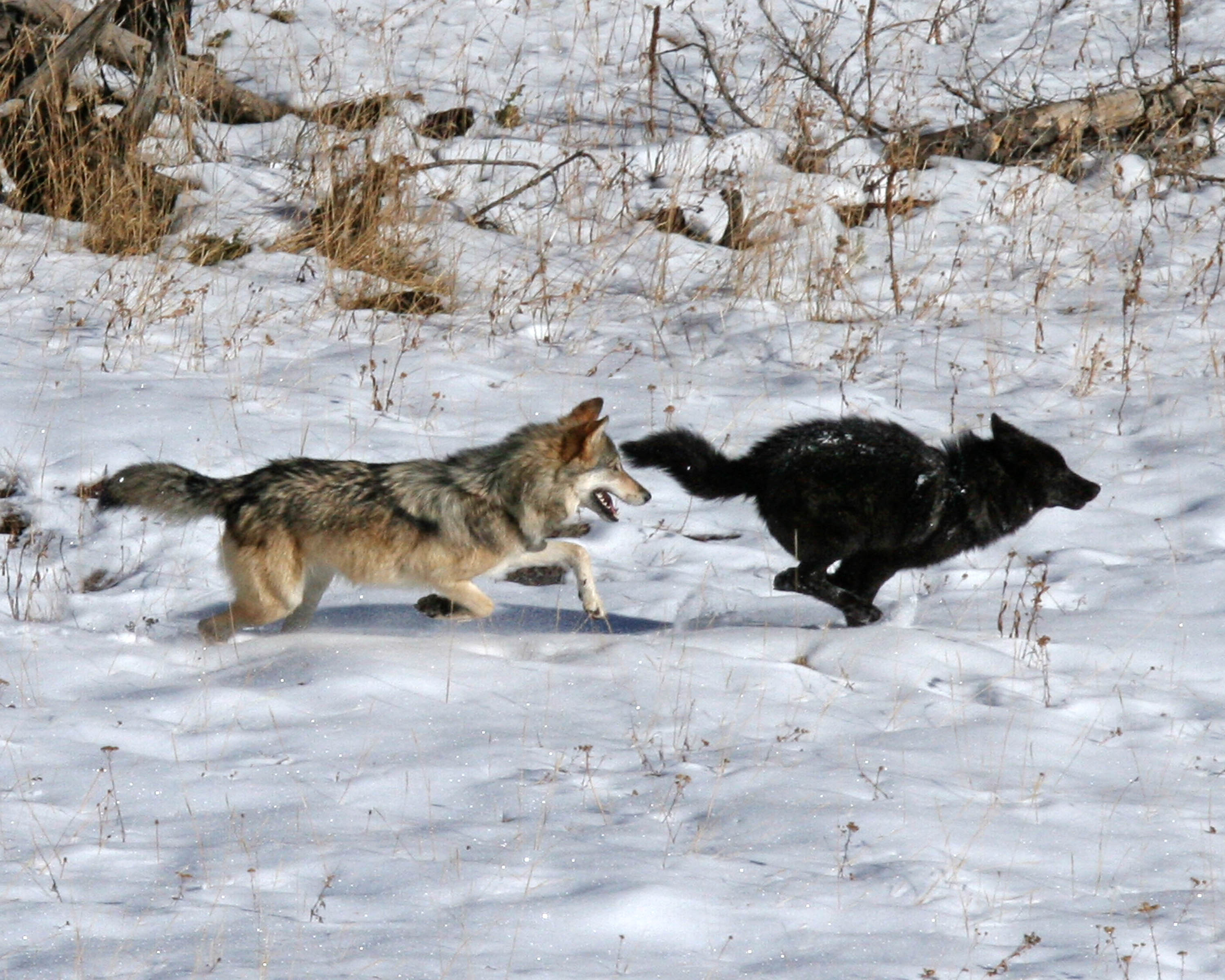
A study of the wolves of Yellowstone National Park recently improved predictions of how these animals will respond to environmental changes.

The study, which was partially funded by the National Science Foundation, appears in the Dec. 2, 2011 issue of Science.

Part of the Yellowstone Wolf Project, researchers tracked changes in various characteristics of wolves living in the  national park between 1998 and 2009. They found some tracked characteristics--such as population size--are related to population ecology, while other tracked characteristics--such as coat color--are genetically determined through evolution.

The project also involved using a new model to compare data collected on Yellowstone wolf characteristics to environmental conditions through the years covered by the study. Researchers defined conditions in the park during each year of the study along a continuum from "good years" to "bad years"--with good years more favorable to wolf survival than bad years.

Tim Coulson of Imperial College London, the study's lead author, explains, "The novelty of the new model is that it looks at how the frequencies of changes in environmental conditions along the 'good to bad' year continuum simultaneously impact many wolf characteristics."

Study results indicate:

•Environmental changes will inevitably generate simultaneous ecological and evolutionary responses in the Yellowstone wolves.
•Changes in mean environment conditions will impact the size of the Yellowstone wolf population more than will changes in the variability of environmental conditions.
•A single environmental change may impact various wolf characteristics differently, depending on which particular aspects of wolf biology it impacts.

Researchers say to understand their conclusions, suppose environmental conditions in a "good year" helped increase the population size of Yellowstone wolves by increasing their survival rates. Also, suppose that a grey coat color would confer a survival advantage to wolves. Then, under those particular "good" conditions, an increase in the size of the wolf population would be expected to produce an increase in the prevalence of grey coats among the wolves.

By contrast, suppose that certain environmental conditions in a "good year" helped increase the population size of Yellowstone wolves by increasing the availability of their prey. Because the availability of prey and coat color are not related to one another, under those particular "good" conditions, an increase in the size of the wolf population would not be expected to produce an increase in the prevalence of grey coats among the wolves.

Coulson says increasing the specificity of the model's predictions requires collecting more data on the ecological and evolutionary responses of Yellowstone's wolves to various environmental conditions and on the relationships of these responses to one another.

As part of this effort, the Yellowstone Wolf Project research team currently is studying the differential impacts of various environmental changes on ecological and evolutionary characteristics of Yellowstone wolves during various stages of their life cycles. The team also  is working to identify the types of environmental conditions--such as the sizes of various populations of prey species and the amount and residence time of snow on the ground--that define good, bad and intermediary years for wolves.

The researchers hope once the methods developed through this study are refined, they may be applicable to other types of species, such as insects or crop pests, that live in other types of ecosystems. What's more, Coulson suggests that these methods may ultimately help answer questions about human populations. As just one example, the methods developed through this study might ultimately be used to help predict the impacts of the ongoing obesity epidemic on survival and fertility rates and the resulting influence of those variables on the growth rate of selected human populations.

The National Science Foundation provided funding to all of this paper's co-authors: Daniel R. MacNulty of the University of Minnesota at St Paul, Daniel Stahler of the National Park Service, Bridgett vonHoldt of the University of California at Irvine, Robert K. Wayne of the University of California at Los Angeles and Douglas Smith of the National Park Service.

-NSF-

Tuesday, September 27, 2011

Asteroid Caught Marching Across Tadpole Nebula

Come see these NASA books about military heroes who became NASA astronauts!

This infrared image from NASA's Wide-field Infrared Survey Explorer, or WISE, showcases the Tadpole Nebula, a star-forming hub in the Auriga constellation about 12,000 light-years from Earth. As WISE scanned the sky, capturing this mosaic of stitched-together frames, it happened to catch an asteroid in our solar system passing by. The asteroid, called 1719 Jens, left tracks across the image. A second asteroid was also observed cruising by.

But that's not all that WISE caught in this busy image -- two natural satellites orbiting above WISE streak through the image, appearing as faint green trails. This Tadpole region is chock full of stars as young as only a million years old -- infants in stellar terms -- and masses over 10 times that of our sun. It is called the Tadpole nebula because the masses of hot, young stars are blasting out ultraviolet radiation that has etched the gas into two tadpole-shaped pillars, called Sim 129 and Sim 130. These "tadpoles" appear as the yellow squiggles near the center of the frame. The knotted regions at their heads are likely to contain new young stars. WISE's infrared vision is helping to ferret out hidden stars such as these.

The 1719 Jens asteroid, discovered in 1950, orbits in the main asteroid belt between Mars and Jupiter. The space rock, which has a diameter of 19 kilometers (12 miles), rotates every 5.9 hours and orbits the sun every 4.3 years.

Twenty-five frames of the region, taken at all four of the wavelengths detected by WISE, were combined into this one image. The space telescope caught 1719 Jens in 11 successive frames. Infrared light of 3.4 microns is color-coded blue: 4.6-micron light is cyan; 12-micron-light is green; and 22-micron light is red.

WISE is an all-sky survey, snapping pictures of the whole sky, including everything from asteroids to stars to powerful, distant galaxies.

Image Credit: NASA/JPL-Caltech/UCLA

Tuesday, July 19, 2011

NASA Dawn Spacecraft Returns Close-Up Image Of Asteroid Vesta

Dwayne C. Brown
Headquarters, Washington                               
 
Priscilla Vega
Jet Propulsion Laboratory, Pasadena, Calif.

PASADENA, Calif. -- NASA's Dawn spacecraft has returned the first close-up image after beginning its orbit around the giant asteroid Vesta. On Friday, July 15, Dawn became the first probe to enter orbit around an object in the main asteroid belt between Mars and Jupiter.

The image taken for navigation purposes shows Vesta in greater detail than ever before. When Vesta captured Dawn into its orbit, there were approximately 9,900 miles (16,000 kilometers) between the spacecraft and asteroid. Engineers estimate the orbit capture took place at 10 p.m. PDT.

Vesta is 330 miles (530 kilometers) in diameter and the second most massive object in the asteroid belt. Ground- and space-based telescopes have obtained images of Vesta for about two centuries, but they have not been able to see much detail on its surface.

"We are beginning the study of arguably the oldest extant primordial surface in the solar system," said Dawn principal investigator Christopher Russell from the University of California, Los Angeles. "This region of space has been ignored for far too long. So far, the images received to date reveal a complex surface that seems to have preserved some of the earliest events in Vesta's history, as well as logging the onslaught that Vesta has suffered in the intervening eons."

Vesta is thought to be the source of a large number of meteorites that fall to Earth. Vesta and its new NASA neighbor are currently approximately 117 million miles (188 million kilometers) away from Earth. The Dawn team will begin gathering science data in August. Observations will provide unprecedented data to help scientists understand the earliest chapter of our solar system. The data also will help pave the way for future human space missions.

After traveling nearly four years and 1.7 billion miles (2.8 billion kilometers), Dawn also accomplished the largest propulsive acceleration of any spacecraft, with a change in velocity of more than 4.2 miles per second (6.7 kilometers per second), due to its ion engines. The engines expel ions to create thrust and provide higher spacecraft speeds than any other technology currently available.

"Dawn slipped gently into orbit with the same grace it has displayed during its years of ion thrusting through interplanetary space," said Marc Rayman, Dawn chief engineer and mission manager at NASA's Jet Propulsion Laboratory (JPL) in Pasadena, Calif. "It is fantastically exciting that we will begin providing humankind its first detailed views of one of the last unexplored worlds in the inner solar system."

Although orbit capture is complete, the approach phase will continue for about three weeks. During approach the Dawn team will continue a search for possible moons around the asteroid; obtain more images for navigation; observe Vesta's physical properties; and obtain calibration data.

In addition, navigators will measure the strength of Vesta's gravitational tug on the spacecraft to compute the asteroid's mass with much greater accuracy than has been previously available. That will allow them to refine the time of orbit insertion.

Dawn will spend one year orbiting Vesta, then travel to a second destination, the dwarf planet Ceres, arriving in February 2015. The mission to Vesta and Ceres is managed by JPL for the agency's Science Mission Directorate in Washington. Dawn is a project of the directorate's Discovery Program, which is managed by NASA's Marshall Space Flight Center in Huntsville, Ala.

UCLA is responsible for Dawn mission science. Orbital Sciences Corp. of Dulles, Va., designed and built the spacecraft. The German Aerospace Center, the Max Planck Institute for Solar System Research, the Italian Space Agency and the Italian National Astrophysical Institute are part of the mission's team.

To view the image and obtain more information about the Dawn mission, visit http://www.nasa.gov/dawn.

To follow the mission on Twitter, visit http://www.twitter.com/NASA_Dawn.

- end -

Monday, July 18, 2011

NASA's Dawn Spacecraft Enters Orbit Around Asteroid Vesta

Dwayne Brown
Headquarters, Washington

Priscilla Vega
Jet Propulsion Laboratory, Pasadena, Calif.

PASADENA, Calif. -- NASA's Dawn spacecraft on Saturday became the first probe ever to enter orbit around an object in the main asteroid belt between Mars and Jupiter.

Dawn will study the asteroid, named Vesta, for a year before departing for a second destination, a dwarf planet named Ceres, in July 2012. Observations will provide unprecedented data to help scientists understand the earliest chapter of our solar system. The data also will help pave the way for future human space missions.

"Today, we celebrate an incredible exploration milestone as a spacecraft enters orbit around an object in the main asteroid belt for the first time," NASA Administrator Charles Bolden said. "Dawn's study of the asteroid Vesta marks a major scientific accomplishment and also points the way to the future destinations where people will travel in the coming years. President Obama has directed NASA to send astronauts to an asteroid by 2025, and Dawn is gathering crucial data that will inform that mission."

The spacecraft relayed information to confirm it entered Vesta's orbit, but the precise time this milestone occurred is unknown at this time. The time of Dawn's capture depended on Vesta's mass and gravity, which only has been estimated until now. The asteroid's mass determines the strength of its gravitational pull. If Vesta is more massive, its gravity is stronger, meaning it pulled Dawn into orbit sooner. If the asteroid is less massive, its gravity is weaker and it would have taken the spacecraft longer to achieve orbit. With Dawn now in orbit, the science team can take more accurate measurements of Vesta's gravity and gather more accurate timeline information.

Dawn, which launched in September 2007, is on track to become the first spacecraft to orbit two solar system destinations beyond Earth. The mission to Vesta and Ceres is managed by NASA's Jet Propulsion Laboratory in Pasadena, Calif., for the agency's Science Mission Directorate in Washington. Dawn is a project of the directorate's Discovery Program, which is managed by NASA's Marshall Space Flight Center in Huntsville, Ala.

The University of California, Los Angeles, is responsible for the overall Dawn mission science. Orbital Sciences Corp. of Dulles, Va., designed and built the spacecraft. The German Aerospace Center, the Max Planck Institute for Solar System Research, the Italian Space Agency and the Italian National Astrophysical Institute are part of the mission's team.

For information about the Dawn mission, visit http://www.nasa.gov/dawn.

To follow the mission on Twitter, visit http://www.twitter.com/NASA_Dawn.

- end -

Friday, June 24, 2011

NASA Probe Nears Position for Year-Long Stay at Giant Asteroid

Dwayne C. Brown
Headquarters, Washington                               
 
Priscilla Vega/Jia-Rui Cook
Jet Propulsion Laboratory, Pasadena, Calif.

WASHINGTON -- NASA's Dawn spacecraft is on track to begin the first extended visit to a large asteroid. The mission expects to go into orbit around Vesta on July 16 and begin gathering science data in early August. Vesta resides in the main asteroid belt and is thought to be the source of a large number of meteorites that fall to Earth.

"The spacecraft is right on target," said Robert Mase, Dawn project manager at NASA’s Jet Propulsion Laboratory (JPL) in Pasadena, Calif. "We look forward to exploring this unknown world during Dawn's one year stay in Vesta's orbit."

After traveling nearly four years and 1.7 billion miles (2.7 billion kilometers), Dawn is approximately 96,000 miles (155,000 kilometers) away from Vesta. When Vesta captures Dawn into its orbit, there will be approximately 9,900 miles (16,000 kilometers) between them. They will be approximately 117 million miles (188 million kilometers) away from Earth.

After Dawn enters Vesta's orbit, engineers will need a few days to determine the exact time of capture. Unlike other missions where a dramatic, nail-biting propulsive burn results in orbit insertion around a planet, Dawn has been using its placid ion propulsion system to subtly shape its path for years to match Vesta's orbit around the sun.

Images from Dawn's framing camera, taken for navigation purposes, show the slow progress toward Vesta. They also show Vesta rotating about 65 degrees in the field of view. The images are about twice as sharp as the best images of Vesta from NASA's Hubble Space Telescope, but the surface details Dawn will obtain are still a mystery.

"Navigation images from Dawn's framing camera have given us intriguing hints of Vesta, but we're looking forward to the heart of Vesta operations, when we begin officially collecting science data," said Christopher Russell, Dawn principal investigator, at the University of California, Los Angeles (UCLA). "We can't wait for Dawn to peel back the layers of time and reveal the early history of our solar system."

Dawn's three instruments are all functioning and appear to be properly calibrated. The visible and infrared mapping spectrometer, for example, has started to obtain images of Vesta that are larger than a few pixels in size. During the initial reconnaissance orbit, at approximately 1,700 miles (2,700 kilometers), the spacecraft will get a broad overview of Vesta with color pictures and data in different wavelengths of reflected light. The spacecraft will move into a high altitude mapping orbit, about 420 miles (680 kilometers) above the surface to systematically map the parts of Vesta's surface illuminated by the sun; collect stereo images to see topographic highs and lows; acquire higher resolution data to map rock types at the surface; and learn more about Vesta's thermal properties.

Dawn then will move even closer, to a low-altitude mapping orbit approximately 120 miles (200 kilometers) above the surface. The primary science goals of this orbit are to detect the byproducts of cosmic rays hitting the surface and help scientists determine the many kinds of atoms there, and probe the protoplanet's internal structure. As Dawn spirals away from Vesta, it will pause again at the high-altitude mapping orbit altitude. Because the sun's angle on the surface will have progressed, scientists will be able to see previously hidden terrain while obtaining different views of surface features.

"We've packed our year at Vesta chock-full of science observations to help us unravel the mysteries of Vesta," said Carol Raymond, Dawn's deputy principal investigator at JPL. Vesta is considered a protoplanet, or body that never quite became a full-fledged planet.

Dawn launched in September 2007. Following a year at Vesta, the spacecraft will depart for its second destination, the dwarf planet Ceres, in July 2012. Dawn's mission to Vesta and Ceres is managed by JPL for NASA's Science Mission Directorate in Washington. Dawn is a project of the directorate's Discovery Program, managed by NASA's Marshall Space Flight Center in Huntsville, Ala.

UCLA is responsible for overall Dawn mission science. Orbital Sciences Corp. of Dulles, Va., designed and built the spacecraft. The German Aerospace Center, the Max Planck Institute for Solar System Research, the Italian Space Agency and the Italian National Astrophysical Institute are part of the mission team.

For more information about Dawn, visit http://www.nasa.gov/dawn.

- end -

Monday, June 20, 2011

NASA Hosts Briefing To Preview Spacecraft Visit Of Large Asteroid

Dwayne Brown
Headquarters, Washington
 
Jia-Rui Cook/Priscilla Vega                    
Jet Propulsion Laboratory, Pasadena, Calif.

WASHINGTON -- NASA will host a news briefing at 2 p.m. EDT on Thursday, June 23, to discuss the Dawn spacecraft's year-long visit to the large asteroid Vesta. The mission expects to go into orbit around Vesta on July 16 and begin gathering science data in early August. The briefing will be held in the NASA Headquarters auditorium located at 300 E St. SW, in Washington. NASA Television and the agency's website will broadcast the event.

Dawn's visit to Vesta will be the first prolonged encounter to a main belt asteroid and the first trip to a protoplanet, or large body that almost became a planet. Observations will help understand the earliest chapter of our solar system's history.

The briefing panelists are:
-- W. James Adams, deputy director, Planetary Science Directorate, NASA Headquarters
-- Robert Mase, Dawn project manager, Jet Propulsion Laboratory (JPL), Pasadena, Calif.
-- Christopher Russell, Dawn principal investigator, UCLA
-- Carol Raymond, Dawn deputy principal investigator, JPL

Reporters may attend the event, ask questions from participating NASA locations or join by phone. To obtain dial-in information, journalists must e-mail Dwayne Brown at dwayne.c.brown@nasa.gov with their name, media affiliation and work telephone number by 11 a.m. on June 23.

For more information about Dawn, visit http://www.nasa.gov/dawn.

For NASA TV streaming video, downlink and schedule information, visit http://www.nasa.gov/ntv.

The briefing also will be carried live on Ustream, with a live chat box available, at http://www.ustream.tv/nasajpl2.

- end -

Monday, June 13, 2011

NASA Spacecraft Captures Video Of Asteroid Approach

Dwayne Brown
Headquarters, Washington
 
Jia-Rui Cook
Jet Propulsion Laboratory, Pasadena, Calif.
 
WASHINGTON -- Scientists working with NASA's Dawn spacecraft have created a new video showing the giant asteroid Vesta as the spacecraft approaches this unexplored world in the main asteroid belt.

The video loops 20 images obtained for navigation purposes on June 1. The images show a dark feature near Vesta's equator moving from left to right across the field of view as Vesta rotates. Images also show Vesta's jagged, irregular shape, hinting at the enormous crater known to exist at Vesta's south pole.

To see the video, visit http://www.nasa.gov/dawn.

The images were obtained by a framing camera during a 30-minute period and show about 30 degrees of a rotation. The pixel size in these images is approaching the resolution of the best Hubble Space Telescope images of Vesta.

"Like strangers in a strange land, we're looking for familiar landmarks," said Jian-Yang Li, a Dawn participating scientist from the University of Maryland, College Park. "The shadowy spot is one of those – it appears to match a feature, known as 'Feature B,' from images of Vesta taken by NASA's Hubble Space Telescope."

Before orbiting Vesta on July 16, Dawn will gently slow down to about 75 mph (120 kph). NASA is expecting to release more images on a weekly basis, with more frequent images available once the spacecraft begins collecting science at Vesta.

"Vesta is coming more and more into focus," said Andreas Nathues, framing camera lead investigator, based at the Max Planck Institute for Solar System Research, Katlenburg-Lindau, Germany. "Dawn's framing camera is working exactly as anticipated."

The mission is managed by NASA's Jet Propulsion Laboratory in Pasadena, Calif., for the agency's Science Mission Directorate in Washington. Dawn is a project of the directorate's Discovery Program, managed by NASA's Marshall Space Flight Center in Huntsville, Ala. UCLA is responsible for overall Dawn mission science. Orbital Sciences Corp. of Dulles, Va., designed and built the Dawn spacecraft. The framing cameras were developed and built under the leadership of the Max Planck Institute for Solar System Research in Katlenburg-Lindau, Germay.

The German Aerospace Center (DLR) Institute of Planetary Research in Berlin made significant contributions in coordination with the Institute of Computer and Communication Network Engineering in Braunschweig. The framing camera project is funded by the Max Planck Society, DLR and NASA.

The video from Dawn also will air Monday afternoon on NASA Television's Video File. For NASA TV downlink information, schedules and links to streaming video, visit http://www.nasa.gov/ntv.

- end -

Friday, May 13, 2011

NASA Spacecraft's Data Reveal Magma Ocean Under Jupiter Moon

Dwayne C. Brown
Headquarters, Washington
 
Jia-Rui Cook
Jet Propulsion Laboratory, Pasadena, Calif.

WASHINGTON -- New data analysis from NASA's Galileo spacecraft reveals a subsurface ocean of molten or partially molten magma beneath the surface of Jupiter's volcanic moon Io.

The finding heralds the first direct confirmation of this kind of magma layer at Io and explains why the moon is the most volcanic object known in the solar system. The research was conducted by scientists at the University of California, Los Angeles, the University of California, Santa Cruz, and the University of Michigan. The study is published this week in the journal Science.

"Scientists are excited we finally understand where Io's magma is coming from and have an explanation for some of the mysterious signatures we saw in some of the Galileo's magnetic field data," said Krishan Khurana, lead author of the study and former co-investigator on Galileo's magnetometer team at UCLA. "It turns out Io was continually giving off a 'sounding signal' in Jupiter's rotating magnetic field that matched what would be expected from molten or partially molten rocks deep beneath the surface."

Io produces about 100 times more lava each year than all the volcanoes on Earth. While Earth's volcanoes occur in localized hotspots like the "Ring of Fire" around the Pacific Ocean, Io's volcanoes are distributed all over its surface. A global magma ocean about 20 to 30 miles (30 to 50 kilometers) beneath Io's crust helps explain the moon's activity.

"It has been suggested that both the Earth and its moon may have had similar magma oceans billions of years ago at the time of their formation, but they have long since cooled," said Torrence Johnson, a former Galileo project scientist based at NASA's Jet Propulsion Laboratory (JPL) in Pasadena, Calif. He was not directly involved in the study. "Io's volcanism informs us how volcanoes work and provides a window in time to styles of volcanic activity that may have occurred on the Earth and moon during their earliest history."

NASA's Voyager spacecraft discovered Io's volcanoes in 1979, making that moon the only body in the solar system other than Earth known to have active magma volcanoes. The energy for the volcanic activity comes from the squeezing and stretching of the moon by Jupiter's gravity as Io orbits the largest planet in the solar system.

Galileo was launched in 1989 and began orbiting Jupiter in 1995. Unexplained signatures appeared in magnetic field data from Galileo flybys of Io in October 1999 and February 2000. After a successful mission, the spacecraft intentionally was sent into Jupiter's atmosphere in 2003.

"During the final phase of the Galileo mission, models of the interaction between Io and Jupiter's immense magnetic field, which bathes the moon in charged particles, were not yet sophisticated enough for us to understand what was going on in Io's interior," said Xianzhe Jia, a co-author of the study at the University of Michigan.

Recent work in mineral physics showed that a group of rocks known as "ultramafic" rocks become capable of carrying substantial electrical current when melted. Ultramafic rocks are igneous in origin, or form through the cooling of magma. On Earth, they are believed to originate from the mantle. The finding led Khurana and colleagues to test the hypothesis that the strange signature was produced by current flowing in a molten or partially molten layer of this kind of rock.

Tests showed that the signatures detected by Galileo were consistent with a rock such as lherzolite, an igneous rock rich in silicates of magnesium and iron found in Spitzbergen, Sweden. The magma ocean layer on Io appears to be more than 30 miles (50 kilometers) thick, making up at least 10 percent of the moon's mantle by volume. The blistering temperature of the magma ocean probably exceeds 2,200 degrees Fahrenheit (1,200 degrees Celsius).

The Galileo mission was managed by JPL for NASA's Science Mission Directorate in Washington. For more information about the Galileo mission and its discoveries, visit http://solarsystem.nasa.gov/galileo and http://www.jpl.nasa.gov/galileo-legacy.

- end -

Monday, May 9, 2011

Comets WISE -- A Family Portrait

During its one-year mission, NASA's Wide-field Infrared Survey Explorer, or WISE, mapped the entire sky in infrared light. Among the multitudes of astronomical bodies that have been discovered by the NEOWISE portion of the WISE mission are 20 comets. This collage shows those 20 new comets together in a kind of family portrait.

The fuzzy background in each picture is due to random fluctuations in infrared light, primarily from dust in our own solar system. Stars cannot be seen because they were subtracted during the process of combining multiple WISE pictures to make this view centered on the moving comets.

Image Credit: NASA/JPL-Caltech/UCLA

Wednesday, May 4, 2011

NASA Dawn Spacecraft Reaches Milestone Approaching Asteroid

Dwayne C. Brown
Headquarters, Washington
 
Jia-Rui Cook
Jet Propulsion Laboratory, Pasadena, Calif.

WASHINGTON -- NASA's Dawn spacecraft has reached its official approach phase to the asteroid Vesta and will begin using cameras for the first time to aid navigation for an expected July 16 orbital encounter. The large asteroid is known as a protoplanet – a celestial body that almost formed into a planet.

At the start of this three-month final approach to this massive body in the asteroid belt, Dawn is 752,000 miles (1.21 million kilometers) from Vesta, or about three times the distance between the Earth and the moon. During the approach phase, the spacecraft's main activity will be thrusting with a special, hyper-efficient ion engine that uses electricity to ionize and accelerate xenon to generate thrust. The 12-inch-wide ion thrusters provide less thrust than conventional engines, but will provide propulsion for years during the mission and provide far greater capability to change velocity.

"We feel a little like Columbus approaching the shores of the New World," said Christopher Russell, Dawn principal investigator, based at the University of California in Los Angeles (UCLA). "The Dawn team can't wait to start mapping this Terra Incognita."

Dawn previously navigated by measuring the radio signal between the spacecraft and Earth, and used other methods that did not involve Vesta. But as the spacecraft closes in on its target, navigation requires more precise measurements. By analyzing where Vesta appears relative to stars, navigators will pin down its location and enable engineers to refine the spacecraft's trajectory. Using its ion engine to match Vesta's orbit around the sun, the spacecraft will spiral gently into orbit around the asteroid. When Dawn gets approximately 9,900 miles (16,000 kilometers) from Vesta, the asteroid's gravity will capture the spacecraft in orbit.

"After more than three and a half years of interplanetary travel, we are finally closing in on our first destination," said Marc Rayman, Dawn's chief engineer, at NASA's Jet Propulsion Laboratory (JPL) in Pasadena, Calif. "We're not there yet, but Dawn will soon bring into focus an entire world that has been, for most of the two centuries scientists have been studying it, little more than a pinpoint of light."

Scientists will search the framing camera images for possible moons around Vesta. None of the images from ground-based and Earth-orbiting telescopes have seen any moons, but Dawn will give scientists much more detailed images to determine whether small objects have gone undiscovered.

The gamma ray and neutron detector instrument also will gather information on cosmic rays during the approach phase, providing a baseline for comparison when Dawn is much closer to Vesta. Simultaneously, Dawn's visible and infrared mapping spectrometer will take early measurements to ensure it is calibrated and ready when the spacecraft enters orbit around Vesta.

Dawn's odyssey, which will take it on a 3-billion-mile journey, began on Sept. 27, 2007, with its launch from Cape Canaveral Air Force Station in Florida. It will stay in orbit around Vesta for one year. After another long cruise phase, Dawn will arrive at its second destination, an even more massive body in the asteroid belt called Ceres, in 2015.

These two icons of the asteroid belt will help scientists unlock the secrets of our solar system's early history. The mission will compare and contrast the two giant asteroids, which were shaped by different forces. Dawn's science instrument suite will measure surface composition, topography and texture. In addition, the Dawn spacecraft will measure the tug of gravity from Vesta and Ceres to learn more about their internal structures.

The Dawn mission to Vesta and Ceres is managed by JPL for NASA's Science Mission Directorate (SMD) in Washington. Dawn is a project of SMD's Discovery Program, which is managed by NASA's Marshall Space Flight Center in Huntsville, Ala. UCLA is responsible for overall Dawn mission science. Orbital Sciences Corp. of Dulles, Va., designed and built the Dawn spacecraft. The framing cameras have been developed and built under the leadership of the Max Planck Institute for Solar System Research in Katlenburg-Lindau in Germany, with significant contributions by the German Aerospace Center (DLR) Institute of Planetary Research in Berlin, and in coordination with the Institute of Computer and Communication Network Engineering in Braunschweig. The framing camera project is funded by NASA, the Max Planck Society and DLR.

For more information about Dawn, visit http://www.nasa.gov/dawn.

- end -

Friday, April 29, 2011

NASA's Swift And Hubble Probe Asteroid Collision Debris

Trent J. Perrotto
Headquarters, Washington
 
Lynn Chandler
Goddard Space Flight Center, Greenbelt, Md.
 
WASHINGTON -- Late last year, astronomers noticed an asteroid named Scheila had unexpectedly brightened, and it was sporting short-lived plumes. Data from NASA's Swift satellite and Hubble Space Telescope showed these changes likely occurred after Scheila was struck by a much smaller asteroid.

"Collisions between asteroids create rock fragments, from fine dust to huge boulders, that impact planets and their moons," said Dennis Bodewits, an astronomer at the University of Maryland in College Park and lead author of the Swift study. "Yet this is the first time we've been able to catch one just weeks after the smash-up, long before the evidence fades away."

Asteroids are rocky fragments thought to be debris from the formation and evolution of the solar system approximately 4.6 billion years ago. Millions of them orbit the sun between Mars and Jupiter in the main asteroid belt. Scheila is approximately 70 miles across and orbits the sun every five years.

"The Hubble data are most simply explained by the impact, at 11,000 mph, of a previously unknown asteroid about 100 feet in diameter," said Hubble team leader David Jewitt at the University of California in Los Angeles. Hubble did not see any discrete collision fragments, unlike its 2009 observations of P/2010 A2, the first identified asteroid collision.

The studies will appear in the May 20 edition of The Astrophysical Journal Letters and are available online.

Astronomers have known for decades that comets contain icy material that erupts when warmed by the sun. They regarded asteroids as inactive rocks whose destinies, surfaces, shapes and sizes were determined by mutual impacts. However, this simple picture has grown more complex over the past few years.

During certain parts of their orbits, some objects, once categorized as asteroids, clearly develop comet-like features that can last for many months. Others display much shorter outbursts. Icy materials may be exposed occasionally, either by internal geological processes or by an external one, such as an impact.

On Dec. 11, 2010, images from the University of Arizona's Catalina Sky Survey, a project of NASA's Near Earth Object Observations Program, revealed Scheila to be twice as bright as expected and immersed in a faint comet-like glow. Looking through the survey's archived images, astronomers inferred the outburst began between Nov. 11 and Dec. 3.

Three days after the outburst was announced, Swift's Ultraviolet/Optical Telescope (UVOT) captured multiple images and a spectrum of the asteroid. Ultraviolet sunlight breaks up the gas molecules surrounding comets; water, for example, is transformed into hydroxyl and hydrogen. But none of the emissions most commonly identified in comets, such as hydroxyl or cyanogen, show up in the UVOT spectrum. The absence of gas around Scheila led the Swift team to reject scenarios where exposed ice accounted for the activity.

Images show the asteroid was flanked in the north by a bright dust plume and in the south by a fainter one. The dual plumes formed as small dust particles excavated by the impact were pushed away from the asteroid by sunlight. Hubble observed the asteroid's fading dust cloud on Dec. 27, 2010, and Jan. 4, 2011.

The two teams found the observations were best explained by a collision with a small asteroid impacting Scheila's surface at an angle of less than 30 degrees, leaving a crater 1,000 feet across. Laboratory experiments show a more direct strike probably wouldn't have produced two distinct dust plumes. The researchers estimated the crash ejected more than 660,000 tons of dust -- equivalent to nearly twice the mass of the Empire State Building.

"The dust cloud around Scheila could be 10,000 times as massive as the one ejected from comet 9P/Tempel 1 during NASA's UMD-led Deep Impact mission," said co-author Michael Kelley, also at the University of Maryland. "Collisions allow us to peek inside comets and asteroids. Ejecta kicked up by Deep Impact contained lots of ice, and the absence of ice in Scheila's interior shows that it's entirely unlike comets."

NASA's Goddard Space Flight Center in Greenbelt, Md., manages Hubble and Swift. Hubble was built and is operated in partnership with the European Space Agency. Science operations for both missions include contributions from many national and international partners. For more information, video and images associated with this release, visit http://www.nasa.gov/topics/universe/features/asteroid-collision.html.

- end -