Showing posts with label microbiology. Show all posts

Friday, September 21, 2012

Unusual Symbiosis Discovered in Marine Microorganisms


Single-celled algae and nitrogen-fixing bacteria help fertilize the oceans
Scientists have discovered an unusual symbiosis between tiny single-celled algae and highly specialized bacteria in the ocean.

The partnership plays an important role in fertilizing the oceans by taking nitrogen from the atmosphere and "fixing" it into a form that other organisms can use.

Details of the finding, published in this week's issue of the journal Science, emerged from the investigation of a mysterious nitrogen-fixing microbe that has a very small genome.

First detected in 1998 by Jonathan Zehr, a marine scientist at the University of California, Santa Cruz (UCSC), the microbe now appears to be the most widespread nitrogen-fixing organism in the oceans.

It belongs to a group of photosynthetic bacteria known as cyanobacteria, but it lacks the genes needed to carry out photosynthesis.

Apparently its association with the algae makes those genes unnecessary.

"The cyanobacterium is a nitrogen-fixer, so it provides nitrogen to the host cell [the algae], and the host cell provides needed carbon to the cyanobacterium, which is lacking the machinery to get its own," says Anne Thompson, a lead author of the paper and researcher at UCSC. Rachel Foster of the Max Planck Institute for Marine Microbiology is the other lead author.

The finding has uncovered a symbiosis between two types of microorganisms that had remained hidden until now, says Matt Kane, program director in the National Science Foundation's (NSF) Division of Environmental Biology, which funded the research along with NSF's Division of Ocean Sciences.

"Genomic analysis indicates that the partnership between these organisms in some ways models the one that led to the evolution of plant organelles," says Kane.

This is an interesting symbiosis from an evolutionary perspective, says Zehr, "because it can be seen as analogous to an early stage in the endosymbiosis that led to chloroplasts in plants."

Chloroplasts, which carry out photosynthesis in all plants, evolved from symbiotic cyanobacteria that eventually were incorporated into host cells in a process known as endosymbiosis.

In previous work, Zehr's team had studied the cyanobacteria in samples processed at sea and brought back to the lab.

The researchers were able to sequence the microbe's complete genome. They discovered that it's missing the genes for several key metabolic pathways, suggesting that it might live in association with another organism.

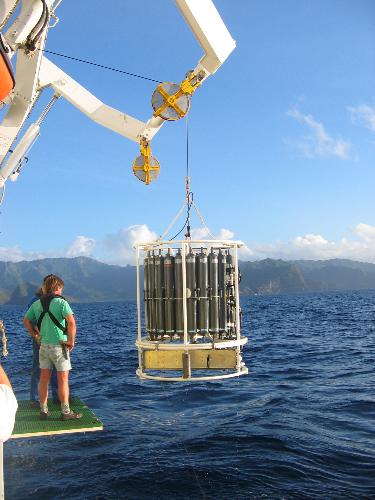
The scientists were only able to see the symbiotic partners together when they sorted freshly collected seawater samples onboard a research vessel.

"Our collaborators at the University of Hawaii, Dave Karl and Ken Doggett, put a cell sorter into a portable laboratory--a lab in a box--so now we can take the machine to sea and sort cells that minutes before were in their natural environment," says Thompson. "That's how we found the association."

Zehr noted that it's difficult to estimate the contribution of this symbiosis to global carbon and nitrogen cycles.

Other algae are more abundant and may be more important in terms of the ocean's carbon cycle than the algae hosts in this symbiosis, he says. But the cyanobacteria partners likely make this a significant contribution to global nitrogen fixation in the oceans.

"Planktonic symbioses are very difficult to study," says Foster. "The associations are often fragile.  Here we used multiple tools to identify one of the first examples of this kind of partnership in plankton."

In addition to Thompson, Zehr and Foster, the co-authors of the paper include Andreas Krupke, Niculina Musat and Marcel Kuypers of the Max Planck Institute for Marine Microbiology; Brandon Carter of UCSC; and Daniel Vaulot of the Station Biologique de Roscoff and the Pierre and Marie Curie University in Paris.

The research was also funded by the Gordon and Betty Moore Foundation and the Max Planck Society.

-NSF-

Thursday, September 20, 2012

Bacteria's Key Innovation Helps Understand Evolution


Genomic analysis of E. coli shows multiple steps to evolve new trait

Several years ago researchers at Michigan State University (MSU) reported discovering a novel, evolutionary trait in a long-studied population of Escherichia coli, a rod-shaped bacterium commonly found in the lower intestine of mammals. The E. coli added a helping of citrate to its traditional diet of glucose, even though other E. coli can't consume citrate in the presence of oxygen.

These same biologists have now analyzed this new trait's genetic origins and found that in multiple cases, the evolving E. coli population needed more than one mutational step before the key innovation took hold.  Complex traits, like using a new food source, are thought to be difficult and arise rarely, making the research of broad interest to both evolutionary biologists and public health scientists.

The findings, reported in this week's journal Nature, document the step-by-step process by which organisms evolve new functions. The study also highlights the importance of evolutionary changes that alter the physical arrangement of genes, leading to new patterns of gene regulation.

E. coli normally can't digest citrate when oxygen is present because they don't express the right protein to absorb citrate molecules. Citrate is a salt or class of citric acid commonly found in fruit such as lemons. So how did this mutation occur?

To find the answer, postdoctoral researcher Zachary Blount and MSU Hannah Distinguished Professor of Microbiology and Molecular Genetics Richard Lenski analyzed dozens of complete genome sequences from bacteria that had evolved this new trait and had been sampled and stored at different time points in the history of the lineage.

The National Science Foundation's Division of Environmental Biology partly funded the research, as did the NSF-supported BEACON Center for the Study of Evolution in Action.

The team used samples from Lenski's long-term E. coli experiment that started in February 1988 and has been ongoing for more than 24 years. The experiment allows Lenski and his students and colleagues to study more than 56,000 generations of bacterial evolution. In terms of generations, it is the longest running evolution experiment in history.

Twelve populations of E. coli live in an incubator in Lenski's laboratory producing about seven new generations every 24 hours. Each day, scientists take one percent of each population and transfer it into a new food source, a flask containing fresh glucose, which the bacteria readily eat, and citrate, which one population discovered how to eat after more than 30,000 generations. The researchers also take samples every 500 generations, and freeze them for later study.

Because they freeze the samples, when something new emerges the scientists can go back to earlier generations to look for the steps that happened along the way, which is what occurred in this case.

The researchers found that at least three mutations were required for the bacteria to effectively use citrate when oxygen is present. One or more mutations were necessary to set the physiological stage for the two later events. Then a critical gene duplication occurred that effectively re-wired the expression of a previously silent gene.

"These bacteria have evolved to consume a food resource--citrate--that no wild E. coli uses. Three mutations are required for this to happen, and they must occur in a specific order," said George Gilchrist, NSF program manager for the BEACON Science and Technology Center. "This study shows that the first mutation is required to set the stage for the next two, but surprisingly, this turns out to occur repeatedly and independently in different populations. What this suggests is that complex traits, at least in the microbial world, can evolve quickly and repeatedly."

Additional co-authors include Jeff Barrick, University of Texas and Carla Davidson, University of Calgary.

To learn more about this research, see the journal article in Nature magazine.

 -NSF-

Thursday, September 6, 2012

New Research Suggests Bacteria Are Social Microorganisms


MIT scientists: Bacteria plays different social roles, including attacking and defending other bacteria

New research from the Massachusetts Institute of Technology reveals that some unlikely subjects--bacteria--can have social structures similar to plants and animals.

The research shows that a few individuals in groups of closely related bacteria have the ability to produce chemical compounds that kill or slow the growth of other populations of bacteria in the environment, but not harm their own.

Published in the September 7 issue of the journal Science, the finding suggests that bacteria in the environment can play different social roles and that competition occurs not only among individual bacteria, but also among coexisting ecological populations.

The National Science Foundation, an independent federal agency that supports fundamental research and education across all fields of science and engineering, funded the research.

"Bacteria typically have been considered purely selfish organisms and bacterial populations as groups of clones," said Otto Cordero, a theoretical biologist and lead researcher on the paper. "This result contrasts with what we know about animal and plant populations, in which individuals can divide labors, perform different complementary roles and act synergistically."

Cordero and colleagues from MIT, along with researchers from the French Research Institute for Exploitation of the Sea and Woods Hole Oceanographic Institution in Massachusetts, studied whether population-level organization exists for bacteria in the wild.

They reasoned social structure can reduce conflict within populations of plants and animals and determine aggression towards competing biological populations. "Think of a population of lions in the Serengeti or a population of fish in a lake," said Cordero. But could the same be true for populations of bacteria?

"It is difficult to know what the environmental interactions really are, because microbes are too small for us to observe them in action," said Martin Polz, an organismic and evolutionary biologist at MIT and principal investigator for the Polz Microbial Ecology and Evolution Lab. "But our research provides strong evidence that antibiotics play a role in fending off competitors."

The researchers found evidence by looking at direct, aggressive competition between ecological populations of bacteria. They reconstructed a large network of bacterial fights--or antibiotic-mediated interactions--between bacteria from the ocean.

The scientists analyzed interactions called interference competitions, wherein bacteria produce antibiotics as a means of chemical warfare, to gain a competitive edge by directly hindering the survival of potential competitors.

This typically occurs when bacteria compete for the same portion of habitat.

The researchers assembled an all-against-all battleground for 185 closely-related, but distinct, members of an ocean-based family of bacteria called Vibrionaceae. They measured bacterial compounds produced by Vibrio isolates that directly antagonized other Vibrio isolates.

The framework provided Cordero and colleagues an opportunity to examine about 35,000 possible antibiotic-mediated interactions.

The researchers found that ecologically delineated bacterial populations act as socially cohesive units. "In these populations, a few individuals produced antibiotics to which closely related individuals in the population were resistant, whereas individuals in other populations were sensitive," said Cordero.

Thus, aggressive chemical reactions occur between, rather than within natural populations.

"It appears to be a group effort where individuals assume the role of antibiotic producers and hence defenders," said Polz. "Of course, competing groups could also produce antibiotics. It's a potential arms race out there."

"Those individuals that don't produce antibiotics can benefit from association with the producers, because they are resistant," added Cordero. "In other words, antibiotics have a social effect, because they can benefit the population as a whole."

The findings may help scientists answer questions about the natural role of antibiotics in human contexts.

"The research has the potential to bridge gaps in our understanding of the relationships between plants and humans and their non-disease- and disease-causing bacterial flora," said Robert Fleischmann, a program director in the Division of Biological Infrastructure for the National Science Foundation.

"We use antibiotics to kill pathogenic microbes, which cause harm to humans and animals," said Polz. "As an unfortunate side effect, this has lead to the widespread buildup of resistance, particularly in hospitals where pathogens and humans encounter each other often."

In addition, the results help scientists make sense of why closely related bacteria are so diverse in their gene content. Part of the answer, they say, is that the diversity allows the bacteria to play different social roles.

Social differentiation, for example, could mitigate the negative effects of two species competing for the same limiting resource--food or habitat, for instance--and generate population level behavior that emerges from the interaction between close relatives.

"Microbiology builds on the study of pure cultures," said Cordero, "that is genotypes isolated from their population. Our work shows that we need to start focusing on population based phenomena to better understand what these organisms are doing in the wild."

 -NSF-

Thursday, August 23, 2012

Watching Evolution Unfold


Image 1: Jeffrey Barrick, a postdoctoral research associate in Michigan State University's (MSU) Department of Microbiology and Molecular Genetics, views bacteria cultures. Barrick worked in the lab of Richard Lenski, the Hannah Professor of Microbial Ecology at MSU, who studies the process of evolution using fast-reproducing bacteria that allow him to watch the process in action.

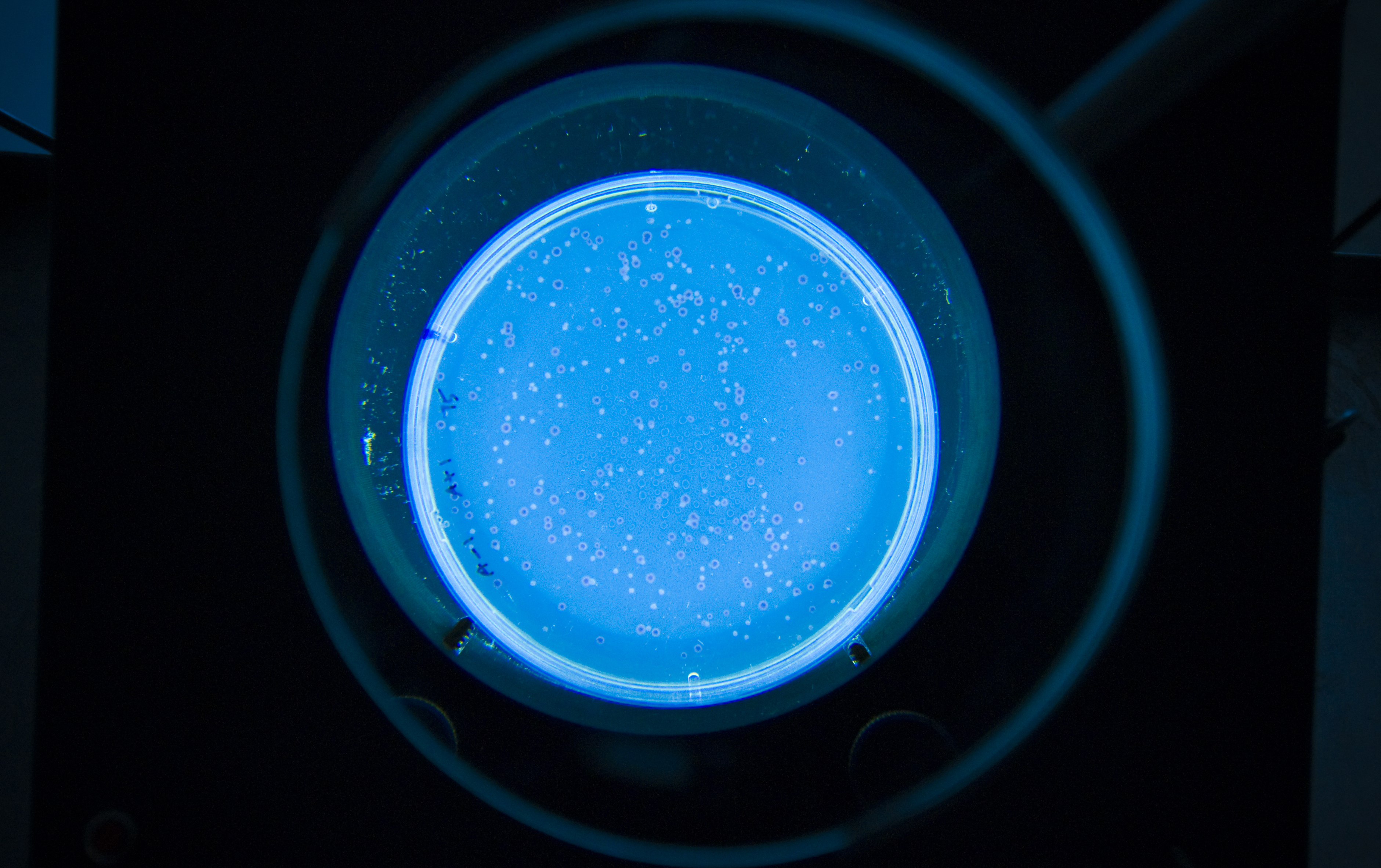
Image 2: Bacteria cultures grow in a Petri dish in the evolutionary biology lab of Richard Lenski, the Hannah Distinguished Professor of Microbial Ecology at Michigan State University. Lenski studies the process of evolution using fast-reproducing bacteria that allow him to watch the process in action.

Lenski began the study in 1988, when he started experimenting with 12 populations the bacteria E. coli. Lenski used E. coli from the same ancestral strain and living in identical environments so he could see how similarly or differently they would evolve. He planned on running the experiment for at least a year and culture about 2,000 bacterial generations, but 21 years and almost 40,000 generations later the experiment continues. The research has been supported by the National Science Foundation and the Defense Advanced Research Projects Agency.

(Date of Images: October 2009)

Credit: G. L. Kohuth, Michigan State University