Showing posts with label university of arizona. Show all posts

Tuesday, August 7, 2012

Orbiter Images NASA's Latest Additions to Martian Landscape


Dwayne Brown     
Headquarters, Washington   
202-358-1726
dwayne.c.brown@nasa.gov
 
Guy Webster / D.C. Agle
Jet Propulsion Laboratory, Pasadena, Calif.
818-354-6278 / 818-393-9011
guy.webster@jpl.nasa.gov / agle@jpl.nasa.gov

PASADENA, Calif. -- Late Monday night, an image from the High Resolution Imaging Science Experiment (HiRISE) camera aboard NASA's Mars Reconnaissance Orbiter captured the Curiosity rover and the components that helped it survive its seven-minute ordeal from space to its present location in Mars' Gale Crater.

"This latest image is another demonstration of the invaluable assistance the Mars Reconnaissance Orbiter team and its sister team with the Mars Odyssey orbiter have provided the Curiosity rover during our early days on the Red Planet," said Mike Watkins, mission manager for the Mars Science Laboratory mission at NASA's Jet Propulsion Laboratory (JPL) in Pasadena, Calif. "The image not only satisfies our curiosity, it can provide important information on how these vital components performed during entry, descent and landing, and exactly locate the rover's touchdown site within Gale Crater."

The Mars Reconnaissance Orbiter's (MRO) image of Curiosity and its parachute, back shell, heat shield and descent stage can be found at http://go.nasa.gov/OXjKz6.

The Curiosity rover is in the center of the image. To the right, approximately 4,900 feet away, lies the heat shield, which protected the rover from 3,800-degree-Fahrenheit temperatures encountered during its fiery descent. On the lower left, about 2,020 feet away, are the parachute and back shell. The parachute has a constructed diameter of 71 feet and an inflated diameter of 51 feet. The back shell remains connected to the chute via 80, 165-foot-long suspension lines. To the upper-left, approximately 2,100 feet away from the rover, is a discoloration of the Mars surface consistent with what would have resulted when the rocket-powered Sky Crane impacted the surface.

"This is the first of what I imagine will be many portraits HiRISE will be taking of Curiosity on the surface of Mars," said Sarah Milkovich, HiRISE investigation scientist at JPL. "The image was taken Monday at about 10:30 p.m. Pacific when MRO was at an altitude of about 186 miles and we are getting resolution on the surface down to 1.3 feet per pixel."

As more of Curiosity's instruments are coming online, more "first images" are being downlinked from the rover's 17 cameras. The latest to come in is from the Mars Hand Lens Imager or MAHLI. The focusable color camera is located on the tool-bearing turret at the end of Curiosity's robotic arm. Researchers will use it for magnified, close-up views of rocks and soils and also for wider scenes of the ground, the landscape or even the rover.

"It is great to have our first MAHLI image under our belt," said Ken Edgett, principal investigator for MAHLI from Malin Space Science in San Diego. "We tested the focus mechanism and imager and the whole system is looking good. We are looking forward to getting up close and personal with Mars."

The first MAHLI image, taken with the dust-coated clear plastic cover over the lens, is available at http://go.nasa.gov/Qb3l6U.

The team plans for Curiosity checkout Tuesday include raising the rover's mast and continued testing of the high-gain antenna.

Curiosity carries 10 science instruments with a total mass 15 times as large as the science payloads on the Mars rovers Spirit and Opportunity. Some of the tools, such as a laser-firing instrument for checking rocks' elemental composition from a distance, are the first of their kind on Mars. Curiosity will use a drill and scoop which is located at the end of its robotic arm to gather soil and powdered samples of rock interiors, then sieve and parcel out these samples into the rover's analytical laboratory instruments.

To handle this science toolkit, Curiosity is twice as long and five times as heavy as Spirit or Opportunity. The Gale Crater landing site places the rover within driving distance of layers of the crater's interior mountain. Observations from orbit have identified clay and sulfate minerals in the lower layers, indicating a wet history.

HiRISE is operated by the University of Arizona in Tucson. The instrument was built by Ball Aerospace & Technologies Corp. in Boulder, Colo. The Mars Reconnaissance Orbiter and Mars Exploration Rover projects are managed by JPL for NASA's Science Mission Directorate. JPL is a division of the California Institute of Technology in Pasadena. Lockheed Martin Space Systems in Denver, built the orbiter.

For more information on NASA's Curiosity mission, visit http://www.nasa.gov/mars and http://marsprogram.jpl.nasa.gov/msl.

For more about the Mars Reconnaissance Orbiter, visit http://www.nasa.gov/mro.

Follow the mission on Facebook and Twitter at http://www.facebook.com/marscuriosity and http://www.twitter.com/marscuriosity.

- end -

Sunday, June 17, 2012

NASA Releases Workshop Data and Findings on Asteroid 2011 AG5


Dwayne Brown
Headquarters, Washington                                   
202-358-1726
dwayne.c.brown@nasa.gov

WASHINGTON -- Researchers anticipate that asteroid 2011 AG5, discovered in January 2011, will fly safely past and not impact Earth in 2040.

Current findings and analysis data were reported at a May 29 workshop at NASA's Goddard Space Flight Center in Greenbelt, Md., attended by scientists and engineers from around the world. Discussions focused on observations of potentially hazardous asteroids (PHAs).

Observations to date indicate there is a slight chance that AG5 could impact Earth in 2040. Attendees expressed confidence that in the next four years, analysis of space and ground-based observations will show the likelihood of 2011 AG5 missing Earth to be greater than 99 percent.

Measuring approximately 460 feet (140 meters) in size, the space rock was discovered by the NASA-supported Catalina Sky Survey operated by the University of Arizona in Tucson. Several observatories monitored 2011 AG5 for nine months before it moved too far away and grew too faint to see.

"While there is general consensus there is only a very small chance that we could be dealing with a real impact scenario for this object, we will still be watchful and ready to take further action if additional observations indicate it is warranted," said Lindley Johnson, program executive for the Near-Earth Object (NEO) Observation Program at NASA Headquarters in Washington.

Several years ago another asteroid, named Apophis, was thought to pose a similar impact threat in 2036. Additional observations taken from 2005 through 2008 enabled NASA scientists to refine their understanding of the asteroid's path, which showed a significantly reduced likelihood of a hazardous encounter.

"Any time we're able to observe an asteroid and obtain new location data, we're able to refine our calculations of the asteroid's future path," said Don Yeomans, manager of NASA's NEO Program Office at the Jet Propulsion Laboratory (JPL) in Pasadena, Calif. "When few observations exist, our initial orbit calculation will include a wider swath to account for uncertainties. With more data points, the knowledge of the potential positions of the asteroid improves and the swath becomes smaller -- typically eliminating the risk of an impact."

Observations of 2011 AG5 have been limited to date because of its present location beyond the orbit of Mars and in the daytime sky on the other side of the sun. In fall 2013, conditions will improve to allow space- and ground-based telescopes to better track the asteroid's path. At that time, 2011 AG5 will be 91 million miles (147 million kilometers) from Earth but favorably located for observations in the late evening sky.

The level of hazard will gain even more clarity in 2023, when the asteroid is approximately 1.1 million miles (1.8 million kilometers) from Earth. If 2011 AG5 passes through a 227-mile-wide (365-kilometer) region in space called a keyhole in early February 2023, Earth's gravitational pull could influence the object's orbital path just enough to bring it back for an impact on February 5, 2040. If the asteroid misses the keyhole, an impact in 2040 will not occur.

"Given our current understanding of this asteroid's orbit, there is only a very remote chance of this keyhole passage even occurring," said Johnson.

Although scientists widely expect it to be a safe flyby, they acknowledge the slight chance that computed odds could rise as a result of observations to be taken from 2013 to 2016. According to the experts at the workshop, even if the odds do increase, there is still ample time to plan and carry out at least one of several viable missions to change the asteroid's course.

PHAs are a subset of the larger group of near-Earth asteroids. They have the closest orbits to Earth's, coming within 5 million miles (about 8 million kilometers). They are large enough to enter Earth's atmosphere intact and cause damage on at least a local scale. Damage from an asteroid the size of 2011 AG5 could cover a region at least a hundred miles wide.

NASA established the NEO Program in 1998 to coordinate the agency's efforts to detect, track and characterize Earth-approaching NEOs and comets larger than 1 kilometer in size. The program now also searches for NEOs as small as object 2011 AG5. NASA supports NEO observation, tracking and analysis activities worldwide. Activities are coordinated through the NEO Program Office at JPL.

To read the workshop report and findings, visit http://neo.jpl.nasa.gov/.

For information about NASA asteroid missions and activities, visit http://www.nasa.gov/asteroids.

EDITOR'S NOTE: Lindley Johnson and Don Yeomans are available for media interviews. To coordinate a time and date, email Dwayne Brown at dwayne.c.brown@nasa.gov.

- end -

Thursday, May 31, 2012

Where Have All the Hummingbirds Gone?


Glacier lilies and broad-tailed hummingbirds out of sync

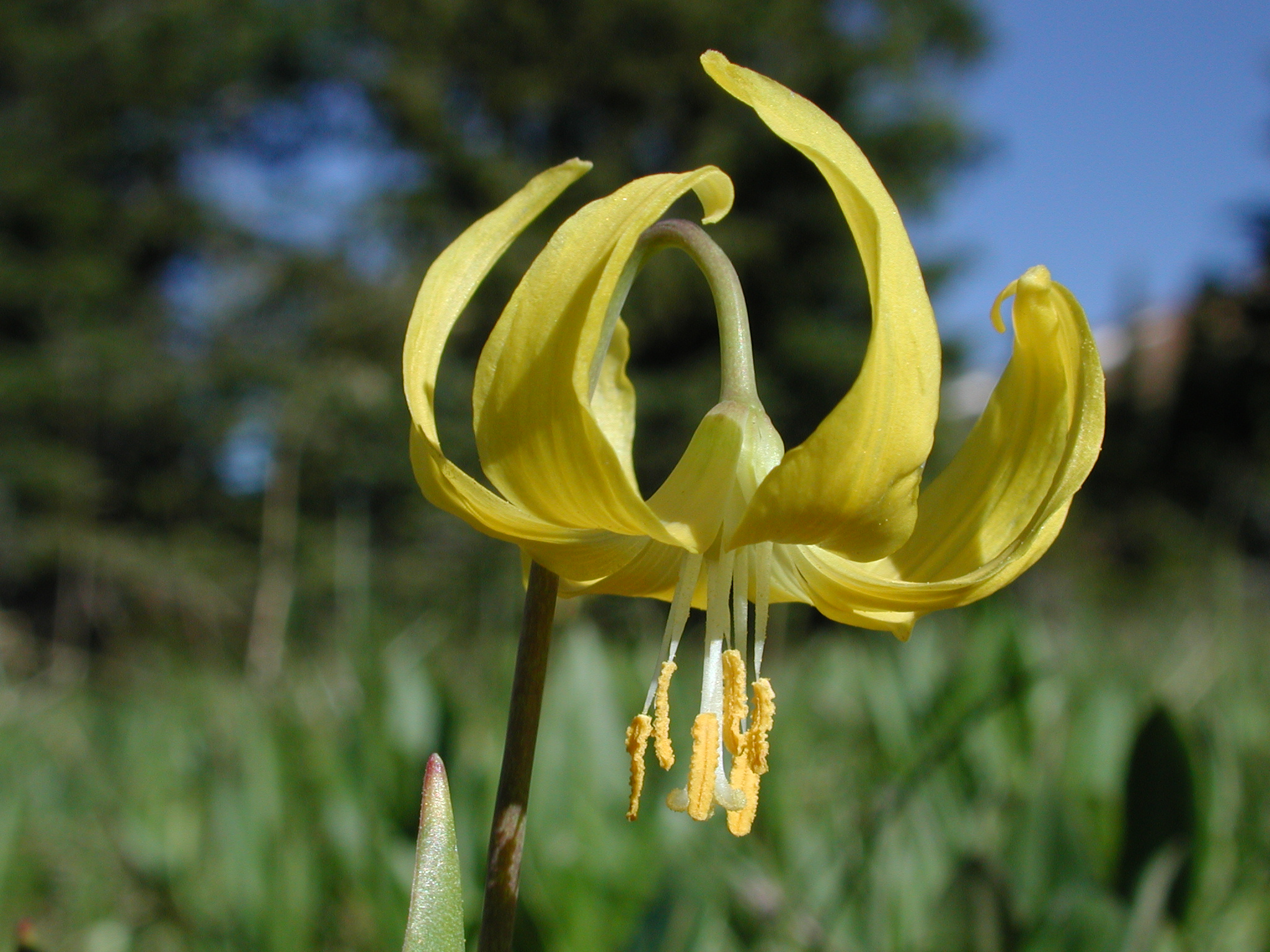
The glacier lily as it's called, is a tall, willowy plant that graces mountain meadows throughout western North America. It flowers early in spring, when the first bumblebees and hummingbirds appear.

Or did.

The lily, a plant that grows best on subalpine slopes, is fast becoming a hothouse flower. In Earth's warming temperatures, its first blooms appear some 17 days earlier than they did in the 1970s, scientists David Inouye and Amy McKinney of the University of Maryland and colleagues have found.

The problem, say the biologists, with the earlier timing of these first blooms is that the glacier lily is no longer synchronized with the arrival of broad-tailed hummingbirds, which depend on glacier lilies for nectar.

By the time the hummingbirds fly in, many of the flowers have withered away, their nectar-laden blooms going with them.

Broad-tailed hummingbirds migrate north from Central America every spring to high-mountain breeding sites in the western United States. The birds have only a short mountain summer to raise their young. Male hummingbirds scout for territories before the first flowers bloom.

But the time between the first hummingbird and the first bloom has collapsed by 13 days over the past four decades, say Inouye and McKinney. "In some years," says McKinney, "the lilies have already bloomed by the time the first hummingbird lands."

The biologists calculate that if current trends continue, in two decades the hummingbirds will miss the first flowers entirely.

The results are reported in a paper in the current issue of the journal Ecology. In addition to McKinney and Inouye, co-authors of the paper are Paul CaraDonna of the University of Arizona; Billy Barr of the Rocky Mountain Biological Laboratory in Crested Butte, Colo.; David Bertelsen of the University of Arizona; and Nickolas Waser, affiliated with all three institutions.

"Northern species, such as the broad-tailed hummingbird, are most at risk of arriving at their breeding sites after their key food resources are no longer available, yet ecologists predict that species will move northward as climate warms," says Saran Twombly, program director in the National Science Foundation's Division of Environmental Biology, which funded the research.

"These conflicting pressures challenge society to ensure that species don't soon find themselves without a suitable place to live."

Broad-tailed hummingbirds that breed farther south have fewer challenges.

"In Arizona, for example," says Inouye, "there's no obvious narrowing of the timing between the first arriving males and the first blooms of, in this case, the nectar-containing Indian paintbrush."

Higher latitudes may be more likely to get out of sync ecologically because global warming is happening fastest there.

As the snow continues to melt earlier in the spring, bringing earlier flowering, says Inouye, the mountains may come alive with glacier lilies long before hummingbirds can complete their journey north.

"Where have all the flowers gone?" then will be "where have all the hummingbirds gone?"

 -NSF-

Monday, November 21, 2011

Claritas Fossae, Mars

Mars' Claritas Fossae region is characterized by systems of "graben" running mainly north-west to south-east. A graben forms when a block of the planet's crust drops down between two faults, due to extension, or pulling, of the crust.
 
This image was originally released July 13, 2011.
 
Image Credit: NASA/JPL-Caltech/University of Arizona

Tuesday, November 1, 2011

Mars' Newton Crater

If you enjoy different science books, you’ll really enjoy the best forensic science books written by the best forensic scientists in the field.

This image, which combines orbital imagery with 3-D modeling, shows flows that appear in spring and summer on a slope inside Mars' Newton Crater. Sequences of observations recording the seasonal changes at this site and a few others with similar flows might be evidence of salty liquid water active on Mars today. Evidence for that possible interpretation is presented in a report by McEwen et al. in the Aug. 5, 2011, edition of Science.
 
This image has been reprojected to show a view of a slope as it would be seen from a helicopter inside the crater, with a synthetic Mars-like sky. The source observation was made May 30, 2011, by the High Resolution Imaging Science Experiment (HiRISE) camera on NASA's Mars Reconnaissance Orbiter. Color has been enhanced. The season was summer at the location, 41.6 degrees south latitude, 202.3 degrees east longitude.
 
The flow features are narrow (one-half to five yards or meters wide), relatively dark markings on steep (25 to 40 degree) slopes at several southern hemisphere locations. Repeat imaging by HiRISE shows the features appear and incrementally grow during warm seasons and fade in cold seasons.
 
Image Credit: NASA/JPL-Caltech/Univ. of Arizona

Monday, September 12, 2011

Viking Lander Model

Are you an aspiring scientist?  Check out the best forensic science books, as well as books on many scientific fields.

NASA's Viking Project found a place in history when it became the first U.S. mission to land a spacecraft successfully on the surface of Mars. Two identical spacecraft, each consisting of a lander and an orbiter, were built. Each orbiter-lander pair flew together and entered Mars orbit; the landers then separated and descended to the planet's surface. Viking 2 launched 36 years ago today on Sept. 9, 1975. This photo shows a test version of the landers in the original "Mars Yard" built at NASA's Jet Propulsion Laboratory in 1975.

The Viking 2 lander settled down at Utopia Planitia on Sept. 3, 1976, while the Viking 1 Lander touched down on the western slope of Chryse Planitia (the Plains of Gold) on July 20, 1976.

Besides taking photographs and collecting other science data on the Red Planet's surface, the two landers conducted three biology experiments designed to look for possible signs of life. These experiments discovered unexpected and enigmatic chemical activity in the Martian soil, but provided no clear evidence for the presence of living microorganisms in soil near the landing sites. According to scientists, Mars is self-sterilizing. They believe the combination of solar ultraviolet radiation that saturates the surface, the extreme dryness of the soil and the oxidizing nature of the soil chemistry prevent the formation of living organisms in the Martian soil.

Although the Viking mission was planned to continue for 90 days after landing, each orbiter and lander operated far beyond its design lifetime. Viking Orbiter 1 functioned until July 25, 1978, while Viking Orbiter 2 continued for four years and 1,489 orbits of Mars, concluding its mission Aug. 7, 1980. Because of the variations in available sunlight, both landers were powered by radioisotope thermoelectric generators -- devices that create electricity from heat given off by the natural decay of plutonium. That power source allowed long-term science investigations that otherwise would not have been possible. The last data from Viking Lander 2 arrived at Earth on April 11, 1980. Viking Lander 1 made its final transmission to Earth Nov. 11, 1982.

Image Credit: NASA/JPL-Caltech/University of Arizona

Sunday, July 31, 2011

Rock Layers in Gale Crater

This oblique view of the lower mound in Gale Crater shows layers of rock that preserve a record of environments on Mars. Here, orbiting instruments have detected signatures of both clay minerals and sulfate salts, with more clay minerals apparent in the foreground of this image and fewer in higher layers. This change in mineralogy may reflect a change in the ancient environment in Gale Crater.

Mars scientists have several important hypotheses about how these minerals may reflect changes in the amount of water on the surface of Mars. The Mars Science Laboratory rover, Curiosity, will use its full suite of instruments to study these minerals to provide insights into these ancient Martian environments. These rocks are also a prime target in the search for organic molecules since these past environments may have been habitable -- able to support microbial life. Scientists will study how organic molecules, if present, vary with mineralogical variations in the layers to understand how they formed and what influences their preservation.

The smaller hills in this view may provide clues to the modern water cycle on Mars. They contain sulfate salts that have water in them, and as temperatures warm into summer, some of that water may be released to the atmosphere. As temperatures cool, they may absorb water from the atmosphere. The Mars Science Laboratory team will investigate how water is exchanged between these minerals and the atmosphere, helping us understand Mars' modern climate. The hills are particularly useful for this investigation because different parts of the hills are exposed to different amounts of sunlight and thus to different temperatures. Curiosity will be able to compare the water in these contrasting areas as part of its investigations.

This three-dimensional perspective view was created using visible-light imaging by the High Resolution Imaging Science Experiment camera on NASA's Mars Reconnaissance Orbiter and the High Resolution Stereo Camera on the European Space Agency's Mars Express orbiter. Three-dimensional information was derived by stereo analysis of image pairs. The vertical dimension is not exaggerated. Color information is derived from color imaging of portions of the scene by the High Resolution Imaging Science Experiment camera.

The Mars Science Laboratory spacecraft is being prepared for launch on Nov. 25, 2011. In a prime mission lasting one Martian year -- nearly two Earth years -- after landing, researchers will use the rover's tools to study whether the landing region has had environmental conditions favorable for supporting microbial life and for preserving clues about whether life existed.

Image Credit: NASA/JPL-Caltech/University of Arizona

Saturday, May 28, 2011

Crews Complete Workday

Spacesuit reconfiguration, work on a carbon dioxide scrubber, and movement of equipment and supplies between Endeavour and the International Space Station kept crew members of the docked spacecraft busy during their just-completed workday.

Early in their day, at about 9:15 p.m. Friday, STS-134 Commander Mark Kelly and Pilot Greg Johnson along with Expedition 27 Flight Engineer Ron Garan talked with middle school students, teachers and others gathered at the University of Arizona in Tucson. At about 7:45 a.m. Saturday Johnson answered questions from representatives of Gannet, Houston's KPRC-TV and the Voice of America.

Friday, April 29, 2011

NASA's Swift And Hubble Probe Asteroid Collision Debris

Trent J. Perrotto
Headquarters, Washington
 
Lynn Chandler
Goddard Space Flight Center, Greenbelt, Md.
 
WASHINGTON -- Late last year, astronomers noticed an asteroid named Scheila had unexpectedly brightened, and it was sporting short-lived plumes. Data from NASA's Swift satellite and Hubble Space Telescope showed these changes likely occurred after Scheila was struck by a much smaller asteroid.

"Collisions between asteroids create rock fragments, from fine dust to huge boulders, that impact planets and their moons," said Dennis Bodewits, an astronomer at the University of Maryland in College Park and lead author of the Swift study. "Yet this is the first time we've been able to catch one just weeks after the smash-up, long before the evidence fades away."

Asteroids are rocky fragments thought to be debris from the formation and evolution of the solar system approximately 4.6 billion years ago. Millions of them orbit the sun between Mars and Jupiter in the main asteroid belt. Scheila is approximately 70 miles across and orbits the sun every five years.

"The Hubble data are most simply explained by the impact, at 11,000 mph, of a previously unknown asteroid about 100 feet in diameter," said Hubble team leader David Jewitt at the University of California in Los Angeles. Hubble did not see any discrete collision fragments, unlike its 2009 observations of P/2010 A2, the first identified asteroid collision.

The studies will appear in the May 20 edition of The Astrophysical Journal Letters and are available online.

Astronomers have known for decades that comets contain icy material that erupts when warmed by the sun. They regarded asteroids as inactive rocks whose destinies, surfaces, shapes and sizes were determined by mutual impacts. However, this simple picture has grown more complex over the past few years.

During certain parts of their orbits, some objects, once categorized as asteroids, clearly develop comet-like features that can last for many months. Others display much shorter outbursts. Icy materials may be exposed occasionally, either by internal geological processes or by an external one, such as an impact.

On Dec. 11, 2010, images from the University of Arizona's Catalina Sky Survey, a project of NASA's Near Earth Object Observations Program, revealed Scheila to be twice as bright as expected and immersed in a faint comet-like glow. Looking through the survey's archived images, astronomers inferred the outburst began between Nov. 11 and Dec. 3.

Three days after the outburst was announced, Swift's Ultraviolet/Optical Telescope (UVOT) captured multiple images and a spectrum of the asteroid. Ultraviolet sunlight breaks up the gas molecules surrounding comets; water, for example, is transformed into hydroxyl and hydrogen. But none of the emissions most commonly identified in comets, such as hydroxyl or cyanogen, show up in the UVOT spectrum. The absence of gas around Scheila led the Swift team to reject scenarios where exposed ice accounted for the activity.

Images show the asteroid was flanked in the north by a bright dust plume and in the south by a fainter one. The dual plumes formed as small dust particles excavated by the impact were pushed away from the asteroid by sunlight. Hubble observed the asteroid's fading dust cloud on Dec. 27, 2010, and Jan. 4, 2011.

The two teams found the observations were best explained by a collision with a small asteroid impacting Scheila's surface at an angle of less than 30 degrees, leaving a crater 1,000 feet across. Laboratory experiments show a more direct strike probably wouldn't have produced two distinct dust plumes. The researchers estimated the crash ejected more than 660,000 tons of dust -- equivalent to nearly twice the mass of the Empire State Building.

"The dust cloud around Scheila could be 10,000 times as massive as the one ejected from comet 9P/Tempel 1 during NASA's UMD-led Deep Impact mission," said co-author Michael Kelley, also at the University of Maryland. "Collisions allow us to peek inside comets and asteroids. Ejecta kicked up by Deep Impact contained lots of ice, and the absence of ice in Scheila's interior shows that it's entirely unlike comets."

NASA's Goddard Space Flight Center in Greenbelt, Md., manages Hubble and Swift. Hubble was built and is operated in partnership with the European Space Agency. Science operations for both missions include contributions from many national and international partners. For more information, video and images associated with this release, visit http://www.nasa.gov/topics/universe/features/asteroid-collision.html.

- end -

Thursday, April 28, 2011

NASA's Swift And Hubble Probe Asteroid Collision Debris

Trent J. Perrotto
Headquarters, Washington
 
Lynn Chandler
Goddard Space Flight Center, Greenbelt, Md.
 
WASHINGTON -- Late last year, astronomers noticed an asteroid named Scheila had unexpectedly brightened, and it was sporting short-lived plumes. Data from NASA's Swift satellite and Hubble Space Telescope showed these changes likely occurred after Scheila was struck by a much smaller asteroid.

"Collisions between asteroids create rock fragments, from fine dust to huge boulders, that impact planets and their moons," said Dennis Bodewits, an astronomer at the University of Maryland in College Park and lead author of the Swift study. "Yet this is the first time we've been able to catch one just weeks after the smash-up, long before the evidence fades away."

Asteroids are rocky fragments thought to be debris from the formation and evolution of the solar system approximately 4.6 billion years ago. Millions of them orbit the sun between Mars and Jupiter in the main asteroid belt. Scheila is approximately 70 miles across and orbits the sun every five years.

"The Hubble data are most simply explained by the impact, at 11,000 mph, of a previously unknown asteroid about 100 feet in diameter," said Hubble team leader David Jewitt at the University of California in Los Angeles. Hubble did not see any discrete collision fragments, unlike its 2009 observations of P/2010 A2, the first identified asteroid collision.

The studies will appear in the May 20 edition of The Astrophysical Journal Letters and are available online.

Astronomers have known for decades that comets contain icy material that erupts when warmed by the sun. They regarded asteroids as inactive rocks whose destinies, surfaces, shapes and sizes were determined by mutual impacts. However, this simple picture has grown more complex over the past few years.

During certain parts of their orbits, some objects, once categorized as asteroids, clearly develop comet-like features that can last for many months. Others display much shorter outbursts. Icy materials may be exposed occasionally, either by internal geological processes or by an external one, such as an impact.

On Dec. 11, 2010, images from the University of Arizona's Catalina Sky Survey, a project of NASA's Near Earth Object Observations Program, revealed Scheila to be twice as bright as expected and immersed in a faint comet-like glow. Looking through the survey's archived images, astronomers inferred the outburst began between Nov. 11 and Dec. 3.

Three days after the outburst was announced, Swift's Ultraviolet/Optical Telescope (UVOT) captured multiple images and a spectrum of the asteroid. Ultraviolet sunlight breaks up the gas molecules surrounding comets; water, for example, is transformed into hydroxyl and hydrogen. But none of the emissions most commonly identified in comets, such as hydroxyl or cyanogen, show up in the UVOT spectrum. The absence of gas around Scheila led the Swift team to reject scenarios where exposed ice accounted for the activity.

Images show the asteroid was flanked in the north by a bright dust plume and in the south by a fainter one. The dual plumes formed as small dust particles excavated by the impact were pushed away from the asteroid by sunlight. Hubble observed the asteroid's fading dust cloud on Dec. 27, 2010, and Jan. 4, 2011.

The two teams found the observations were best explained by a collision with a small asteroid impacting Scheila's surface at an angle of less than 30 degrees, leaving a crater 1,000 feet across. Laboratory experiments show a more direct strike probably wouldn't have produced two distinct dust plumes. The researchers estimated the crash ejected more than 660,000 tons of dust -- equivalent to nearly twice the mass of the Empire State Building.

"The dust cloud around Scheila could be 10,000 times as massive as the one ejected from comet 9P/Tempel 1 during NASA's UMD-led Deep Impact mission," said co-author Michael Kelley, also at the University of Maryland. "Collisions allow us to peek inside comets and asteroids. Ejecta kicked up by Deep Impact contained lots of ice, and the absence of ice in Scheila's interior shows that it's entirely unlike comets."

NASA's Goddard Space Flight Center in Greenbelt, Md., manages Hubble and Swift. Hubble was built and is operated in partnership with the European Space Agency. Science operations for both missions include contributions from many national and international partners. For more information, video and images associated with this release, visit http://www.nasa.gov/topics/universe/features/asteroid-collision.html.

- end -

Wednesday, April 13, 2011

NASA Telescopes Help Discover Surprisingly Young Galaxy

Trent Perrotto
Headquarters, Washington
 
Whitney Clavin
Jet Propulsion Laboratory, Pasadena, Calif.
 
Ray Villard
Space Telescope Science Institute, Baltimore, Md.
 
Larry O'Hanlon
W.M. Keck Observatory, Mauna Kea, Hawaii

WASHINGTON -- Astronomers have uncovered one of the youngest galaxies in the distant universe, with stars that formed 13.5 billion years ago, a mere 200 million years after the big bang. The finding addresses questions about when the first galaxies arose, and how the early universe evolved.

NASA's Hubble Space Telescope was the first to spot the newfound galaxy. Detailed observations from the W.M. Keck Observatory on Mauna Kea in Hawaii revealed the observed light dates to when the universe was only 950 million years old; the universe formed about 13.7 billion years ago.

Infrared data from both Hubble and NASA's Spitzer Space Telescope revealed the galaxy's stars are quite mature, having formed when the universe was just a toddler at 200 million years old.

"This challenges theories of how soon galaxies formed in the first years of the universe," said Johan Richard of the Centre de Recherche Astronomique de Lyon, Université Lyon 1 in France, lead author of a new study accepted for publication in the Monthly Notices of the Royal Astronomical Society. "It could even help solve the mystery of how the hydrogen fog that filled the early universe was cleared."

This galaxy is not the most distant ever observed, but it is one of the youngest to be observed with such clarity. Normally, galaxies like this one are extremely faint and difficult to study, but, in this case, nature has provided the astronomers with a cosmic magnifying glass. The galaxy's image is being magnified by the gravity of a massive cluster of galaxies parked in front of it, making it appear 11 times brighter. This phenomenon is called gravitational lensing.

"Without this big lens in space, we could not study galaxies this faint with currently available observing facilities," said co-author Eiichi Egami of the University of Arizona in Tucson. "Thanks to nature, we have this great opportunity to see our universe as it was eons ago."

The findings may help explain how the early universe became "reionized." At some point in our universe's early history, it transitioned from the so-called dark ages to a period of light, as the first stars and galaxies began to ignite. This starlight ionized neutral hydrogen atoms floating around in space, giving them a charge. Ultraviolet light could then travel unimpeded through what had been an obscuring fog.

The discovery of a galaxy possessing stars that formed only 200 million years after the big bang helps astronomers probe this cosmic reionization epoch. When this galaxy was developing, its hot, young stars would have ionized vast amounts of the neutral hydrogen gas in intergalactic space. A population of similar galaxies probably also contributed to this reionization, but they are too faint to see without the magnifying effects of gravitational lensing.

NASA's James Webb Space Telescope (JWST), scheduled to launch later this decade, will be able to see these faint galaxies lacking magnification. A successor to Hubble and Spitzer, JWST will see infrared light from the missing population of early galaxies. As a result, the mission will reveal some of our universe's best-kept secrets.

"Seeing a galaxy as it appeared near the beginning of the universe is an awe-inspiring feat enabled by innovative technology and the fortuitous effect of gravitational lensing," said Jon Morse, NASA's Astrophysics Division director at the agency's headquarters in Washington.

"Observations like this open a window across space and time, but more importantly, they inspire future work to one day peer at the stars that lit up the universe following the big bang."

For more information about Spitzer and Hubble, visit http://www.nasa.gov/spitzer and http://www.nasa.gov/hubble.

- end -