Showing posts with label Africa. Show all posts

Tuesday, May 22, 2012

Relationship Between Social Status and Wound-Healing in Wild Baboons


Findings show it's best to be "top baboon"

Turns out it's not bad being top dog, or in this case, top baboon.

Results of a study by University of Notre Dame biologist Beth Archie and colleagues from Princeton University and Duke University finds that male baboons that have a high rank within their society recover more quickly from injuries, and are less likely to become ill than other males.

The finding is somewhat surprising, given that top-ranked males also experience high stress, which should suppress immune responses.

Archie, Jeanne Altman of Princeton and Susan Alberts of Duke examined health records from the Amboseli Baboon Research Project in Kenya. They published their results in this week's issue of the journal Proceedings of the National Academy of Sciences.

The scientists also found that social status is a better predictor of wound-healing than age.

"The power of this study is in identifying the biological mechanisms that may confer health benefits to high-ranking members of society," says George Gilchrist, program director in the National Science Foundation's (NSF) Directorate for Biological Sciences, which co-funded the research with NSF's Directorate for Social, Behavioral & Economic Sciences.

"We know that humans have such benefits, but it took meticulous long-term research on baboon society to tease out the specific mechanisms," says Gilchrist. "The question remains of causation: is one a society leader because of stronger immune function or vice versa?"

Although research on health and disease in animals in laboratory settings has been extensive, this study is one of the most comprehensive conducted on animals in a natural setting, the scientists say.

The researchers examined 27 years of data on naturally-occurring illnesses and injuries in wild male baboons. They investigated how differences in age, physical condition, stress, reproductive effort and testosterone levels contribute to status-related differences in immune function.

Previous research found that high testosterone levels and intense reproductive efforts can suppress immune function and are highest among high-ranking males.

However, Archie and colleagues found that high-ranking males were less likely to become ill and recovered faster from injuries and illnesses than low-ranking males.

The authors suggest that chronic stress, old age and poor physical condition associated with low rank may suppress immune function in low-ranking males.

"The complex interplay among social context, physiology and immune system-mediated health costs and benefits illustrates the power of interdisciplinary research," says Carolyn Ehardt, program director in NSF's biological anthropology program.

"This research begins to tease apart the trade-offs in both high- and low-status in primates--including ourselves--which may lead to a new understanding of the effects of social status on death and disease."

 -NSF-

Monday, April 30, 2012

Better Than Bottled Water


Water purification specialists with Combat Logistics Battalion 24, 24th Marine Expeditionary Unit , put their water purification systems to the test on a Moroccan beach, during the bi-lateral exercise named African Lion 2012.

The Marines assembled a Tactical Water Purification System  (TWPS) and Lightweight Water Purification System  (LWPS) on the beach to turn ocean water into a sustainable, potable water source for the Marines conducting training operations with the Royal Moroccan Armed Forces , and test the systems on a foreign water source.

“Instead of bringing thousands of pallets of water ashore, this is what we use,” said Cpl. Kyle Slusher, a water purification specialist with CLB 24. “This is what’s going to sustain our force, and we can use it wherever there is a water source.”

Marines  use water purification systems to sustain their forces and also to provide water for a number of other operations such as disaster relief, and humanitarian assistance, according to Cpl. Cody Sorrell, a water purification specialist.

“We can use this capability for any sort of mission where Marines are going to be there a long period of time,” Sorrell said. “You can’t conduct operations without a sustainable water source.”

The current mission is to provide a clean water source for Marines training ashore in the desert landscape of Morocco . The water these Marines are sustaining the training units ashore who are working with members of the Moroccan military.

Without this capability, the logistics problem of supplying clean water to the shores of Morocco would become a problem of time and money that would distract from the mission of training between the Marines and Moroccans.

The TWPS is 10,000 pounds, and able to purify approximately 10,000 gallons of water a day by pumping it through a series of filters, which reduce the TDS (total dissolved solids) rating to a level more than fit for human consumption.

Pound for pound for Marines on the ground, it is more than worth its weight in water.

“It’s better than bottled water,” said Slusher.

According to the Marion, Ohio native, the average bottle of water has a TDS ratting between 400 and 500. Using the TWPS, water purification specialist can reduce the TDS ratting to 20.

“A bottle of water from the TWPS is more pure than what you would get from a factory,” he said. “It’s because the only thing we have to add back into the water is chlorine to preserve it.”

The TWPS has the ability to purify water ranging from lake water to nuclear contaminated water, he said.

“If a nuclear bomb went off behind me, we would be able to provide contaminate free water in an hour,” he said.

The LWPS is a smaller version of the TWPS. While not able to boast the same range of capabilities as the TWPS, its use is focused on supplying a small force. Weighing 3,580 pounds the system is able to provide around 2,000 gallons of water a day.

“We use this somewhere we have a really small foot print,” he said.

The last opportunity the Marines had to test their system’s capabilities was in September 2011 at Fort Pickett, Va. , where they filtered lake water, substantially easy to filter in comparison to the salty ocean water they now face in Morocco, according to Slusher.

“Right now we’re showing we can get in, set up and operate it anywhere,” he said.

Story written by Sgt. Richard Blumenstein
On location in Morocco

Monday, February 27, 2012

New Mosquito Repellant Could Be Frightening ... for the Mosquitoes!

Repellant overwhelms their odor sensors, scaring them away

In a small, narrow, temperature-controlled lab room at Vanderbilt University live some of the most deadly and dangerous animals in the world.

"These are Anopheles mosquitoes that still think that they're in Central Africa. We won't tell them any different," says Laurence Zwiebel, professor of molecular biology and pharmacology.

Anopheles gambiae mosquitoes can be killers. In warmer climates, the bloodsuckers carry and spread diseases, including malaria, the second most deadly transmitted disease in Africa. The mosquitoes growing up in Zwiebel's lab are disease-free. But, as Zwiebel points out, they still bite.

"Anopheles gambiae often shows a strong preference for biting people. How do they do this? What makes them so predisposed to bite humans?"

With support from the National Science Foundation (NSF), Zwiebel and his team want to find some answers. They know mosquitoes zero in on their next meal using their keen sense of smell. "A mosquito can smell you and me from a very long distance and can track its way to you based on odor plumes that we're giving off," explains vector biologist Jason Pitts.

The team has identified microscopic odor receptors on the mosquito's antennae that look like tiny microscopic hairs. "We've identified large families of receptors in the mosquito," says Pitts.

Different hairs target different smells. Pitts says Anopheles' hairs home-in on human body odors from the carbon dioxide in our breath to the ammonia in our sweaty feet. "Some mosquitoes have been shown to be highly attracted to feet," he notes.

"The number of compounds that have been identified in human sweat number in the hundreds," says Pitts. "Things like carbon dioxide, ammonia, which is a byproduct of human sweat, and lactic acid, that we give off in sweat, other animals don't. These are often cited as compounds that are part of the human signature. Which of those compounds are the most important [for the Anopheles mosquito] is still a subject of debate."

Researchers often refer to a mosquito as "her" because only female mosquitoes bite. They drink the blood for reproduction--to make eggs. "So, only female mosquitoes spread disease. A female will drink her weight in blood when she takes a blood meal from you," says Pitts.

The team has also isolated chemicals that target odor receptors and could one day be used to formulate a new class of mosquito repellent, potentially more powerful than Deet. The new repellent would bombard the mosquitoes with so many strong odors, it would scare them away.

"It's literally screaming into a mosquito's nose," says Zwiebel.

Zwiebel points out that other insects, including agricultural pests, also have these receptors. So do honeybees. So, such repellants would have to be used carefully. A better understanding of how the receptors work could one day help take the bite out of the mosquitoes' ability to spread deadly disease.

Miles O'Brien, Science Nation Correspondent
Ann Kellan, Science Nation Producer

Monday, January 9, 2012

Out of Africa and Into the American Midwest

Grasses bend in the wind, their golden tips tracing arcs across fields that stretch toward the horizon. Sunwashed by a fading evening light, these reedy ballet dancers are central figures in savanna, an ecosystem that covers some 20 percent of Earth's land area.

The largest savanna--or grassland with widely spaced trees--is in Africa.

But the American Midwest is half a planet away from the equatorial grasslands of Cameroon's East Province or Kenya's Masai Mara.

Savannas are found throughout the world, but their dominant trees differ. In this lightly forested Midwestern savanna, bur oaks and northern pin oaks take the place of Africa's acacias.

Scientists at the National Science Foundation's (NSF) Cedar Creek Long-Term Ecological Research (LTER) site in Minnesota, one of 26 such NSF LTER sites across the globe, study a mixture of trees and grasses called oak savanna.

Oak savannas were once widespread across the U.S. Midwest, according to Peter Reich, an ecologist at the University of Minnesota who conducts research at Cedar Creek

Early travelers across the northern tier states remarked about the "park-like" character of the region's vegetation. "They may have been the last to see unbroken miles and miles of oak savanna," says Reich.

"Conversion of oak savanna to agricultural land, changing deer and bison numbers and frequency of fires and rainfall and fluctuating nitrogen deposition and atmospheric carbon dioxide levels are all threatening this important ecosystem," says ecologist Elizabeth Borer of the University of Minnesota. Borer is also affiliated with the Cedar Creek LTER site.

Today oak savannas are among the rarest plant communities on Earth. Cedar Creek is home to one of the last of these savannas.

By their definition, oak savannas foster open-growing oak trees. When a single tree grows away from other trees, it doesn't face competition for light from its woody neighbors. Its branches are able to spread out and become very large. An oak savanna sprouts up in an already-open area, which in the North-Central U.S. is usually part of a prairie.

"Oak savannas here are found in a zone that's at the dividing line between forest and prairie," says Reich.

In Earth's warming climate, that prairie/forest line may march toward the northeast. "It's one of the reasons we're working to understand how the parts of this ecosystem fit together," Reich says.

In any story of the oak savanna, the primary characters are oak trees and prairie grasses.

Or so biologists thought.

Reich, along with researchers Rebecca Montgomery and Brian Pelc of the University of Minnesota, discovered that low-growing and oft-forgotten shrubs also play important roles. They reported their results in a recent issue of the journal Forest Ecology and Management.

"Savannas are globally important ecosystems maintained by a balance between species interactions and natural disturbances," says Saran Twombly, director of NSF's LTER program.

"The response of shrubs to disturbance in oak savannas has important implications for management of these endangered ecosystems."

Before European settlement, the oak savanna was part of a larger "fire ecosystem." Fires, set by lightning or by Native Americans, ensured that savannas didn't become forests. Only trees with a high tolerance for fire, such as bur oaks, survived.

Homesteaders eventually cleared much of the oak savanna for agricultural uses. By removing tinder-box grasses, they suppressed the fire cycle. The pockets of savanna that remained became forest or thicket.

Oak savanna conservation and restoration efforts began in earnest in the 1970s. Controlled burns, such as those at Cedar Creek, have become a primary means of maintaining and restoring oak savanna. Woody shrubs that would otherwise overtake grasses and form thickets are weeded out by the scorching heat.

Unburned plots within Cedar Creek "burn areas" illustrate the effect of fire on savanna plant communities. Bur oaks with lichen-covered, wide-spreading limbs still thrive; they're evidence of a more open past.

But the absence of fast-burning fires has allowed the plots to brush up with hazel, sumac and blackberry, eliminating most echoes of the true savanna.

One tract of bur oaks is threatened not by loss of fire, but by cattle-grazing that took place until the 1970s. The cattle ate everything but unpalatable juniper bushes that grow in the area.

Junipers eventually dominated the understory to the exclusion of all other species. "The 'juniper savanna,' if one could call it that," says Reich, "may be interesting to look at, but all is not well there."

Many shrub species, such as American hazel, have adapted to disturbances like fire by vigorously resprouting afterward, says Montgomery.  "How fast they resprout influences the size and density of individual shrubs, and can alter the structure of the entire plant community."

"Shrub expansion has become problematic for management goals in some disturbance-dependent ecosystems [such as oak savannas] where natural resource values, habitat quality, plant diversity, abundance of economically-desired species, and/or ecosystem function have been altered by increases in shrub abundance," the scientists wrote in their paper.

To find answers, Reich, Montgomery and Pelc measured the growth of individual American hazel shrubs in response to the frequency and timing of stem-clipping in both open and shaded conditions.

In their experiments, clipping substituted for the effects of fire and was tested because of its use as a management and restoration tool.

In the 12 weeks after a spring clipping, American hazel shrubs in open oak savannas recovered 82 percent of their lost stem biomass, showing why a single fire or clipping treatment may not work to reduce shrubs like the hazel.

It's a management challenge for those working to preserve savannas, says Reich.

"More importantly," he says, "timing had as significant an effect on resprout potential as the number of clipping events." Even small differences were important.

Plants clipped in mid- and late June and in July, regrew 57, 17 and 8 percent as much biomass, respectively, as those clipped in early June.

The results have much to say about fires set to maintain oak savannas: fires that burn later in summer (compared with those in spring) would have a greater effect.

"If peak biomass production in American hazel occurs in June and early July, a typical prescribed burn in late spring may have little inhibitory effect on resprout vigor," says Reich.

The limited resprouting of American hazel later in the year could be of value to oak savanna restoration. "Many degraded sites need both thinning of tree canopy layer and understory [shrub] management," says Montgomery.

The last oak savanna may depend not on oaks or grasses, but on shrubby on-stage interlopers. Without fires--or clipping that mimics fires--that enter the scene at the right time, oak savannas could be long gone.

Out of the American Midwest and into an English thicket.

--Cheryl Dybas, NSF

Friday, September 30, 2011

Engineer Blends Science, Patriotism With USARAF Mission

If you're into military technology, you should check out thees great police technology articles and see where the two are related!

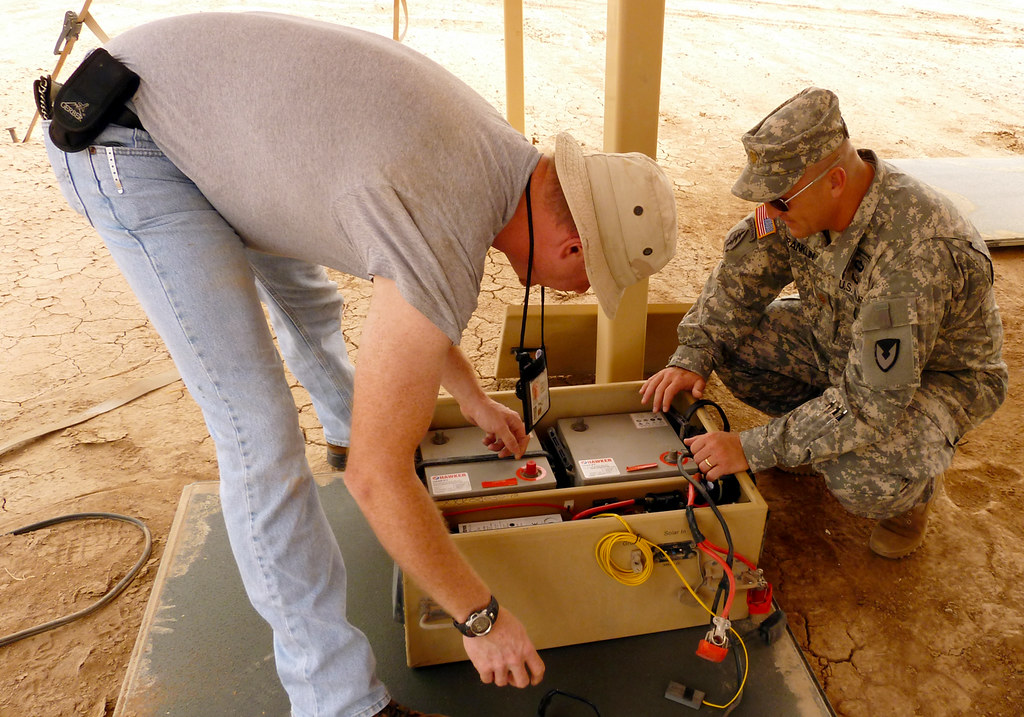
U.S. Army Africa is working in cooperation with U.S. Army Natick Research, Development and Engineering Center on a solar shade system in Camp Lemonnier, Djibouti, that produces two kilowatts of power. Natick engineer Steve Tucker is the lead project manager and brings a unique skill set to the mission.

Tucker has never served as a Soldier, but his daily service to the U.S. Army is remarkable.

Tucker is an electrical engineer by trade and works for the U.S. Army Natick Research, Development and Engineering Center in Massachusetts. His list of deployments in combat zones and isolated areas included Iraq, Afghanistan, Egypt and Korea. His trip to Djibouti focused on a limited military use assessment of a solar energy project called the solar shade. It’s a project he’s working in cooperation with U.S. Army Africa.

He began his Army civilian career shortly after Sept. 11, 2001. In the opening days of Operation Iraqi Freedom, Tucker was working alongside Soldiers in Mosul, Iraq, during a year-long tour.

In many respects, his demeanor is dyed-in-the-wool Army green.

While in Djibouti, his bunk in the containerized living unit or CLU, sported hospital corners and the obligatory dollar-width top sheet fold over the blanket. His speech is infused with a lexicon of Army acronyms and you can tell he genuinely enjoys working with Soldiers.

Before coming to work for the Army, Tucker was an electrical engineer in the private sector for nearly 20 years. He’s worked on high speed computer upgrades, nuclear medical equipment and helped develop an underwater re-breather system for divers.

For Tucker, working in places where the heat is often far above the 100 degree mark and the humidity is nearly 100 percent, it’s all part of the job. He’s in his element in the austere and scorching environment of Djibouti where he checked out one of his projects, a solar shade that produces two kilowatts of power on a daily basis.

“There are always challenges working in places like Camp Lemonnier. Sure it’s hot and muggy, but it’s always great to be helping our Soldiers. The solar shade can help Soldiers in multiple ways,” he said. Tucker explains some of the benefits of the solar shade.

“If you had a tent under the solar shade, it would block up to 90 percent of the sun heating the tent up. It could significantly reduce the cost to cool the tent. It’s extremely efficient in two ways. You get an energy savings because the shade blocks direct sunlight from tent skin. And you are also generating energy with the photovoltaic modules on the exposed surface of the shade,” Tucker said.

“With the solar shade, it’s low or no maintenance and no fossil fuel consumption. The logistics trail is short. This is ideal for isolated places where it is extremely expensive or difficult to ship fuel. A repeater site for radio transmission, remote village stability operations or even in a disaster relief scenario…where power isn’t available off the grid,” Tucker said.

Tucker is a lean, tall master mechanic, SCUBA diver and classic Harley owner and enthusiast. He’s constantly fixing and adjusting equipment like the air conditioner in his temporary quarters at Camp Lemonnier. The door lock didn’t escape his fix-it-now approach to life, so he treated it with a squirt of machine oil. With his attention to detail, you can tell why he became an engineer.

While cleaning up modules on the solar shade he expressed satisfaction in the project.

“Overall, I’m pleased how the unit has weathered the high winds, exposure to ultraviolet light and the harsh conditions of Djibouti. It’s performed extremely well,” Tucker said.

Tucker explained some of the solar shades features.

“The shade will block about 80-90 percent of the solar load. There are a lot of solar cells that convert sunlight to free and clean energy. The solar shade uses flexible photo voltaic panels. It’s light and thin. The trade off is that it doesn’t produce as much electricity as single crystal rigid photo voltaic cells. This system is ideal for an austere, off-the-grid environment,” Tucker said.

“I’d like to see this picked up by a program manager who is really interested in alternative energy. Someone who is interested in decreasing their organizations logistics fuel tail and providing our Soldiers with something that can give them power with minimal maintenance,” Tucker said.

Tucker says that there may be a place for alternative energy sources in the military.

“A possible holistic approach to energy management might be in a mini grid system for expeditionary or remote sites. This would combine alternative and traditional energy sources on an as needed basis. These micro grids would use intelligent control of generators – storing energy in battery banks and shutting off the generator off when it’s not needed. The generator is using fuel whether the energy is being used or not. The main goal is to stop burning fuel when it’s not needed. It’s being done in the U.S. with wind and solar energy in large electrical grid,” Tucker said.

“I’ve enjoyed everything that I’ve done in my career, but none of it as much as I enjoy working for the military,” Tucker said. “Every project I work on that can support the Soldier in the field – those projects have a part of my heart.”

You can see more photos of the shade system in action on U.S. Army Africa’s Flickr page.

(Originally posted on the official site for U.S. Army Africa)