Showing posts with label defense advanced research projects agency. Show all posts

Sunday, June 4, 2023

The History of DARPA: Pioneering Technological Innovations for National Security

Since its establishment in 1958, the Defense Advanced Research Projects Agency (DARPA) has been at the forefront of technological innovation, driving advancements that have shaped the landscape of national security, science, and technology. DARPA's rich history is a testament to its mission of preventing technological surprise and maintaining the technological superiority of the United States. In this article, we will delve into the remarkable history of DARPA, exploring its key milestones, groundbreaking projects, and lasting impact on society.

DARPA traces its roots to the aftermath of the Soviet Union's successful launch of the Sputnik satellite in 1957. Concerned about the implications of this achievement for national security, the United States government established the Advanced Research Projects Agency (ARPA) to catalyze research and development efforts that could match or surpass the Soviet Union's technological advancements.

ARPA's early years were marked by a spirit of audacity and ambition. The agency embarked on a series of visionary projects that pushed the boundaries of science and engineering. One of its earliest successes was the creation of the ARPANET, a pioneering computer network that laid the foundation for the internet as we know it today. Through ARPANET, researchers connected computers at various universities and research institutions, facilitating the exchange of information and setting the stage for the digital revolution that would follow.

In the 1960s and 1970s, ARPA focused on research areas with significant military implications. Project MAC (Multiple Access Computers) aimed to develop time-sharing computer systems, making it possible for multiple users to access a single computer simultaneously. This groundbreaking work paved the way for the development of modern operating systems and laid the foundation for the personal computer revolution.

Another landmark project during this period was the creation of ARPANET's successor, the Defense Data Network (DDN). DDN established the framework for secure and reliable communication between military installations, a critical component of defense infrastructure. Its success demonstrated the transformative power of computer networks for military operations and civilian applications alike.

In the 1980s and 1990s, ARPA underwent a significant transformation. In 1972, it was renamed the Defense Advanced Research Projects Agency (DARPA) to reflect its evolving mission and expanded scope. DARPA shifted its focus to more specific areas of research and development, including advanced weaponry, autonomous systems, and emerging technologies.

During this period, DARPA played a pivotal role in the development of stealth technology, leading to the creation of the world's first operational stealth aircraft, the F-117 Nighthawk. DARPA's investment in research on materials, aerodynamics, and radar evasion techniques resulted in a game-changing advancement in military aviation, providing the United States with a strategic advantage.

DARPA also spearheaded research in artificial intelligence (AI) and robotics. Projects such as Shakey, the first mobile robot capable of reasoning and problem-solving, showcased the potential of AI for complex tasks. The development of autonomous vehicles, including the DARPA Grand Challenge, paved the way for advancements in self-driving cars and revolutionized transportation and logistics.

In the 21st century, DARPA continued to push the boundaries of technological innovation. The agency led efforts in cybersecurity, recognizing the growing threats posed by malicious actors in cyberspace. DARPA's research and development initiatives focused on enhancing the resilience and security of critical information infrastructure, leading to advancements in cryptography, secure communications, and network defense.

DARPA also made significant contributions to the field of biotechnology and healthcare. The development of advanced prosthetics, such as the DARPA-funded DEKA Arm, revolutionized the capabilities of prosthetic limbs, providing unprecedented levels of functionality and dexterity for amputees. DARPA's investment in brain-computer interfaces aimed at restoring sensory and motor functions further showcased the agency's commitment to advancing healthcare technologies.

One of DARPA's most notable recent projects is the development of the Defense Advanced Research Projects Agency Network (DARPANET), a new network infrastructure that aims to revolutionize communications and data transmission capabilities for military use. This project seeks to create a secure and resilient network architecture that can withstand cyber attacks and disruptions, ensuring reliable and secure communication in critical military operations.

Beyond its specific projects, DARPA's influence extends to the broader technology and innovation ecosystem. The agency's emphasis on fostering collaborations between academia, industry, and government has led to the creation of a robust network of partnerships. DARPA's approach of funding high-risk, high-reward projects has also inspired other organizations to adopt similar models, fueling innovation across various sectors.

In conclusion, the history of DARPA is a testament to its relentless pursuit of technological innovation and its commitment to maintaining national security. From the creation of the ARPANET to pioneering advancements in stealth technology, artificial intelligence, and cybersecurity, DARPA has consistently pushed the boundaries of what is possible. As we look to the future, DARPA's legacy serves as a constant reminder of the transformative power of research and development in shaping the world we live in.


Monday, September 24, 2012

Strong As Steel, Light As Plastic


As a global force, the U.S. military is called upon to conduct missions that subject its platforms to extreme operational environments and structural loads.

The endurance and performance of future Department of Defense platforms may call for the availability of materials with structural properties that significantly surpass the limits of what is achievable with current technology. Material properties include strength, density and stiffness, among many others.

DARPA’s Materials with Controlled Microstructural Architecture (MCMA) program seeks the capability to develop materials with properties tailored to meet specific mission requirements. For instance, as demonstrated in this video, DARPA was able to construct a material so light that it can rest atop a bubble.

MCMA researchers are working toward the goal of developing a material that is as strong as steel, but as light as a plastic.

Observe:


Video provided by DARPATV

Monday, August 27, 2012

DARPA Awards $15.3M In Basic Research Grants!


DARPA mentors Young Faculty Award recipients in pursuit of science and mathematics breakthroughs.

Innovation requires latitude to experiment and freedom to explore without fear of failure. Strategic innovation requires experimentation with a purpose.

Every year since 2006, DARPA has awarded grants to promising academic scientists, engineers and mathematicians to foster strategic innovation in a defense context and, in the process, enhance basic research at colleges and universities throughout the United States.

Under the auspices of the Young Faculty Awards (YFA) program, DARPA hopes to develop the next generation of researchers in key defense-related disciplines and encourage them to focus a significant portion of their careers on defense issues.

This year DARPA welcomes 51 recipients, hailing from 18 states and 34 academic institutions, who will each apply $300,000 grants over two years to a wide spectrum of basic research in areas spanning physical sciences, materials, mathematics and biology. Though the sponsored research is not expected to feed directly into DARPA programs, faculty and projects are selected in part for their potential to seed future breakthroughs in defense-related research areas.

In fact, members of the 2006-2010 YFA classes participate in 27 recent or ongoing DARPA programs.

“The Young Faculty Awards are a pipeline that connects early career researchers to DARPA programs where their ideas for novel research might take root and grow over time into new capabilities,” said Bill Casebeer, a DARPA program manager and director of the YFA program. “DARPA’s aim is to channel existing expertise by funding basic research, mentoring tenure-track individuals and helping them build their networks to bridge academics, defense and industry. We measure success not through development of specific capabilities, but through expanding a base of scientific knowledge and human capital that will serve as building blocks for future efforts.”

The leeway granted to YFA recipients to pursue innovative ideas is given in recognition of the fact that technological breakthroughs often result from cross-collaboration among disciplines and operating outside of commonly accepted disciplinary boundaries.

YFA is designed to support that business model.

“The challenging budgetary climate in which researchers currently operate makes it harder to justify risks for a lot of the organizations that help the United States to maintain its technological edge. However, budget concerns don’t alleviate our need to keep pressing forward and exploring,” said Jay Schnitzer, Director of DARPA’s Defense Sciences Office. “DARPA’s mission is to prevent and create strategic surprise, so it is incumbent on the Agency to invest in the people, research and technologies that will keep us successful in that mission.”

Ideas nurtured through YFA have shaped research in six DARPA programs to date, on top of their contributions to advancing basic science. At the same time, grant recipients experience professional benefits in their academic careers.

For example, YFA recipient Dr. Howard Salis at Pennsylvania State University developed predictive biophysical models to design synthetic DNA sequences for biotechnology applications, including the therapeutic nucleic acids that regulate protein expression across many bacterial species. These medicines are a potential alternative to antibiotics. His lab’s advanced methods for designing synthetic DNA are available to the scientific community here.

YFA recipient Dr. Martin Zwierlein of the Massachusetts Institute of Technology studies ultra-cold gases near absolute zero temperature. In Fermi gases, atoms team up in pairs that can flow without friction; this has direct analogy to electron pairs in superconductors, which transport current without resistance. Dr. Zwierlein’s YFA research could ultimately provide insight into the unsolved problem of high-Tc superconductivity. He is currently expanding on his research in DARPA’s Optical Lattice Emulator program.

A record 560 researchers applied to YFA in 2012, marking a 38% increase over the 2011 applicant pool; applicants represented 46 states and territories, and 150 universities. DARPA selected 51 applicants to receive grants totaling approximately $15.3 million, representing the largest class of awardees since the program began. Each grant recipient will receive approximately $150,000 per year for two years.

“The world’s best and brightest are applying new ideas to advance the sciences and develop technologies which could prove to be very useful to deployed servicemembers. This year we are funding scholars investigating topics ranging from the latest developments in quantum theory to novel synthetic biology research,” Casebeer said.

A complete list of the 2012 Young Faculty Award recipients and research topics is available.

YFA is open to U.S. citizens and non-citizens employed by a U.S. research institution. The YFA solicitation is published annually on FBO.gov and at Grants.gov.

Information for this post provided by DARPA

Sunday, August 26, 2012

Ultrafast Pulsed Lasers


A Navy ship at sea is surrounded by water, with nothing but its carrier group in site, and searches the skies for activity overhead.

Isolated radars on each ship in the group scan independently of each other with limited effectiveness. But consider if all of the ships’ radars could be coherently linked to function as one.

Such a capability would improve the range and resolution of each radar system, making it possible to identify and characterize objects further away and with greater fidelity.

Conventional X-ray machines provide images of bones and organs that help doctors make crucial decisions regarding patient care. They cannot, however, resolve structures at the cellular level.

Imagine having access to a table-top x-ray imager that could not only image a single cell, but also the nucleus, ribosomes and other components that make it up; and not only as a flat image, but in 3-D. Such information would be invaluable for testing responses to candidate drugs and discovering new treatments.

These two very different applications are not science fiction and could be enabled by the same basic technology: ultrafast, pulsed lasers operating at optical wavelengths.

These kinds of pulsed lasers are known as frequency combs because they are composed of thousands of individual laser lines, equally separated in frequency like the teeth of a comb. DARPA seeks to control the entire electromagnetic spectrum by using frequency combs to generate and engineer waves in the optical domain and then down or up-convert those waveforms to the desired wavelength.

Such technology has many potential applications relevant to the Department of Defense (DoD), such as low phase noise microwave oscillators for secure communications, explosive and chemical agent detection, and the production of attosecond (10-18s) pulses for imaging the motion of electrons in complex materials.

Many of the techniques that underlie these applications have been demonstrated, but are currently unsuitable for practical use because they are restricted to a laboratory setting. DARPA’s Program in Ultrafast Laser Science and Engineering (PULSE) aims to enable synchronization, metrology and communications applications for DoD by advancing compact, high power and environmentally insensitive frequency comb technology, as well as the science underlying these applications.

Achieving these goals will require input from researchers across a broad spectrum of disciplines. Potential proposers are encouraged to review and respond to the PULSE Broad Agency Announcement (BAA).

“PULSE is a basic research program initially focused on component technology. Our primary concern isn’t demonstrating a specific application, rather making these tools a reality at a practical scale by overcoming current obstacles like size and thermal management,” said Jamil Abo-Shaeer, DARPA program manager for PULSE. “The range of potential applications is enormous. Literally any technology that uses electromagnetic radiation could be impacted.”

Low phase noise microwave oscillators represent one potential application of the high frequency stability provided by optical frequency combs. Under PULSE, DARPA will pursue enabling technologies to reduce comb size. One possible approach involves recently demonstrated, chip-based optical frequency combs that were generated from micron-scale optical resonators.

However, while such combs potentially offer a vast reduction in form-factor compared with conventional technology, they have yet to demonstrate the stability and bandwidth required for low phase noise microwave oscillator production.

At the other end of the spectrum, PULSE will explore how to capitalize on the high intensity obtainable from pulsed lasers for applications like x-ray imaging. PULSE aims to enhance the capabilities of tabletop, high-peak power, pulsed-laser driven x-ray generation techniques; these sources should produce high flux, coherent x-rays with wavelengths in the water-window (2.3 to 4.4 nm) for biological imaging applications.  At present, these types of x-rays can only be generated by a few building-sized machines, thus limiting the range of applications.

Proposers are sought for the development of ultrafast laser science applications, including microwave generation, optical time-transfer, laser-driven secondary radiation generation and attosecond science.

As a fundamental research program, PULSE welcomes proposals from U.S. and international researchers and is expected to span over a five year time-scale. For detailed information, please review the BAA.  Proposal abstracts are due by 4:00 PM ET, September 6, 2012. Full proposals are due by 4:00 PM ET, November 6, 2012.

Information for this story provided by DARPA

Thursday, August 23, 2012

Watching Evolution Unfold


Image 1: Jeffrey Barrick, a postdoctoral research associate in Michigan State University's (MSU) Department of Microbiology and Molecular Genetics, views bacteria cultures. Barrick worked in the lab of Richard Lenski, the Hannah Professor of Microbial Ecology at MSU, who studies the process of evolution using fast-reproducing bacteria that allow him to watch the process in action.

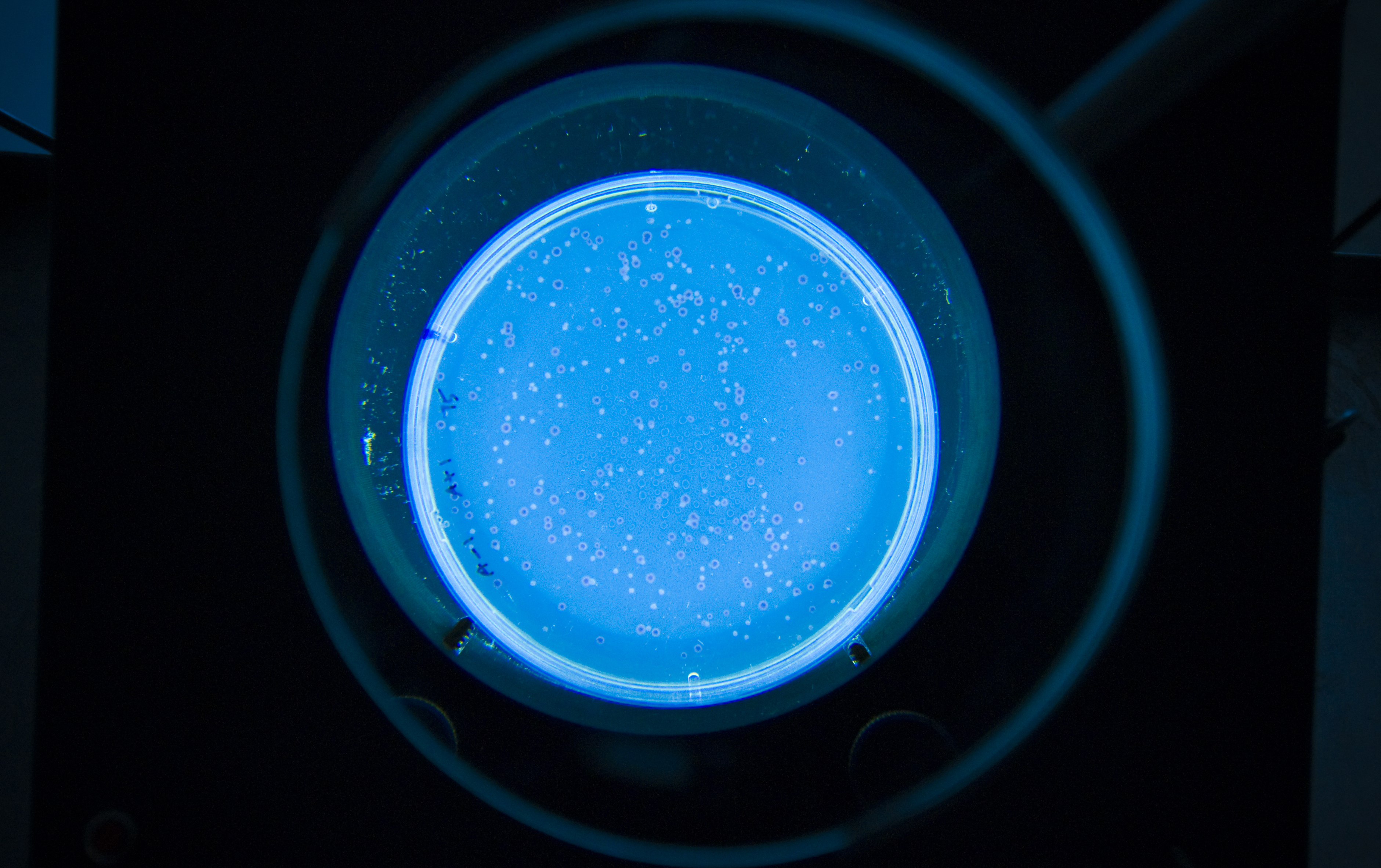
Image 2: Bacteria cultures grow in a Petri dish in the evolutionary biology lab of Richard Lenski, the Hannah Distinguished Professor of Microbial Ecology at Michigan State University. Lenski studies the process of evolution using fast-reproducing bacteria that allow him to watch the process in action.

Lenski began the study in 1988, when he started experimenting with 12 populations the bacteria E. coli. Lenski used E. coli from the same ancestral strain and living in identical environments so he could see how similarly or differently they would evolve. He planned on running the experiment for at least a year and culture about 2,000 bacterial generations, but 21 years and almost 40,000 generations later the experiment continues. The research has been supported by the National Science Foundation and the Defense Advanced Research Projects Agency.

(Date of Images: October 2009)

Credit: G. L. Kohuth, Michigan State University